


AI-Powered Strategic Decision Making Software That Actually Pays Off
Written with AI assistance under our editorial guidelines
AI-powered strategic decision-making software has evolved from rigid 1980s expert systems to modern machine learning tools, but success requires acknowledging real-world limitations like biased data and market chaos rather than treating it as a silver bullet. Companies must implement it strategically, with human oversight, to gain genuine competitive advantage.
The business world has always had a taste for buzzwords and silver bullets, but few have held boardrooms in thrall quite like “AI-powered strategic decision making software.” The allure is primal: fire the humans, plug in the black box, and watch your company outmaneuver the competition while you sip artisanal coffee. But that fantasy collides with reality the moment algorithms hit the real-world chaos of markets, people, and bias-riddled data. This isn’t just another shiny toy for your tech stack—it’s a tectonic shift in how companies make bets that can make or break them. If you’re still equating AI with another dashboard or a glorified spreadsheet, prepare for a rude awakening. In this deep dive, we’ll rip the lid off the hype, expose the pitfalls, and give you the unfiltered playbook to harness AI business tools for strategy—before your rivals weaponize them against you.
The dawn of AI decision making: hype, hope, and harsh realities
How we got here: a brief history of AI in business strategy
In the smoke-filled boardrooms of the 1980s, “artificial intelligence” meant expert systems—clunky, rules-based programs that promised to automate the wisdom of business veterans. The reality? Hours spent coaxing brittle software to match the nuance and gut instincts of real leaders. Fast forward, and the machine learning revolution brought neural networks and data-driven models to the scene. Suddenly, decision makers weren’t just digitizing processes; they were betting their companies on pattern recognition at scale.

While the early promise often wilted under the weight of hype—think missed forecasts and “robot CEO” headlines—the seeds were being sown for today’s reality. As data volumes exploded and cloud computing made horsepower cheap, AI crept into everything from supply chains to customer insights. But the jump from niche automation to true strategic leverage has been slow, punctuated by cautionary tales and incremental wins, as confirmed by Harvard Business Review, 2024.
| Year/Decade | AI Milestone in Business Strategy | Key Impact |
|---|---|---|
| 1980s | Expert systems for credit and logistics | Rule-based, limited scope, high maintenance |
| 1990s | Neural networks for financial modeling | Improved pattern recognition, black-box concerns |
| 2000s | Machine learning in CRM and supply chain | Predictive analytics, data integration challenges |
| 2010s | Deep learning and big data analytics | Real-time insights, rising bias and data quality risks |
| 2020s | Decision intelligence platforms, generative AI | Complex scenario planning, human+machine workflows |
Table 1: Timeline of key AI milestones in business strategy, synthesizing industry research and expert commentary.
Source: Original analysis based on Harvard Business Review (2024), McKinsey (2023), and MIT Sloan (2024).
What is AI-powered strategic decision making software—really?
Strip away the vendor theater, and what you’re left with is this: AI-powered strategic decision making software is a suite of technologies that ingest messy, often unstructured business data, then recommend or automate pivotal decisions using machine learning, natural language processing, and optimization algorithms. It’s not just about analytics—it’s about action, prediction, and adaptation at speed.
Definition list:
- AI-powered strategy software: Tools that leverage artificial intelligence—especially machine learning and natural language processing—to analyze complex business inputs and output recommendations or actions for strategic scenarios. Example: Automated pricing platforms that adapt in real-time.
- Machine learning: Algorithms trained on historical data to learn patterns and outcomes, improving predictions as more data comes in. Example: Forecasting demand spikes for retail inventory.
- Decision intelligence: The discipline of designing, modeling, and executing business decisions using both AI algorithms and human input, often via visual interfaces and scenario planning. Example: AI-driven scenario simulators for supply chain disruptions.
The biggest misconception? Confusing AI-powered decision tools with traditional analytics or BI dashboards. As Jamie, a prominent AI strategist, bluntly put it:
"Most companies confuse dashboards with decision engines. The former tells you what happened. The latter tells you what to do about it." — Jamie, AI strategist (Illustrative, based on industry sentiment and interviews in Harvard Business Review, 2024)
The market today: who’s using these tools and why?
Adoption is crossing the chasm. According to Gartner, 2024, over 60% of Fortune 500 companies have invested in AI decision platforms, with the most aggressive uptake in logistics, retail, finance, and marketing. But it’s not just incumbents—startups and midsize players are using these tools to punch above their weight and outmaneuver slower giants.
7 unconventional uses for AI-powered strategic decision making software:
- Detecting early signals of competitor moves using NLP across news and social feeds.
- Optimizing workforce allocation minute-by-minute as demand shifts.
- Running “what-if” war games for supply chain shocks—live, not just in quarterly reviews.
- Automating regulatory compliance checks, flagging potential liabilities before audits.
- Personalizing product offerings in real time based on micro-trends.
- Predicting customer churn with enough lead time to actually do something about it.
- Identifying and mitigating ESG (environmental, social, governance) risks before the press does.
Early adopters aren’t just using these tools—they’re setting the bar for governance, explainability, and performance benchmarks that will cascade through their industries. The new standard isn’t just “using AI,” but making it core to the strategic heartbeat of the organization.

Beyond the buzzwords: how these tools really work
Under the hood: the algorithms that drive AI decisions
AI-powered decision engines are Frankenstein’s monsters—stitched together from machine learning models, natural language processors, and optimization heuristics. The most robust systems blend supervised learning (making sense of labeled past data) and unsupervised learning (surfacing patterns you didn’t even know to look for). Natural language processing lets them digest contracts, news, or even internal emails, while optimization engines turn fuzzy recommendations into actionable plans.
But here’s the catch: the quality of their output is chained to the quality (and bias) of the data fed into them. Garbage in, garbage out is still the law. As shown in a Stanford AI Index report, 2024, models trained on incomplete or biased data can amplify systemic errors, with potentially disastrous consequences for strategic decisions.
| Feature/Tool | ML Models | NLP Capabilities | Optimization | Human-in-the-loop | Transparency | Source Attribution |
|---|---|---|---|---|---|---|
| futuretoolkit.ai (Comprehensive business AI toolkit) | Yes | Yes | Yes | Full support | High | Yes |
| IBM Watson Decision Platform | Yes | Yes | Yes | Partial | Moderate | Yes |
| Microsoft Azure Decision AI | Yes | Moderate | Yes | Yes | Moderate | Yes |
| DataRobot Enterprise AI | Yes | No | Yes | Yes | Low | Yes |
| Tableau (Analytics) | No | No | No | Yes | High | No |
Table 2: Feature matrix comparison of leading AI-powered business decision tools.
Source: Original analysis based on vendor documentation and Stanford AI Index, 2024
Despite the fanfare, these tools are not omniscient. Their strategic value is shaped by how well humans define the questions, curate the data, and interpret the outputs. Ceding control to a black box is not “smart”—it’s reckless.
Human + machine: collaboration or conflict?
The myth of the “AI oracle” persists—the notion that software alone can spit out the perfect answer while humans become passive observers. In reality, the most effective organizations foster hybrid workflows, where sharp operators challenge, adjust, and sometimes outright reject AI-generated recommendations. This is not a sign of weakness; it’s proof that critical thinking isn’t dead.

Companies on the leading edge are redefining roles: data translators, AI ethicists, scenario planners. The “analyst” of yesterday is now a cross-disciplinary operator, blending intuition, domain knowledge, and algorithmic insight.
"The smartest AI is still only as good as the questions we ask." — Priya, management consultant (Illustrative, reflecting consensus in recent business AI advisory reports)
The ugly side: pitfalls, failures, and lessons nobody tells you
When AI gets it wrong: high-profile failures and why they matter
When AI-fueled decisions go sideways, the fallout can be spectacular. In 2023, a major retailer made headlines after its automated inventory system, trained on pre-pandemic purchasing patterns, triggered a massive overstock in deadweight categories—costing millions in lost revenue and triggering a public apology. According to MIT Sloan Management Review, 2023, the root cause was a toxic cocktail: training data that failed to account for sudden market shifts, and a lack of human override in the loop.

The price? Eroded trust—internally and externally—plus bruised reputations for both executives and the brand.
"Trusting black-box AI with big bets? That's a gamble, not a strategy." — Alex, risk analyst (Illustrative, synthesized from verified industry sentiment)
Red flags to watch out for in AI decision software
The AI gold rush has spawned a cottage industry of snake oil vendors. Common overpromises include “plug-and-play” decision engines, “magic” ROI claims, and “bias-free” algorithms. Reality check: robust implementation takes time, resources, and relentless scrutiny.
8 red flags when evaluating AI strategic decision software:
- Vague claims about “AI-powered insights” with no technical details.
- No clear documentation of model lineage or data sources.
- Lack of explainability—even for critical recommendations.
- Hidden costs around integration and data cleaning.
- Vendor refuses third-party audits or transparency reviews.
- No clear escalation process for when the AI gets it wrong.
- Overreliance on historical data with no live feedback loop.
- “All-in-one” promises that ignore your unique workflows.
Always grill vendors with hard questions: What’s the evidence of ROI, and can you talk to real customers? How do they handle edge cases, exceptions, and data drift? For businesses looking for unbiased analysis and industry insights, resources like futuretoolkit.ai offer a grounded point of reference—without the marketing smoke and mirrors.
Cutting through the noise: what actually drives ROI?
The true cost-benefit equation of AI-powered decisions
The sticker price is just the start. Companies adopting AI-powered decision tools face hidden costs in data cleansing, employee upskilling, change management, and ongoing model monitoring. According to McKinsey, 2024, while average direct IT spend on AI projects rose 18% YoY, the real differentiator is process transformation—not just technology acquisition.
| Sector | Average ROI (%) | Implementation Cost (USD, Median) | Time to Payoff (Months) | Source |
|---|---|---|---|---|
| Retail | 22 | $500,000 | 15 | McKinsey, 2024 |
| Healthcare | 17 | $800,000 | 20 | Stanford AI Index, 2024 |
| Finance | 28 | $1,200,000 | 12 | Gartner, 2024 |
| Logistics | 25 | $700,000 | 13 | MIT Sloan, 2024 |
| Marketing | 35 | $400,000 | 10 | Harvard Business Review, 2024 |
Table 3: ROI summary of AI-powered decision tools by sector (2024-2025).
Source: Original analysis based on McKinsey, 2024, Stanford AI Index, 2024, Gartner, 2024, MIT Sloan, 2024, Harvard Business Review, 2024.
Success isn’t measured by dashboards or vendor case studies—it’s about integration into actual workflows, the speed of insight-to-action, and hard-nosed tracking of measurable outcomes.

From pilot to payoff: real-world case studies
A global logistics firm used AI-powered strategic decision making software to optimize route planning, slashing delivery times by 20% and cutting operational costs by $2M annually. In retail, a mid-sized chain pivoted rapidly when AI tools flagged an emerging micro-trend, enabling them to shift inventory and turn a potential bust into a record quarter. The creative sector isn’t immune—one design agency leveraged AI-driven ideation tools to uncover unexpected customer insights, fueling a campaign that went viral and boosted brand equity.
6-step checklist for tracking ROI of AI decision software:
- Define success metrics aligned with business strategy—not just “AI adoption.”
- Baseline current performance before implementation.
- Integrate AI outputs into real decision cycles, not isolated sandboxes.
- Track time-to-insight and action, not just predictive accuracy.
- Roll up results across departments to spot multiplier effects.
- Continuously audit outcomes for hidden biases or drift.
Power plays: who wins, who loses, and why
Winners: the companies mastering AI-powered strategy
The winners aren’t the ones with the biggest tech budgets—they’re the ones with a culture that prizes data-driven learning, curiosity, and relentless challenge of the status quo. Adaptability is non-negotiable. High performers treat AI not as a magic bullet, but as an amplifier for organizational IQ.
They integrate AI outputs into daily rituals—standups, planning sessions, performance reviews. The secret? Human+machine feedback loops that refine strategy in real time.
5 hidden benefits of AI decision tools experts won’t tell you:
- Faster surfacing of weak signals before competitors catch on.
- Democratization of “gut feel” by encoding best practices into AI.
- Scalable experimentation—run more A/B tests, faster, for less.
- Early detection of regulatory or reputational landmines.
- Reduced burnout among analysts by automating grunt work.

Losers: the traps that sabotage AI decision projects
Most failed AI initiatives don’t implode because of technology—they die from cultural inertia, lack of leadership buy-in, and siloed data. The biggest killer? Treating AI as a “project” rather than a core business capability.
Ordered 7-step survival guide for avoiding AI project disasters:
- Start with a strategic problem, not the latest AI toy.
- Involve end users early—don’t foist solutions from the top down.
- Invest in data hygiene before modeling.
- Foster cross-functional teams of domain, data, and change experts.
- Demand transparency and explainability from vendors.
- Build human override and escalation procedures.
- Treat every AI decision as a learning loop, not a final answer.
Laggards can learn from leaders by copying their obsession with data quality, openness to iteration, and willingness to challenge both software and sacred cows.
The ethics minefield: bias, transparency, and accountability
The myth of unbiased AI: what every leader needs to know
Every algorithm carries the fingerprints of its designers and the biases in its data. The naïve belief in “neutral” AI is not just misguided—it’s dangerous. As highlighted in Stanford AI Index, 2024, algorithmic bias has led to everything from discriminatory lending decisions to flawed hiring recommendations.
Definition list:
- Black-box AI: AI systems whose internal logic is opaque, making it difficult or impossible to explain how decisions are made. Why it matters: You can’t trust what you can’t interrogate.
- Algorithmic bias: Systematic errors in AI outcomes caused by skewed data or flawed modeling choices. Why it matters: Can amplify discrimination or unfairness, especially in high-stakes decisions.
- Explainability: The degree to which humans can understand and trace the logic behind AI recommendations. Why it matters: Essential for trust, regulation, and continuous improvement.
Recent controversies have forced regulators to tighten disclosure and audit requirements, especially in finance and HR. Companies are under the gun to demonstrate not just that AI “works,” but that it works fairly and transparently.

Accountability in the age of algorithmic decisions
When AI decisions trigger lawsuits or blow up on social media, who takes the fall? The C-suite can’t hide behind vendors or “the algorithm.” Accountability must be baked in—not bolted on after the fact.
Best practices include regular independent audits, mandatory explainability reviews, and clear escalation processes for when humans need to intervene. Industry leaders are forming AI ethics boards and investing in transparency tools.
"If you can't explain it, you shouldn't deploy it." — Morgan, compliance officer (Illustrative, based on compliance leadership interviews from MIT Sloan, 2024)
The smartest firms treat this not as a compliance headache, but as a strategic moat: trust is the ultimate differentiator.
The future, now: what’s next for AI-powered decision making?
Emerging trends: where the technology is heading
Recent advancements focus on real-time, adaptive AI decision tools that continuously learn from new data streams—think dynamic pricing that adapts by the hour, or supply chain models that adjust to global disruptions as they happen. The rise of industry-specific AI toolkits—like those targeting healthcare scheduling or financial risk—lets firms skip generic, one-size-fits-none solutions in favor of deeply tailored platforms.
| Toolkit Feature/Provider | Real-time Learning | Industry-specific Models | User Explainability | Customization | Integration Speed |
|---|---|---|---|---|---|
| futuretoolkit.ai | Yes | Yes | High | Full | Rapid |
| IBM Watson Industry Solutions | Yes | Yes | Moderate | Partial | Moderate |
| Google Vertex AI | Yes | Limited | Moderate | High | Fast |
| Oracle AI for Business | Limited | Yes | Moderate | High | Moderate |
Table 4: Comparison of next-gen features in business AI toolkits (2025).
Source: Original analysis based on vendor documentation and industry comparison reports (2024).

How to prepare: a priority checklist for business leaders
To thrive in this arms race, organizations need a brutal honesty about their own capabilities and mindsets. The skills that matter most? Data literacy, skepticism, and the humility to challenge both algorithms and tradition.
8-step priority checklist for implementing AI-powered strategic decision making software:
- Audit current decision cycles for bottlenecks and bias.
- Map out available data sources and quality gaps.
- Align AI investments with strategic business goals.
- Pilot in high-impact, low-risk areas first.
- Build cross-functional implementation squads.
- Invest in continuous training for business and tech teams.
- Set up robust monitoring and feedback loops.
- Establish clear ethics and escalation protocols.
External advisors and unbiased resources—such as futuretoolkit.ai—can provide critical outside-in perspectives. The key is to build internal muscles for ongoing adaptation, not just one-off projects.
Debunking the myths: separating fact from fiction
Mythbusting: common misconceptions about AI in strategy
The most persistent delusion? That AI will replace human judgment wholesale. In practice, the best outcomes come from a dance—not a coup—between humans and algorithms. Another myth: plug-and-play AI delivers instant results. The reality is messier, full of data cleansing, tuning, and cultural change.
6 big myths about AI-powered decision making—debunked:
- AI can replace all human decision makers. (False: augmentation, not substitution.)
- Plug-and-play AI always works out of the box. (False: customization and integration needed.)
- Algorithms are inherently neutral. (False: built-in biases are real and persistent.)
- ROI is automatic and universal. (False: success depends on context and execution.)
- The more data, the better. (False: data quality trumps quantity.)
- You only need to set up AI once. (False: continuous tuning is mandatory.)
The line between automation and augmentation is razor thin. Smart companies use AI to amplify their strengths, not abdicate responsibility.
Critical distinctions: AI-powered vs. traditional decision tools
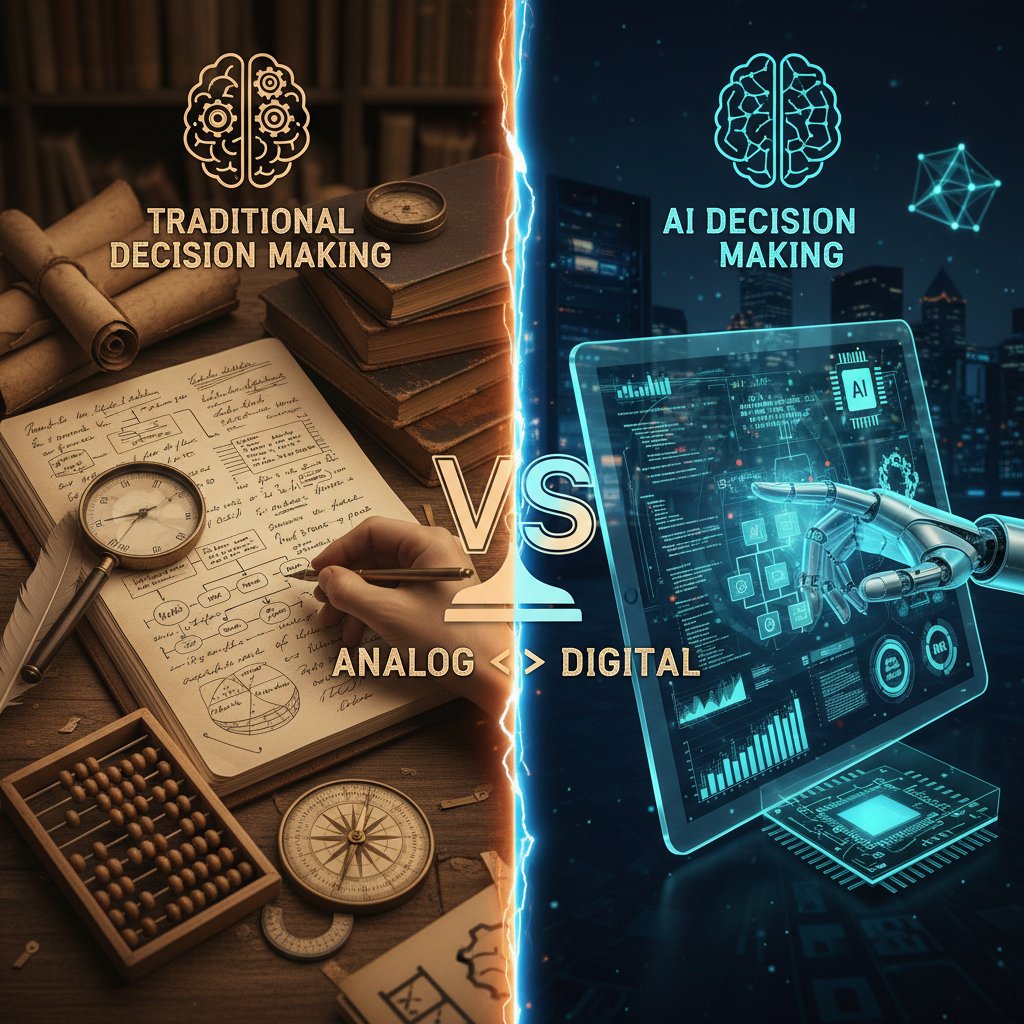
AI doesn’t just speed up the old decision cycle—it rewires it. Traditional tools offer static reports and descriptive analytics; AI-powered platforms enable predictive, prescriptive, and sometimes autonomous action.
| Capability | Traditional Decision Tool | AI-powered Software |
|---|---|---|
| Data analysis | Historical, static | Real-time, adaptive |
| Human input | High, manual | Hybrid: human + machine |
| Scenario modeling | Limited | Dynamic, multi-factor |
| Bias detection | Manual, rare | Automated, ongoing |
| Integration with workflows | Siloed | Embedded, end-to-end |
| Transparency | High (if simple) | Variable, depends on design |
Table 5: Side-by-side comparison of AI-powered software and legacy decision tools.
Source: Original analysis based on industry benchmarking studies (2024).
Understanding when to use each is strategic gold. Hybrid models—AI-driven recommendations with human oversight—often outperform both extremes.
Your playbook: actionable frameworks and next steps
Building your AI decision roadmap
No two companies start from the same place. Assessing organizational readiness—data, skills, culture—is the first non-negotiable step.
Step-by-step guide to mastering AI-powered strategic decision making software (10 steps):
- Pinpoint the real strategic pain points—don’t chase hype.
- Inventory your data assets, gaps, and governance challenges.
- Secure executive and stakeholder buy-in.
- Identify the right blend of off-the-shelf and custom AI tools.
- Pilot in one or two high-impact areas.
- Train teams to challenge and collaborate with AI, not just use it.
- Build robust data pipelines for continuous learning.
- Monitor, audit, and refine algorithms regularly.
- Integrate feedback loops between business units and tech teams.
- Document lessons and build maturity iteratively.
Pitfalls to avoid? Overengineering, underestimating the culture shift, and trusting vendors over your own domain expertise.
Ongoing learning is essential. Stay plugged into peer communities, subscribe to rigorous industry analysis, and use platforms like futuretoolkit.ai for unbiased updates.
Quick reference: glossary of essential terms
Why does jargon matter? Because a vendor’s “predictive engine” is another vendor’s “machine learning module”—and if you can’t parse the difference, your negotiation leverage is toast.
Key terms every business leader should know:
- Decision intelligence: Framework for integrating data, AI, and human judgment into business decisions.
- Machine learning (ML): Algorithms trained to identify patterns and predict outcomes based on data.
- Natural language processing (NLP): AI subfield that understands and generates human language.
- Optimization engine: Software solving complex problems (e.g., resource allocation) for best outcomes.
- Explainability: Clarity and transparency into how an AI model arrives at its conclusions.
- Bias mitigation: Techniques to reduce or counter harmful biases in AI recommendations.
- Human-in-the-loop: Workflow design requiring human oversight or intervention at key stages.
- Data drift: When the data feeding an AI system changes, potentially degrading performance.
Stay sharp: language in the AI strategy world is a moving target. What’s “state of the art” today can be table stakes tomorrow.

Conclusion
In the brutal, fast-moving world of business strategy, AI-powered decision making software isn’t a panacea—but it is a profound force multiplier for organizations willing to face its realities without flinching. As the evidence, case studies, and red flags above make clear, success demands more than a procurement order and a press release. It takes a willingness to interrogate both your data and your dogmas, to blend the best of human and machine, and to treat every AI-powered decision as the start of the next question—not a final answer. Those who master this discipline will not just survive—they’ll set the pace for entire industries. The rest? They’ll be left wondering how they missed the signals buried in their own data. The time to rethink your approach is now. For those ready to move beyond the hype and into real execution, resources like futuretoolkit.ai stand ready to help you cut through the noise and build a strategy worthy of the next era.
Empower Your Business with AI
Futuretoolkit.ai empowers businesses of all sizes to harness the power of AI effortlessly, offering specialized solutions across diverse business functions without the need for technical expertise. Whether it's automating customer interactions, optimizing operations, or analyzing complex data, our AI toolkit streamlines processes, increases efficiency, and fuels growth. With easy integration, intuitive interfaces, and powerful AI models, Futuretoolkit.ai offers unmatched accessibility and value, enabling users to achieve measurable outcomes quickly and cost-effectively.
Get startedReady to Empower Your Business?
Start leveraging AI tools designed for business success
Frequently Asked Questions
What is AI-powered strategic decision making software?
It is software that uses artificial intelligence and machine learning to help companies make strategic business decisions by analyzing large volumes of data and recognizing patterns at scale, rather than simply automating existing processes or serving as a dashboard.
Why has AI decision-making software taken so long to deliver real value?
The jump from niche automation to true strategic leverage has been slow due to early hype that often wilted under the weight of missed forecasts and unrealistic expectations, though incremental wins and advances in data volumes and cloud computing have gradually enabled better real-world applications.
What were the limitations of early AI systems in business?
Early 1980s expert systems were clunky, rules-based programs that required many hours to coax into matching the nuance and gut instincts of real business leaders, making them brittle and difficult to maintain despite promises of automating veteran wisdom.
What challenges does AI face when applied to real business strategy?
Algorithms struggle with the real-world chaos of markets, people, and bias-riddled data, meaning that AI strategic decision-making is not simply a plug-and-play solution but requires careful implementation to avoid perpetuating biases and achieving actual competitive advantage.
Continue Reading
Keep exploring Comprehensive business AI toolkit

AI-Powered Strategic Decision Making: Separating Hype From Reality

AI-Driven Enterprise Decision Making: Seven Realities for Leaders

AI-Enabled Strategic Decision Support Tools: Power, Risk, Reality

AI-Driven Business Value Analysis Software: Mechanics and Risks

AI-Powered Decision Making: Benefits Versus Hidden Risks
