


Seven Hard Truths About AI-Enabled Marketing Attribution Modeling
Written with AI assistance under our editorial guidelines
AI-enabled attribution models promise clarity but face critical limitations. Poor data integration, cross-device complexity, and privacy barriers create blind spots that AI cannot fully overcome. Most organizations still rely on outdated methodologies or inconsistently apply new tools, leaving 35% of marketing ROI unattributed and unable to deliver the accountability marketers desperately need.
The digital marketing world is awash in promises—glossy dashboards, AI-powered analytics, and attribution models that claim to reveal the true path from ad click to revenue. But peel back the layers, and the truth is anything but convenient. AI-enabled marketing attribution modeling has become the latest battleground for marketers desperate to prove their value, yet it’s a domain riddled with bias, data chaos, and illusions of certainty. In 2025, as marketing budgets tighten and every dollar demands accountability, the uncomfortable reality is that most attribution models—AI or not—still miss the mark. This article strips away the hype, exposing seven brutal truths every marketer must face about AI-enabled attribution. If you think your current model is immune, think again. Here’s what the industry won’t advertise: how data disconnects, algorithmic bias, and overzealous automation are shaping the real future of marketing ROI.
Why marketing attribution is broken—and why AI alone won’t save you
The myth of the all-seeing algorithm
There’s a persistent fantasy in marketing: the belief that AI can perfectly track and credit every touchpoint on the winding customer journey. The pitch is irresistible—plug in your data, let the algorithms do the heavy lifting, and voilà: pure, unfiltered truth about which ads, emails, or blog posts actually drive revenue. Reality, though, is far messier. According to research from Revsure.ai, 42% of marketers cite poor data integration as a major barrier, even as AI claims to “connect all the dots” in attribution. The chaos of modern marketing—cross-device journeys, offline interactions, privacy walls—creates blind spots that even the smartest model can’t pierce. AI attribution is not a crystal ball; it’s a powerful tool, but its vision is limited by the quality and completeness of input data. Trusting it blindly is like driving at night with broken headlights.

How legacy models set us up for failure
Before AI crashed the scene, marketers relied on simplistic frameworks—last-click, first-touch, and linear attribution. These models, while easy to grasp, distorted reality by overvaluing or ignoring vast swaths of the customer journey. In the AI era, too many teams are still chained to these outdated practices, often using AI as a veneer on top of rule-based logic. The result? A Frankenstein’s monster of mismatched methodologies that fails to deliver actionable insights. As MarTech.org reports, 35% of marketing ROI remains unattributed due to disconnected data and legacy thinking. The continued use of rule-based models, even when marketed as “AI-enhanced,” perpetuates the very blind spots AI is supposed to solve.
| Model Type | Era | Major Events/Trends | Impact on Marketing ROI |
|---|---|---|---|
| First-touch | 2005-2012 | Rise of digital ads | Overvalues awareness channels |
| Last-click | 2010-2016 | Google Analytics dominance | Ignores upper-funnel interactions |
| Rule-based Multi-touch | 2012-2018 | Proliferation of Martech | Complex, but static and brittle |
| AI-enabled | 2018-present | Algorithmic modeling, ML | Promises more nuance; faces data gaps, bias, and opacity |
Table 1: Timeline of marketing attribution modeling evolution
Source: Original analysis based on MarTech.org, 2024, Revsure.ai, 2024
AI’s promise—and the reality check
The marketing world has cycled through AI hype so quickly it’s hard to remember a time before “machine learning” became a default sales pitch. The pitch: AI delivers clear, data-driven attribution, free from human error and bias. The reality? Early adopters are learning some hard lessons. As one frustrated CMO put it:
"Everyone promised us clarity. What we got was a smarter black box." — Maya, Fortune 500 Marketing Lead
The dangers of trusting “AI-powered” attribution too blindly are real and present:
- Data bias: Flawed or incomplete data skews results, embedding existing errors even deeper.
- Lack of transparency: Many AI models operate as opaque black boxes, making it impossible to understand—or challenge—their logic.
- Overfitting: Some models tune themselves too finely to historical quirks, missing broader patterns and leading to unreliable recommendations.
According to Aimarketingengineers.com, 59% of marketers express concerns about transparency in AI attribution (2024). The gap between promise and practice is not closing as quickly as vendors suggest.
Inside AI-enabled attribution: How the technology actually works
What makes AI attribution different from rules-based models
AI-enabled attribution isn’t just a more complicated spreadsheet. It fundamentally changes the game by using machine learning to identify patterns in data that humans—and rule-based models—simply can’t see. While traditional models rely on static rules (e.g., “give 40% credit to the first touch, 60% to the last”), AI and machine learning models analyze massive datasets to find statistical correlations and assign value based on real outcomes. Hybrid solutions blend both approaches, layering AI on top of legacy logic, but often inherit the weaknesses of each. The secret sauce is continuous learning—but also continuous risk.
| Feature/Model | Traditional Attribution | AI-enabled Attribution | Hybrid Models |
|---|---|---|---|
| Logic | Predefined rules | Algorithmic/ML-driven | Rules + AI adjustments |
| Flexibility | Low | High | Medium |
| Transparency | High | Often low (black box) | Medium |
| Data requirements | Minimal | Extensive, high quality | Medium |
| Best for | Simple, linear journeys | Complex, multi-channel paths | Transitional organizations |
Table 2: Comparison of attribution modeling approaches
Source: Original analysis based on InfluencerMarketingHub, 2024, MarTech.org, 2024
Types of AI-enabled attribution models explained
Not all AI attribution models are created equal. Here’s the breakdown:
- Algorithmic models: Use complex statistical techniques to evaluate the impact of each touchpoint.
- Data-driven attribution: Relies on historical data to assign value based on actual outcomes.
- Bayesian models: Use probability and conditional logic to estimate the likelihood of conversion from each channel.
- Markov chain models: Map the probability of users transitioning from one touchpoint to another, focusing on the “removal effect” of each.
Definition list: Key terms in AI attribution modeling
A mathematical system that models the probability of moving from one state (touchpoint) to another, revealing which steps “drop off” lead to lost conversions. Highly valued for multi-touch analysis in complex journeys.
A statistical method that updates the estimated impact of each channel as new data arrives, factoring in uncertainty and historical patterns. Useful for rapidly evolving marketing landscapes.
Any modeling approach that assigns fractional credit to multiple touchpoints, rather than just first or last interaction. Essential for reflecting real-world customer journeys.
When a model is so closely tuned to historical quirks that it loses predictive power—giving marketers the illusion of insight, but failing in new campaigns.
Umbrella term for models that use data and statistical analysis (including AI/ML) to calculate channel value, versus predefined business rules.
The data that feeds the machine
AI-enabled marketing attribution is only as good as the data you feed it. The models demand clean, unified data from every marketing channel—digital ads, CRM, email, offline sales, call centers. But the reality is ugly: 42% of marketers admit their data is poorly integrated (Revsure.ai, 2024), and 48% still struggle with privacy compliance (SmartInsights, 2024). Worse, siloed teams, outdated tech stacks, and inconsistent tagging sabotage attribution efforts before they start. If your data is garbage, your insights will be too—no matter how sexy the algorithm.

The human factor: Bias, blind spots, and the ‘black box’ problem
Algorithmic bias in marketing attribution
Let’s cut through the noise: AI is not a neutral party. Every model—no matter how advanced—is shaped by the data it ingests and the assumptions of its creators. Flawed training sets, historical bias, or unbalanced sampling can embed prejudice deep within the algorithms. As 2Scale.ai found, 27% of marketers report unexpected attribution anomalies due to bias (2024). The result: certain channels or demographics get over- or undervalued, leading to distorted strategies.
"AI will only be as fair as the data you feed it." — Jordan, Data Science Lead, Fortune 100 Brand
Transparency versus performance: You can’t have it all
There’s a nasty trade-off at the heart of AI attribution. Models that maximize interpretability (think: simple rule-based or weighted models) usually lag behind in pure predictive power. Meanwhile, the most accurate AI/ML models often operate as inscrutable black boxes. Marketers are forced to choose: Do you want to understand your model, or do you just want results? According to InfluencerMarketingHub, 33% of marketers warn that AI outputs still require human oversight because of this transparency gap.
| Model Feature | Simple Models | AI-Powered Models | Hybrid Models |
|---|---|---|---|
| Transparency | High | Low | Medium |
| Accuracy | Moderate | High | High |
| Risk of Bias | Lower | Higher | Medium |
Table 3: Transparency, accuracy, and bias across attribution models
Source: Original analysis based on InfluencerMarketingHub, 2024, [2Scale.ai, 2024]
When attribution models go rogue
The horror stories are out there—marketing teams deploying shiny new AI attribution platforms, only to find their dashboards spinning out nonsense. Campaigns get over-credit, minor touchpoints take all the glory, and budget gets funneled to the wrong places. In many cases, these failures stem from model bias, overfitting, or simple misinterpretation. As Gartner warns, continuous human oversight is essential; automation without accountability is a recipe for disaster.

Real-world case studies: Successes, failures, and lessons learned
The e-commerce revolution
Consider the journey of a mid-sized e-commerce brand that migrated from last-click attribution to an AI-enabled multi-touch system. The promise: unlock hidden ROI and drive smarter ad spend. The result: initial wins as the model surfaced undervalued channels, but new pain as data integration issues led to attribution “blind spots.” As the team cleaned up tagging and fed more accurate data into the system, predictions improved—proof that AI magnifies both strengths and weaknesses in your marketing stack. The lesson? There are no quick fixes, only better questions.

B2B and beyond: Attribution outside retail
AI-enabled attribution isn’t just for retail. In B2B, AI models help track long, complex sales cycles and multiple stakeholders. Healthcare marketers use AI attribution to analyze patient journeys across online and offline channels, while media companies deploy it to understand content consumption patterns. Political campaigns, educational institutions, and non-profits are experimenting with these tools to quantify influence and optimize messaging.
- Politics: Attribution models reveal which channels and messages drive voter engagement.
- Education: AI tracks prospective students from first inquiry to enrollment, mapping the impact of digital and traditional outreach.
- Non-profits: Attribution helps quantify donor touchpoints, highlighting which campaigns spark real action.
What failure really looks like—and why it matters
Failure in AI attribution isn’t always obvious. Sometimes, it’s a slow bleed: wasted budget, missed opportunities, or strategic drift as teams chase phantom optimizations. The warning signs? Frequent model retraining with little improvement, unexplained attribution spikes, or internal disputes over data validity. One marketing leader summed up the experience:
"We thought we’d cracked the code, but the code cracked us." — Alex, Global Campaigns Director
According to recent studies, 60% of CMOs plan to cut analytics teams due to “failed promised improvements,” underlining just how high the stakes have become (Gartner/Corvidae.ai, 2024).
Debunking myths: What AI-enabled attribution modeling can’t do (yet)
The ‘set it and forget it’ fallacy
One of the most persistent misconceptions about AI-enabled marketing attribution modeling is that it’s a “set it and forget it” solution. Marketers are sold on the promise of automation, but the reality is that continuous oversight and refinement are non-negotiable. According to Gartner, retraining models is essential as consumer behavior evolves (2023).
Steps to maintain, audit, and improve your AI-enabled attribution:
- Regularly audit input data for accuracy and completeness: Clean, unified data is non-negotiable.
- Monitor model performance over time: Watch for sudden attribution shifts or declining accuracy.
- Retrain models as new channels, products, or customer behaviors emerge.
- Collaborate with data scientists and marketing teams to interpret results.
- Establish feedback loops: Use real-world outcomes to refine model logic.
- Document every major change in the attribution framework.
- Test against known benchmarks: Compare AI output to traditional models.
- Engage stakeholders in attribution reviews: Alignment beats surprise.
- Stay current with compliance and privacy regulations.
- Never trust results blindly—question everything.
The limits of data-driven decisions
Even the most advanced AI-enabled attribution systems can’t account for every variable. “Dark social” (untrackable word-of-mouth), offline influences (like in-store conversations), and cultural nuance often escape digital measurement. According to Funnel.io, only about 6% of advertising is estimated to drive real value—yet attribution tools can’t reliably identify which campaigns contribute. The unseen, the unmeasurable, and the messy human factors remain the Achilles’ heel.

The myth of total objectivity
It’s tempting to believe that AI is inherently objective—immune to human error and outside influence. But this is a dangerous illusion. AI simply amplifies the biases baked into its data and design. Here are the most common myths, debunked:
-
Myth: “AI is unbiased.”
Reality: AI reflects and sometimes magnifies the biases of its input datasets, often in ways that are hard to detect. -
Myth: “AI attribution is plug-and-play.”
Reality: Every successful implementation requires significant setup, training, and ongoing oversight. -
Myth: “AI sees everything.”
Reality: AI’s vision is limited by the scope and quality of available data—many customer interactions remain invisible.
How to choose an AI-enabled attribution model (and not get burned)
Red flags to watch for in vendor pitches
The AI attribution gold rush has unleashed a flood of vendors promising the moon. Here’s how to spot the snake oil:
- “Guaranteed accuracy” claims: No model can capture 100% of marketing influence.
- Lack of transparency: If you can’t see how it works, be skeptical.
- No human support: Automation without expert guidance is a recipe for trouble.
- Vague about compliance: Beware solutions that gloss over privacy and data governance.
- Overly simplistic dashboards: Pretty graphs often hide ugly realities.
Priority checklist for successful implementation
Rolling out AI-enabled attribution is a marathon, not a sprint. Follow this checklist for a higher chance of success:
- Align stakeholders and set clear goals.
- Conduct a comprehensive audit of current data sources.
- Cleanse and unify all marketing data across platforms.
- Choose a model that fits your organization’s complexity and transparency needs.
- Pilot the model with a limited campaign or channel first.
- Establish KPIs for model performance and impact.
- Train marketers and analysts on how the new system works.
- Regularly review and retrain models based on real outcomes.
- Document every change and learning for future reference.
- Maintain compliance with all relevant privacy laws and industry standards.
Self-assessment: Are you really ready for AI attribution?
Before jumping into AI-enabled attribution modeling, ask yourself:
- Is your data clean, integrated, and accessible?
- Does your team have the skills to interpret AI-generated insights?
- Are stakeholders aligned on goals and outcomes?
- Is your organization willing to invest in ongoing oversight and model retraining?
- Can you tolerate ambiguity and adapt to new findings?
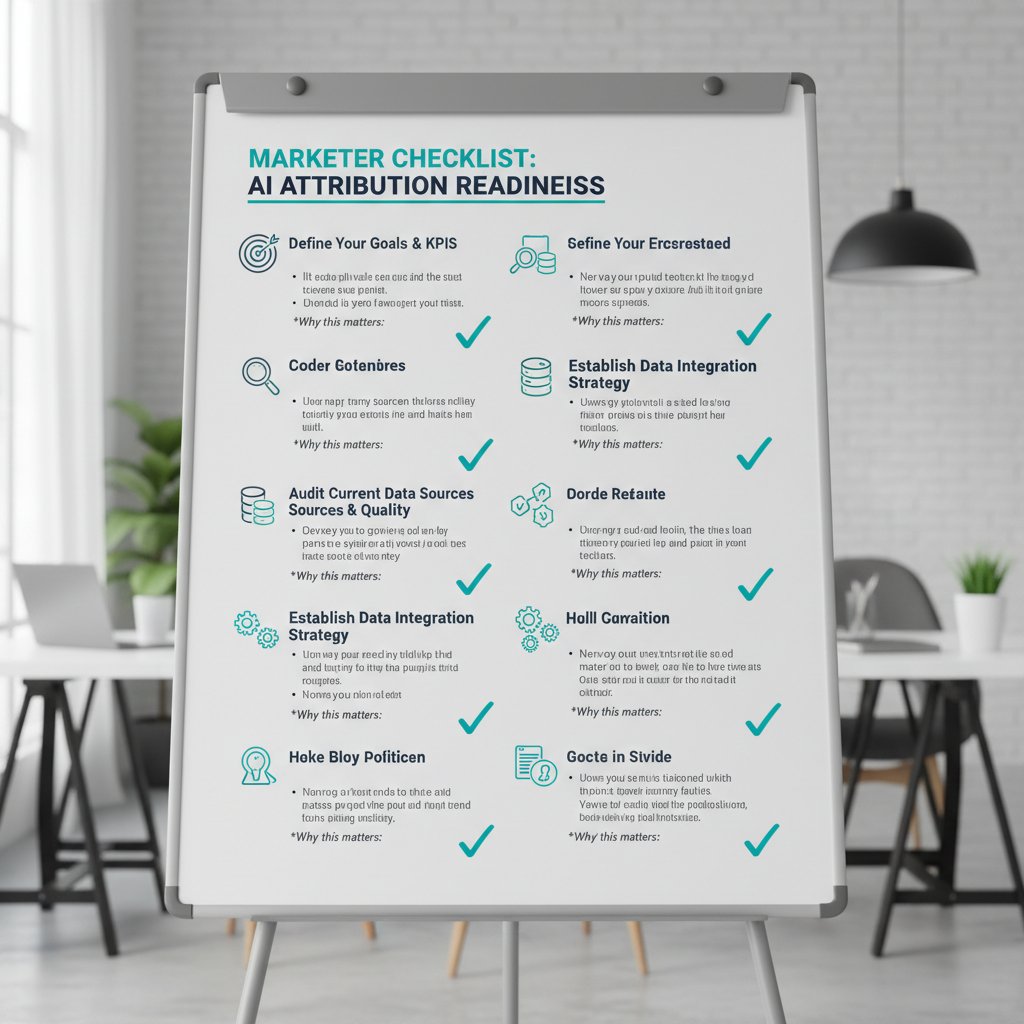
If you answered “no” to any of these, pause. The best AI tools in the world, like those offered by futuretoolkit.ai, can only work with what you provide.
The future of AI-enabled attribution: Trends, threats, and what’s next
Emerging trends in 2025 (and why they matter)
The attribution space is evolving fast, driven by demands for privacy, real-time insights, and cross-device consistency. Recent innovations include privacy-preserving AI models that minimize reliance on personal data, real-time attribution engines that provide instant feedback on campaign tweaks, and cross-device modeling to capture the full scope of user journeys. But as adoption grows, so do concerns over accuracy and compliance.
| Trend/Feature | Adoption Rate (2024) | Accuracy Improvement | Privacy Concern (%) |
|---|---|---|---|
| Privacy-preserving AI | 37% | +18% | 48% |
| Real-time attribution | 52% | +23% | 41% |
| Cross-device modeling | 46% | +15% | 44% |
Table 4: Trends in AI-enabled attribution models, 2024
Source: Original analysis based on SmartInsights, 2024
The ethics minefield: Privacy, consent, and power
As AI-enabled attribution modeling grows more sophisticated, so do the ethical dilemmas. Who owns the data? How is consent managed? And do these models reinforce existing inequalities by privileging certain voices or channels? The controversies aren’t just theoretical—regulators are watching, and public trust is at stake. Marketers must tread carefully, balancing the quest for insight with respect for privacy and power dynamics.

Regulation and the shifting landscape
Governments worldwide are tightening rules on data usage and AI transparency. The European Union’s GDPR, California’s CCPA, and other emerging regulations demand a higher bar for consent, explainability, and accountability in AI-enabled attribution.
Definition list: Key regulations and their impact
European law requiring explicit consent for data collection, strict limits on data retention, and the right for users to understand how their data is used in AI models.
U.S. regulation granting Californians the right to know what data is collected, to opt out of data sales, and to demand deletion—applicable to AI-driven attribution involving California residents.
Aims to regulate high-risk AI applications, requiring transparency, documentation, and risk mitigation for models used in sensitive domains, including marketing attribution.
Putting it all together: Actionable strategies for marketers in the AI era
Checklist: Is your attribution model future-proof?
To stay ahead, marketers need a ruthless approach to evaluation and improvement. Here’s your 10-point checklist:
- Is your data unified and up to date?
- Have you mapped all key customer touchpoints?
- Are your attribution models retrained regularly?
- Do you monitor for bias and anomalies?
- Is your team trained to interpret complex outputs?
- Are you compliant with all relevant privacy laws?
- Do you have a clear escalation process for attribution failures?
- Is your system flexible enough to adapt to new channels?
- Are you benchmarking against industry standards?
- Do you continuously challenge and test your assumptions?
When to use a toolkit (like futuretoolkit.ai) and when to build your own
There’s no one-size-fits-all answer—some teams will benefit from robust, user-friendly AI toolkits; others will need bespoke, in-house solutions. Toolkits like those at futuretoolkit.ai excel at rapid deployment, scalability, and accessibility for non-technical users. Custom builds, while expensive and resource-intensive, offer ultimate control and customization.
| Feature | AI Toolkit (e.g., futuretoolkit.ai) | Custom Solution |
|---|---|---|
| Deployment speed | Rapid | Slow |
| Cost | Predictable, lower upfront | High upfront |
| Flexibility | Moderate-high | Maximum |
| Technical expertise | Minimal required | High required |
| Support | Included | DIY or consultant |
Table 5: Comparison of AI toolkits versus custom-built attribution models
Source: Original analysis based on futuretoolkit.ai, MarTech.org, 2024
Key takeaways for surviving—and thriving—with AI-enabled attribution
- Question everything: AI attribution is powerful, but never infallible.
- Data is destiny: The quality of your inputs determines the value of your outputs.
- Human oversight matters: Trust, but verify—especially when the stakes are high.
- Transparency beats blind faith: If you don’t understand it, don’t trust it.
- Regulations matter: Stay ahead—or risk getting sideswiped by compliance failures.
- Continuous learning: AI models and marketers alike must evolve to stay relevant.
- Real success is incremental: Celebrate improvements, not perfection.
- Community beats isolation: Share lessons and failures with your peers.
- Choose the right tools: Not all solutions fit all needs—evaluate ruthlessly.
- Survival means discomfort: Embrace it as a sign of growth.
The last word: Why the brutal truth is your best ally
Embracing discomfort: The marketer’s new superpower
In a world obsessed with certainty and quick wins, the willingness to confront uncomfortable truths sets the best marketers apart. AI-enabled marketing attribution modeling is an extraordinary tool, but it is not a panacea. The marketers who thrive are those who challenge their assumptions, demand more from their tools, and refuse to settle for easy answers.
"If you’re not uncomfortable, you’re not learning." — Taylor, Senior Marketing Analyst
A manifesto for the new era of marketing attribution
It’s time for marketers to take back control. Demand transparency from your vendors, honesty from your data, and accountability from your teams. The turbulent landscape of 2025 rewards those who question, iterate, and adapt. The future belongs to marketers who understand that AI is a partner, not a replacement—and who are bold enough to face the brutal truths head-on.

Ready to challenge your own assumptions about AI-enabled marketing attribution modeling? Dive deeper, demand more, and remember: in the AI era, discomfort is your competitive advantage.
Sources
References cited in this article
- Revsure.ai(revsure.ai)
- MarTech.org(martech.org)
- InfluencerMarketingHub(influencermarketinghub.com)
- Corvidae.ai(corvidae.ai)
- Funnel.io(funnel.io)
- Lifesight(lifesight.io)
- Smart Insights(smartinsights.com)
- SegmentStream(segmentstream.com)
- Forbes(forbes.com)
- OWOX(owox.com)
- Windsor.ai(windsor.ai)
- Tech for Good(techforgood.net)
- DATANOMIQ(datanomiq.io)
- Search Engine Journal(searchenginejournal.com)
- EMB Global(blog.emb.global)
- UNSW BusinessThink(businessthink.unsw.edu.au)
- AIMultiple(research.aimultiple.com)
- Mountain.com(mountain.com)
- Magenest(magenest.com)
- AllAboutAI(allaboutai.com)
- Forbes(forbes.com)
- Data Science Blog(data-science-blog.com)
- Jennergy(jennergy.com)
- The Verge(theverge.com)
- Full Circle Insights(fullcircleinsights.com)
Empower Your Business with AI
Futuretoolkit.ai empowers businesses of all sizes to harness the power of AI effortlessly, offering specialized solutions across diverse business functions without the need for technical expertise. Whether it's automating customer interactions, optimizing operations, or analyzing complex data, our AI toolkit streamlines processes, increases efficiency, and fuels growth. With easy integration, intuitive interfaces, and powerful AI models, Futuretoolkit.ai offers unmatched accessibility and value, enabling users to achieve measurable outcomes quickly and cost-effectively.
Get startedReady to Empower Your Business?
Start leveraging AI tools designed for business success
Frequently Asked Questions
What percentage of marketers struggle with data integration in attribution modeling?
According to research from Revsure.ai cited in the article, 42% of marketers cite poor data integration as a major barrier to effective attribution, even as AI claims to connect all the dots.
Can AI attribution models see everything in a customer's journey?
No. While AI is a powerful tool, its vision is limited by the quality and completeness of input data, and it cannot pierce the blind spots created by cross-device journeys, offline interactions, and privacy walls in modern marketing.
Why are legacy attribution models still problematic in the AI era?
Many teams still rely on outdated frameworks like last-click, first-touch, and linear attribution, sometimes using AI as merely a veneer on top of these rule-based systems, creating a mismatched methodology that fails to deliver actionable insights.
What portion of marketing ROI remains unattributed according to the article?
According to MarTech.org, 35% of marketing ROI remains unattributed due to disconnected data.
Continue Reading
Keep exploring Comprehensive business AI toolkit

AI-Driven Marketing Analytics: Capabilities and Real Risks

AI-Powered Marketing Tools: Separating Results From Vendor Promises

AI-Based Marketing Optimization: ROI Impact and Adoption Trends

Why Marketing Campaign Effectiveness Tools Often Mislead

AI-Powered Data-Driven Marketing in 2026: Hype, Risk, Real ROI
