


AI-Powered Marketing Automation Platforms You Can Actually Trust
Written with AI assistance under our editorial guidelines
AI-powered marketing automation platforms have reshaped modern marketing, with 69.1% of marketers adopting AI in 2024. The market is valued at $30.8 billion with a projected 19% annual growth rate through 2032, driven by cost savings and competitive pressure, though many marketers struggle to understand what their platforms actually do.
Under the relentless staccato of keyboard clicks and the blue glow of midnight monitors, something tectonic has shifted in marketing. AI-powered marketing automation platforms have not just entered the scene—they’ve bulldozed their way into the heart of modern business, reshaping everything from how brands talk to customers to how marketers talk to themselves. The hype is deafening, the statistics are staggering, and the FOMO? Palpable. But what’s real, and what’s just noise? Welcome to a narrative that refuses to be a glossy pitch deck: the raw, unvarnished reality of AI-powered marketing automation platforms in 2025. Here, you’ll pull back the velvet curtain to see the moving gears—warts and wonders both—and decide what’s worth your trust, your investment, and maybe even your job.
Welcome to the new marketing underground
The AI takeover nobody planned
It didn’t start with a bang. AI’s infiltration into marketing stacks was more like water seeping under a locked door—subtle, silent, but utterly transformative. One day you’re manually segmenting lists and slogging through A/B tests; the next, you’re staring at a dashboard that knows your customer’s next move before you do. According to Influencer Marketing Hub, 2024, a staggering 69.1% of marketers adopted AI in 2024—an 8% jump in a single year. Yet, if you polled every cubicle and Zoom call, you’d find a surprising number of marketers can’t explain what their shiny new “AI platform” is actually doing. AI didn’t introduce itself; it squatted in your stack, rewrote the rules, and left the team Googling “what is machine learning?” at 2 AM.

"AI didn’t knock—it just showed up and changed the rules." — Alex
Why everyone is suddenly obsessed with automation
If you’ve felt the buzz, you’re not alone. Spending on AI-powered marketing automation platforms is skyrocketing, with the industry valued at $30.8 billion in 2023 and riding a projected 19% compound annual growth rate through 2032 (Loopex Digital, 2024). The rush isn’t just about cost savings—though 42% of businesses cite that as a motivator—it’s about the primal human urge to not be left behind. FOMO isn’t just a meme; it’s a driving force. There’s an emotional cocktail at play: envy of AI-enabled competitors, the thrill of “efficient” campaigns, and the anxiety of being the last analog marketer in an AI world. The result? Brands leap in, often skipping the slow burn of strategy for the dopamine hit of “look, we’re using AI now!”—sometimes with astonishing success, sometimes with cautionary-tale-worthy failure.
What this article will (and won’t) do
Let’s clear the air: you won’t find vendor-sponsored fairy tales here. This article isn’t a parade of gushing testimonials or a thinly disguised product demo. Instead, you’ll get the back-alley truth about AI-powered marketing automation platforms—the rewards, the risks, and the realities that vendors gloss over. Expect hard data, sharp analysis, and a willingness to poke at sacred cows. You’ll walk away knowing not just what these platforms promise, but what they actually deliver, and how to separate the signal from the static. Discomfort is guaranteed; actionable insight is the payoff.
Deconstructing the buzz: What actually is an AI-powered marketing automation platform?
From old-school email blasters to neural networks
Marketing automation didn’t always wear an “AI” badge. The journey began decades ago with batch email blasters and basic drip campaigns—if/then logic wrapped in a shiny GUI. Today, many platforms tout machine-learning-powered orchestration, predictive analytics, and even “sentiment engines.” The difference is night and day, but the lineage is clear: every revolution is built on the bones of the last.
| Year | Technology | Impact |
|---|---|---|
| 2000 | Basic rule-based automation (email, SMS) | Manual setup, limited personalization |
| 2010 | Multi-channel workflow engines | Omnichannel reach, still rule-based |
| 2017 | Predictive analytics, basic ML | Data-driven targeting, some personalization |
| 2021 | Natural Language Processing (NLP), advanced ML | Real-time content adaptation, chatbots |
| 2023 | Generative AI, deep learning | Automated content creation, hyper-personalization |
Table 1: Evolution of marketing automation platforms from rule-based engines to AI-driven orchestration. Source: Original analysis based on Influencer Marketing Hub, 2024 and Loopex Digital, 2024.
The difference between automation and real AI
Here’s the dirty secret: not everything branded “AI” actually deserves the name. True artificial intelligence involves systems that learn, adapt, and make complex decisions in real time. Classic automation, by contrast, is just following orders—no learning, no nuance, just brute repetition.
Definition list: What’s what in the world of marketing tech
Systems that learn from data, identify patterns, and adapt their outputs—think of predictive lead scoring or content generation that improves over time.
Scripted rules that execute repeatable tasks, like sending a welcome email when someone signs up. Reliable, but not “smart.”
The coordinated execution of multiple automated tasks, sometimes with basic decision trees, but not always involving true AI.
Why does it matter? Because platforms that blur these lines may overpromise—and underdeliver—on transformative results. According to research from TechPilot.ai, 2023, nearly half of marketers using so-called “AI platforms” are actually engaging with glorified rule engines.
What’s under the hood: Tech that powers the hype
Today’s leading platforms tout a mouthful of acronyms: ML (machine learning), NLP (natural language processing), predictive analytics, and, increasingly, generative AI models. These technologies do more than automate—they analyze web content to match search intent (used by 84% of businesses), generate on-the-fly campaign assets, and enable 24/7 personalized chat support (Influencer Marketing Hub, 2024). But sophistication comes at a price: complexity, opacity, and the ever-present risk of black-box decision-making.

The promises—and the pitfalls—of AI marketing automation
Efficiency gains: Reality or mirage?
Vendors promise AI-powered marketing automation platforms will slash hours, crush costs, and let teams “do more with less.” Sometimes they deliver. A 2024 survey found that 50% of marketing leaders use AI for content generation, and 42% cite cost reduction as a key benefit (Influencer Marketing Hub, 2024). But scratch beneath the surface, and the numbers tell a more nuanced story. According to user data, efficiency gains often depend on implementation maturity: beginners see modest returns, while AI experts reap the lion’s share of the upside.
| Claim | Promised Efficiency Gain | Actual Efficiency Gain (avg.) |
|---|---|---|
| Content creation time savings | 60% | 35% |
| Lead scoring accuracy | 40% | 25% |
| Campaign ROI uplift | 30% | 18% |
| Cost reduction | 50% | 28% |
Table 2: Comparing vendor claims versus reported efficiency gains with AI-powered marketing automation platforms, 2024-2025. Source: Original analysis based on Influencer Marketing Hub, 2024 and Loopex Digital, 2024.
Where AI platforms fail (and why no one talks about it)
The truth few vendors volunteer? AI platforms can—and do—fail, often spectacularly. Common culprits include:
- Garbage in, garbage out: If you feed an AI bad data, it’ll spit out bad results—faster and on a larger scale.
- Black-box decisions: When algorithms make calls you can’t explain, you’re left defending outcomes you barely understand.
- Integration hell: Bolt-on AI rarely plays nice with legacy tech, resulting in wasted budgets and project fatigue.
- Skill gaps: With 45% of marketers self-identified as AI beginners and 63% citing lack of education as a barrier, many teams simply aren’t ready.
- Hidden costs: From surprise overages on API calls to the need for pricey data consultants, “self-service” AI often isn’t.
The hidden risk: Data as both asset and liability
Marketers love to wax poetic about “data-driven decisions,” but few contemplate the double-edged sword they wield. Data privacy regulations (like GDPR and CCPA) loom large; bias in training data can warp campaign outcomes; and compliance failures can mean massive fines. The ultimate irony? The same data that powers personalization can, if mishandled, annihilate trust.
"We trusted the data until it bit us back." — Morgan
AI in the wild: Real-world stories of automation gone right (and wrong)
Case files: Successes that changed the game
Consider the story of a retail brand facing flatlining engagement and ballooning support costs. By deploying an AI-powered marketing automation platform, they automated 70% of customer inquiries with chatbots, slashed response times by half, and personalized promotions using real-time data. The result? A 40% jump in campaign effectiveness and a 30% boost in inventory accuracy—figures echoed by industry-wide research (Influencer Marketing Hub, 2024).

When AI backfires: Lessons from the field
But it’s not all confetti and dashboards. One notorious fail: a fast-scaling e-commerce brand unleashed an AI-driven promo engine, only to see it misinterpret buying signals—spamming customers with irrelevant offers. Complaints flooded in, and the brand suffered a temporary exodus of loyal buyers. It took months of hands-on debugging and a hard pivot to regain lost ground, a cautionary tale repeated in various guises across the industry.
What you can actually learn from these stories
What do these case files teach us? Success hinges on both the technology and the humans behind it. Overreliance on the “magic” of AI, coupled with poor data discipline or lack of oversight, is a recipe for disappointment.
- Conduct a forensic review: After every campaign, dig deep into failures and wins—don’t just look at the numbers, analyze the “why.”
- Interrogate the data: Identify where bias, gaps, or garbage data may have skewed results.
- Map the human factor: Chart points where human intuition intervened or was ignored.
- Document lessons: Turn insights into new protocols and “guardrails” for future campaigns.
- Iterate, don’t stagnate: Use every success and failure as fuel for smarter, safer AI use.
Debunking the myths: What AI marketing can (and can’t) do for you
Why ‘set it and forget it’ is a dangerous lie
No matter what the glossy brochures claim, AI-powered marketing automation platforms can’t run campaigns on autopilot. Real marketers know: even the sleekest algorithm needs tuning, exceptions, and hands-on oversight. According to TechPilot.ai, 2023, platforms left entirely unchecked drift off-target, falling prey to “drift” and delivering ever-fainter ROI.
The creativity question: Is AI killing originality?
There’s a real tension at play. As AI platforms churn out “optimized” subject lines and social posts at scale, marketers face the creeping sense of creative sameness. The risk? Campaigns blur together, originality fades, and true brand voice gets lost in the algorithm.
"The best campaigns still come from gut and grit, not just code." — Riley
Are marketers being automated out of existence?
The fear is real: will algorithms replace marketers? The job market tells a subtler story. While repetitive roles are shrinking, new positions—AI strategist, data ethicist, prompt engineer—are on the rise. According to research from G2 Learning, 2024, marketers who blend technical savvy with creative vision are more vital than ever.
Choosing your arsenal: How to compare AI-powered marketing automation platforms
Must-have features vs. nice-to-haves
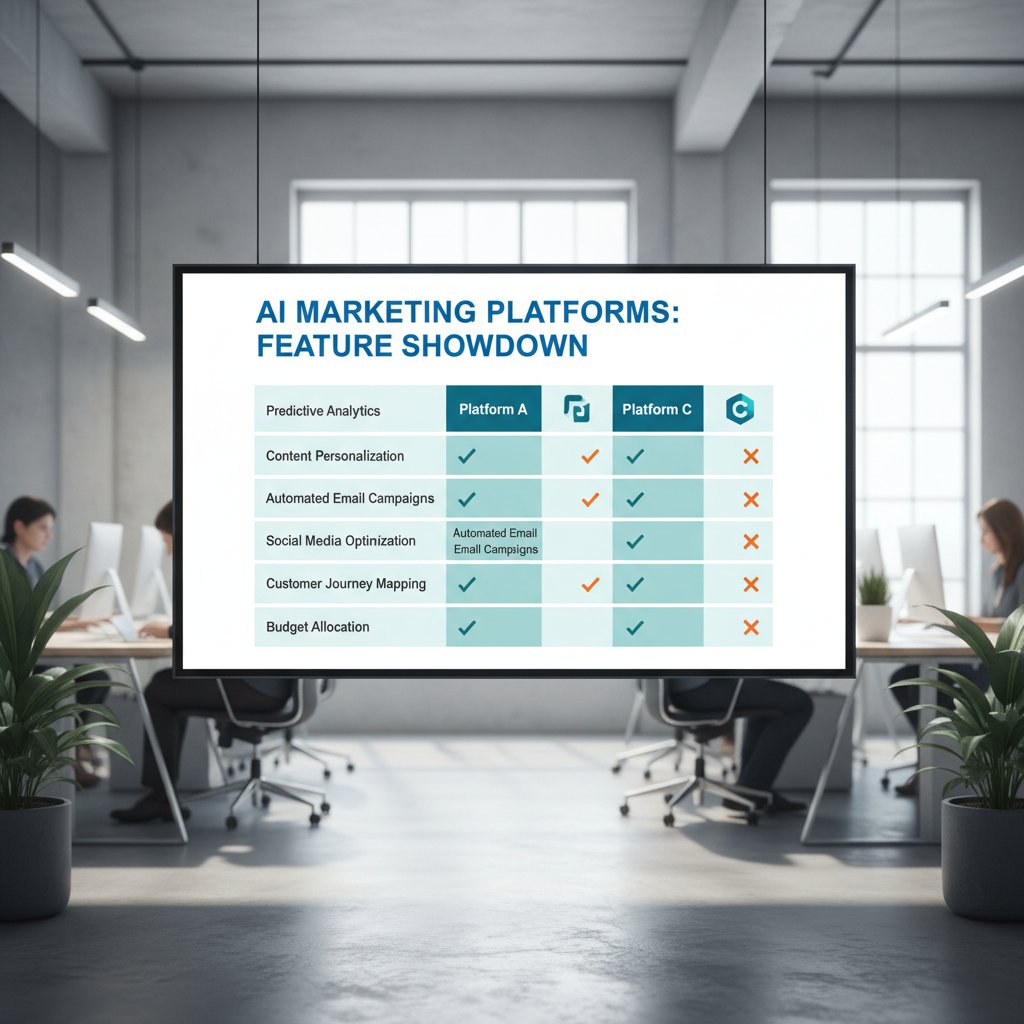
With every vendor promising the moon, it’s easy to get lost in feature lists. In 2025, essentials include:
- True AI-powered personalization for every customer touchpoint
- Seamless multi-channel orchestration (email, social, SMS, web)
- Advanced analytics with actionable insights, not just dashboards
- No-code or low-code workflow builders for rapid deployment
- 24/7 AI chatbots capable of nuanced, contextual responses
- Industry-specialized modules for retail, finance, healthcare, and more
For small businesses, cost efficiency and ease of use trump everything. For enterprises, scalability and integration with legacy tech are critical.
Red flags in the sales pitch (and how to spot hype)
Don’t be seduced by buzzwords and demo sizzle. Watch for these warning signs:
- Promises of “fully autonomous” marketing—if it sounds too good, it is.
- Opaque pricing or hidden “integration” fees.
- Vague claims about “AI” without specifics on technology used.
- No clear path for data export or platform exit.
- Lack of compliance guarantees (GDPR, CCPA).
- Limited customer support or training resources.
- Overreliance on case studies instead of live demos.
- Frequent “beta” features—potentially buggy or unstable.
- No peer-reviewed security certifications.
- Absence of independent ROI benchmarks.
The ultimate comparison table: Who’s leading, who’s lagging
| Platform | True AI Personalization | Ease of Use | Cost Efficiency | Scalability | Support |
|---|---|---|---|---|---|
| Futuretoolkit.ai | Yes | High | High | Highly scalable | Strong |
| Competitor A | Limited | Moderate | Moderate | Limited | Moderate |
| Competitor B | Yes | Low | Moderate | High | Limited |
| Competitor C | No | High | High | Moderate | Strong |
Table 3: Feature matrix comparing top AI-powered marketing automation platforms, 2025. Source: Original analysis based on verified vendor reports and market data.
Implementing AI marketing automation without wrecking your brand
How to prep your data and team for AI success
Clean data isn’t optional; it’s non-negotiable. The best platforms can’t save you from dirty databases or siloed workflows. Equally, your team needs upskilling—AI is not a plug-and-play miracle. Change management is everything.
- Audit your data: Identify gaps, duplicates, and inconsistencies.
- Upskill your team: Host hands-on AI workshops, not just webinars.
- Define success: Set clear KPIs before launch.
- Test in the sandbox: Run pilot campaigns before full rollout.
- Create feedback loops: Establish regular reviews to tune algorithms and processes.
Avoiding the common faceplants: What most companies get wrong
Classic mistake: treating AI-powered marketing automation as a one-and-done install. The graveyard is littered with failed projects that ran afoul of poor planning, lack of internal buy-in, and underestimating the change curve. This is where platforms like futuretoolkit.ai shine, offering industry-specialized, no-code solutions that make AI accessible—without a parade of consultants.
How to measure what actually matters (and stop chasing vanity metrics)
Clicks and opens are yesterday’s news. In the AI era, focus on metrics that map directly to business outcomes, not just digital noise.
Definition list: Modern AI marketing metrics, explained
Measures the total revenue a customer generates—AI enables precise prediction and optimization.
Goes beyond clicks; tracks multi-channel, multi-touch interactions.
Monitors customer drop-off, with AI predicting at-risk segments for intervention.
With AI-driven analytics, tracks which touchpoints truly drive conversions, not just last-click attributions.
What’s next: The future (and possible backlash) of AI-powered marketing
The commoditization dilemma: When everyone uses AI, who wins?
As the AI arms race heats up, a new risk emerges: sameness. When every brand automates to the hilt, standing out requires more than just algorithmic prowess. Human insight, authentic brand voice, and the courage to break the mold become the new competitive edge. According to Forbes’ Gerber, AI is “elevating intelligence from a weakness to a superpower,” but only if paired with creative human strategy.
AI and the consumer: Will trust survive?
Consumers are getting wise to the game. From “personalized” spam to uncanny valley chatbots, AI fatigue is a real threat. Trust is fragile, and every misstep—be it a data leak or a tone-deaf campaign—chips away at brand equity.

The next competitive edge: Beyond the algorithm arms race
The brands that thrive won’t just deploy AI—they’ll build AI-native teams, combining human creativity with machine intelligence. Hybrid skillsets, flexible toolkits like futuretoolkit.ai, and a culture of continuous learning mark the real winners. The battle is not for the best algorithm, but for the smartest blend of human and machine.
The new marketer’s manifesto: Staying human in an AI world
Embracing the machine without losing your edge
AI is here to stay, but your value isn’t vanishing—it’s evolving. Let AI handle the grunt work, but keep your hands on the wheel for creative, strategic, and ethical calls. Before you automate, ask:
- Does this solution enhance or erode our unique brand voice?
- Am I solving a real problem or chasing a trend?
- Who’s accountable for the outcomes—me or the machine?
Your next steps: Turning insight into action
Ready to future-proof your marketing? Start with a ruthless audit of your current processes, tech stack, and team skills.
- Map your existing workflows and identify repetitive pain points.
- Evaluate your data quality—don’t let AI amplify bad inputs.
- Inventory your martech stack for integration gaps.
- Survey your team’s strengths and training needs.
- Prioritize AI projects where ROI is clear and risk is manageable.
Final word: The only certainty is change
The story of AI-powered marketing automation platforms is still being written—and the pen is in your hand. Will you shape the future, or let it flatten you? The harshest truth is also the most liberating: in a world of relentless change, adaptability is the only safe bet.

Sources
References cited in this article
- Influencer Marketing Hub(influencermarketinghub.com)
- Loopex Digital(loopexdigital.com)
- TechPilot.ai(techpilot.ai)
- Forbes(forbes.com)
- Smart Insights(smartinsights.com)
- Grazitti(grazitti.com)
- ActiveCampaign(activecampaign.com)
- Expert Market Research(expertmarketresearch.com)
- HubSpot(blog.hubspot.com)
- Vendasta(vendasta.com)
- Persado(persado.com)
- Influencer Marketing Hub(influencermarketinghub.com)
- ResearchGate 2024(researchgate.net)
- IBM AI in Marketing(ibm.com)
- SEMrush(semrush.com)
- Salesforce(salesforce.com)
- WriteCure(writecure.com)
- DigitalMarketer(digitalmarketer.com)
- Forbes(forbes.com)
- Influencer Marketing Hub(influencermarketinghub.com)
- Scienz AI(scienzai.com)
- Winsavvy(winsavvy.com)
- Compunnel(compunnel.com)
- TrustArc(trustarc.com)
- Mosaikx(mosaikx.com)
- Jennergy(jennergy.com)
- Forbes(forbes.com)
- TalkCMO(talkcmo.com)
- Frontify(frontify.com)
- Merkle(merkle.com)
- Exploding Topics(explodingtopics.com)
- Marketer Interview(marketerinterview.com)
- NoGood(nogood.io)
- Analytics Insight(analyticsinsight.net)
Empower Your Business with AI
Futuretoolkit.ai empowers businesses of all sizes to harness the power of AI effortlessly, offering specialized solutions across diverse business functions without the need for technical expertise. Whether it's automating customer interactions, optimizing operations, or analyzing complex data, our AI toolkit streamlines processes, increases efficiency, and fuels growth. With easy integration, intuitive interfaces, and powerful AI models, Futuretoolkit.ai offers unmatched accessibility and value, enabling users to achieve measurable outcomes quickly and cost-effectively.
Get startedReady to Empower Your Business?
Start leveraging AI tools designed for business success
Frequently Asked Questions
What percentage of marketers adopted AI in 2024?
According to the article, 69.1% of marketers adopted AI in 2024, representing an 8% jump in a single year.
How much is the AI-powered marketing automation platform industry valued at?
The industry was valued at $30.8 billion in 2023 and is projected to grow at a 19% compound annual growth rate through 2032.
What is the main reason businesses are adopting AI marketing automation?
While 42% of businesses cite cost savings as a motivator, the article suggests the primary driver is FOMO—the fear of being left behind by AI-enabled competitors.
Do most marketers understand how their AI platforms actually work?
No, according to the article, a surprising number of marketers cannot explain what their AI platform is actually doing, despite having adopted it.
Continue Reading
Keep exploring Comprehensive business AI toolkit

AI-Driven Marketing Automation: Capabilities and Implementation

AI-Powered Marketing Tools: Separating Results From Vendor Promises

Automated Targeted Marketing Software: Capabilities and Pitfalls

AI-Driven Marketing Intelligence Tools: Hype, Risk and Real Wins

AI-Driven Marketing Analytics: Capabilities and Real Risks
