


AI-Based Predictive Analytics That Works: Why 80% of Projects Fail
Written with AI assistance under our editorial guidelines
AI-based predictive analytics projects fail at staggering rates—70 to 85 percent according to 2024 research—primarily due to unclear business value, poor stakeholder engagement, immature data ecosystems, overambitious scope, and failure to integrate insights into actual workflows. Organizations that succeed focus on concrete business problems and iterative approaches rather than pursuing transformative moonshots without foundational readiness.
Beneath the shimmering surface of business AI, where buzzwords rain from every keynote and marketing pitch, there’s a reality most executives tiptoe around: AI-based predictive analytics is less a magic bullet, more a minefield—ruthless, rewarding, and utterly unforgiving of wishful thinking. As 2025 looms, nearly every industry faces a pivotal question: can you harness predictive analytics to outsmart competitors, or will you drown in a sea of failed pilots, biased models, and tech hype? Here’s the unvarnished truth: while AI-based predictive analytics offers a seismic leap in business intelligence, it’s also fraught with pitfalls most won’t admit. The failure rate is jaw-dropping. Yet, for those who get it right, the rewards aren’t just incremental—they’re transformative, shaping new revenue streams, radical cost savings, and hyper-personalization that turns customers into loyalists. If you think you know what’s really going on under the hood, think again. This no-BS guide cuts through spin and surface-level advice, exposing the brutal realities and hidden wins behind AI-driven business forecasting, analytics, and decision-making. If you’re considering deploying, scaling, or rescuing your predictive analytics strategy in 2025, buckle up—what follows will change how you see the game.
Why most AI-based predictive analytics projects fail before they begin
The real reasons behind the 80% failure rate
Let’s start by torching the myth of easy AI wins. According to research by Gartner and Harvard Business Review in 2024, a staggering 70-85% of AI-based predictive analytics initiatives collapse before generating value. The numbers are even more brutal for organizations with immature analytics practices: the failure rate spikes to 90% (Melbourne Business School, 2024). What’s really sinking these projects?
- Unclear business value: Many teams chase shiny algorithms without a clue how they’ll connect to actual profits, cost savings, or customer outcomes. Without a concrete business problem, AI becomes an expensive science experiment.
- Poor stakeholder engagement: Predictive models are only as good as the buy-in from those who use their outputs. Internal resistance and misalignment doom the project before code is even written.
- Immature data ecosystems: Flawed, siloed, or incomplete data means your “AI” is more likely to hallucinate than to predict anything useful.
- Overambitious scope: Teams try to boil the ocean—tackling moonshot projects when a focused, iterative approach would deliver more value.
- Workflow integration failure: Insights that never reach frontline decisions are as useless as a Ferrari without an engine.

“Most failed AI initiatives weren’t technical failures—they were failures of business planning, communication, and expectation management.” — Dr. Michael Brand, Professor of Data Science, Melbourne Business School, 2024
Top reasons AI-based predictive analytics projects crash and burn:
- Lack of clear, measurable business objectives
- Data quality issues—missing, inconsistent, or biased data
- Failure to engage key users and shareholders from day one
- Trying to implement the ‘perfect’ model instead of iterating quickly
- Ignoring the need to integrate outputs into daily workflows
False promises vs. operational realities
Marketing decks promise unicorns. Operational reality bites. While vendors tout “plug-and-play” AI solutions, industry surveys from 2024-2025 reveal a much more sobering picture: 55% of organizations cite legacy system integration as a core barrier (McKinsey, 2025), and 60% of predictive models still suffer from poor data quality (Gartner, 2025). The leap from proof-of-concept to real-world deployment is where even seasoned teams stumble.
First, many businesses underestimate the inertia of their own processes. Models may deliver stunning accuracy in a sandbox, but the avalanche of exceptions, edge cases, and human workarounds in live environments expose hidden cracks. Second, there’s a chronic shortage of talent able to bridge the gap between business and data science—a whopping 58% talent gap, according to the LinkedIn Workforce Report (LinkedIn, 2025). Bottom line: most of the pain points are organizational, not technical.
| Promise | Real-World Barrier | Outcome (2024-2025) |
|---|---|---|
| “Plug-and-play” deployment | Data silos, legacy systems | 55% struggle to integrate AI solutions |
| “Instant ROI” | Poor data quality | 60% of models underperform expectations |
| “No-code, for everyone” | Skills and culture gap | 58% face talent shortages |
| “Fully automated workflows” | Change management failure | Most projects stall before scaling |
Table 1: The gulf between AI vendor promises and operational reality
Source: Original analysis based on Gartner 2025, McKinsey 2025, LinkedIn 2025
How to spot doomed projects early
So, how do you avoid becoming another cautionary statistic? Pattern recognition, ironically, is your best weapon. According to Deloitte’s 2025 survey, 65% of companies report positive ROI from predictive analytics within 12 months—if they avoid classic missteps (Deloitte, 2025). Look for these red flags:
- Vague project scope with no defined business metric
- Data teams working in isolation from business units
- No plan for integrating model outputs into existing workflows
- Reluctance to start small and iterate
If you see two or more, start asking hard questions now.
- What exact business outcome will the model impact?
- Is the data not just available, but trustworthy?
- Who owns the change management process?
- Are there clear plans for post-deployment feedback loops?
- What’s the fastest path to a “minimum viable prediction”?
A project that can’t answer these doesn’t need more AI—it needs a reset and a reality check.
In sum, the real tragedy isn’t technical. It’s a failure of business nerve, focus, and honesty about the hard work required to turn predictive analytics from hype to measurable value.
Demystifying the black box: how AI-based predictive analytics actually works
From data chaos to business foresight
At its core, AI-based predictive analytics is about transforming a surging tide of raw, chaotic data into clear, actionable foresight. Unlike traditional analytics—which only tells you what happened—predictive analytics attempts to forecast what will happen next. That’s where the magic (and the peril) lies. But make no mistake: algorithms don’t divine the future. The process is rigorous, methodical, and fraught with human judgment at every stage.

The journey begins with data wrangling—extracting, cleaning, and structuring vast datasets from disparate sources. Next, machine learning algorithms parse historical patterns, hunting for signals that correlate with future outcomes. Sophisticated models—ranging from simple regressions to neural networks—are trained, validated, and stress-tested against real-world scenarios. Finally, results are translated back into business language, often through intuitive dashboards or direct workflow integrations. The goal? Actionable, trustworthy predictions, not just statistical noise.
Key Terms in AI-based Predictive Analytics
The labor-intensive process of collecting, cleaning, and organizing raw data for analysis. It’s where 80% of the work (and frustration) lives.
Crafting the right input variables (“features”) that give your model predictive power. More art than science—and often the difference between failure and breakthrough.
Teaching an algorithm to recognize relevant patterns by feeding it labeled historical data.
Stress-testing a model on unseen data to ensure it doesn’t just memorize the past (overfitting), but actually generalizes well.
Tools and techniques that make a model’s predictions understandable to humans—now a top priority for 72% of enterprises (Forrester, 2025).
What’s inside the AI: algorithms, models, and mystery
Let’s puncture the “black box” mystique. At a technical level, AI-based predictive analytics combines several core components:
First up are the algorithms—the rulebooks that crunch data. Think logistic regression, decision trees, ensemble methods, and, increasingly, advanced neural networks. The choice depends on the problem: forecasting churn? Try gradient-boosted trees. Predicting image-based anomalies? Deep learning shines.
Second, there’s the model itself: a trained representation of how inputs relate to specific outcomes. But here’s the edge: even the most sophisticated model is only as good as the data (and assumptions) it’s fed. Garbage in, garbage out—at machine speed.
Finally, the “mystery” isn’t so much the math (which is well-documented), but the contextual, often messy, decisions about which features to use, what trade-offs to accept, and how to interpret the outputs in a business context.
- Algorithms: The mathematical engines powering predictions, from linear regression to deep neural nets.
- Models: Trained systems that encapsulate learned patterns, applied to new data for forecasting.
- Feature selection: The often underappreciated art of choosing which variables to feed the algorithm, deeply impacting model accuracy.
- Bias mitigation: Systematic checks (and sometimes cross-industry collaboration) to minimize distortion in predictions—now a frontline concern.
Machine learning, deep learning, and everything in between
The predictive analytics landscape is a sprawling ecosystem. Machine learning encompasses everything from simple supervised models (like decision trees) to unsupervised clustering that finds hidden groupings in your data. Deep learning—fueled by multi-layered neural networks—pushes boundaries further, handling unstructured data (images, text, audio) and enabling more complex predictions.
But sophistication brings new risks. Deep learning models can be inscrutable, making explainability and regulatory compliance a minefield for many organizations. Despite the hype, the most effective predictive analytics projects often combine classic statistical techniques with cutting-edge AI, balancing accuracy, transparency, and operational fit.
“AI-based predictive analytics isn’t about replacing human judgment—it’s about augmenting it, spotlighting blind spots and surfacing the unexpected.” — Dr. Eric Siegel, Author of Predictive Analytics, Forbes, 2024
AI-based predictive analytics across industries: game-changers and cautionary tales
Retail: from inventory nightmares to demand nirvana
Retailers were among the first to weaponize predictive analytics at scale, desperate to tame the chaos of inventory, pricing, and customer churn. By 2025, nearly half implement real-time predictive models to forecast demand and personalize offers (IDC, 2025). The result? Up to 30% increases in engagement and retention when AI is used for personalization.
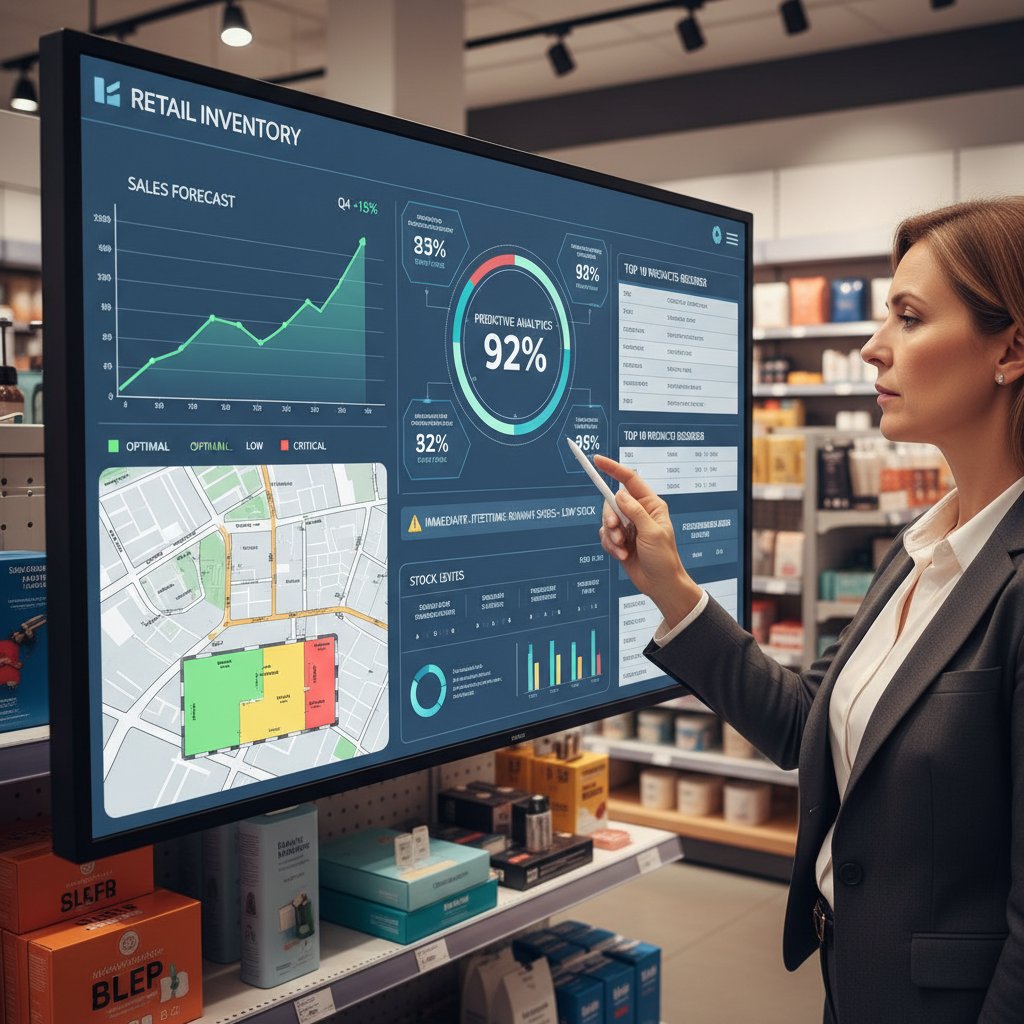
But for every success story, there’s a graveyard of over-engineered solutions and warehouse write-offs. Retailers that win are those who start with focused pilots—like optimizing a single product category—before scaling across the chain. Integration with point-of-sale data, supply chain feeds, and customer profiles is the secret sauce.
Early adopters experienced notorious stumbles: models trained on pre-pandemic data crashed and burned when shopper behavior shifted overnight. The lesson? Predictive analytics is only as good as its data’s relevance and recency.
Healthcare: predicting patient risks—and ethical landmines
Healthcare is ground zero for both the promise and peril of predictive analytics. AI models now flag patient risks (like readmission or adverse events) earlier than ever. According to RAND, 2024, smart triage systems can reduce avoidable admissions by up to 15%, and workflow automation is slashing administrative burdens (McKinsey, 2025). However, the stakes are uniquely high: errors can cost lives, not just dollars.
- Bias is a constant threat: Models trained on non-representative data can perpetuate inequalities, risking both patient outcomes and organizational reputation.
- Regulatory scrutiny is rising: With explainability and privacy at the forefront, compliance is moving from “nice-to-have” to existential.
- Ethics aren’t optional: Deploying a black-box model without robust validation and oversight can lead to catastrophic trust failures.
- Workflow integration is pivotal: Predictions must fit seamlessly into clinical decision-making, not add friction.
Finance and logistics: numbers that make or break
Finance and logistics are “all in” on predictive analytics, with a focus on risk, fraud, and operational optimization. The finance sector reports up to 35% improvements in forecasting accuracy and significant reductions in risk (Deloitte, 2025). Logistics firms use AI models to optimize routes and cut delivery times—boosting both profit and customer satisfaction.
| Industry | Use Case | Outcome (2024-2025) |
|---|---|---|
| Finance | Risk and fraud detection | 35% greater forecast accuracy |
| Logistics | Route and supply optimization | 30% reduction in delays |
| Retail | Demand forecasting | 30% increased engagement |
| Healthcare | Patient risk stratification | 15% fewer avoidable events |
Table 2: Industry outcomes from AI predictive analytics
Source: Original analysis based on Deloitte 2025, IDC 2025, RAND 2024
The cautionary tale? Overfitting to historical data and failing to adjust to macroeconomic shocks—like sudden supply chain disruptions—can leave companies exposed when it matters most.
Debunking the top myths about AI-based predictive analytics
‘Set it and forget it’—the automation illusion
If you think predictive analytics lets you put your business on autopilot, think again. The hard truth is, AI models degrade over time as data and behaviors shift—a fact known as “model drift.”
“Automating insight generation doesn’t mean abdicating responsibility. Human oversight is vital to ensure predictions remain valid.”
— Sarah K. White, Senior Editor, CIO Magazine, 2024
The lesson? AI is a force multiplier, not a hands-free solution. Constant monitoring, retraining, and feedback are essential to avoid catastrophic errors. Businesses that treat AI as a plug-and-play savior often find themselves blindsided when models start generating nonsense—or, worse, amplify existing biases.
Regular model validation is non-negotiable. The most successful organizations embed predictive analytics into dynamic, feedback-rich processes where humans and machines work in tandem.
The myth of unbiased AI
Let’s burst the bubble: there’s no such thing as a truly unbiased model. Every dataset contains the thumbprint of human choice—what’s collected, what’s ignored, how it’s labeled. This is more than a technical challenge; it’s a risk to reputation and compliance.
- Data reflects historical inequalities: If past decisions were biased, your AI will encode and potentially amplify them.
- Bias creeps in at every step: From data selection to feature engineering, subjective judgment shapes outcomes.
- Blind trust is dangerous: Explainability tools help, but only if combined with deliberate bias audits and cross-functional oversight.
Organizational strategies must include bias detection as a core pillar, not an afterthought.
The ROI fantasy: what the numbers really say
Vendors love to tout sky-high returns, but the reality is nuanced. While 65% of companies realize measurable ROI within a year, per Deloitte, 2025, most failed projects never recoup their costs.
| Claim | Reality (2024-2025 Data) | Source |
|---|---|---|
| “ROI in 3 months” | 65% see ROI within 12 months | Deloitte 2025 |
| “Guaranteed cost savings” | 48% use real-time analytics, but 70% projects fail pre-deployment | IDC 2025, Gartner/HBR 2024 |
| “Quick wins for all” | Success depends on maturity level | Melbourne Business School 2024 |
Table 3: Comparing predictive analytics ROI claims to reality
Source: Original analysis based on Deloitte 2025, IDC 2025, Gartner/HBR 2024, Melbourne Business School 2024
The takeaway: Treat ROI projections with skepticism. Success is possible, but it’s neither automatic nor evenly distributed. Context, execution, and organizational readiness matter.
Power moves: making AI-based predictive analytics work in the real world
Checklist: are you ready for AI-based predictive analytics?
Before you even think about signing that contract or launching your pilot, gut-check your readiness. According to industry benchmarks, organizational preparedness trumps technical prowess.
- Is your business problem clearly defined and measurable?
- Do you own, or have access to, reliable data?
- Are stakeholders from across the org committed (not just IT)?
- Do you have resources for ongoing model monitoring and retraining?
- Is there a plan for integrating predictions into actual workflows?
- Have you established metrics for success (and failure)?
- Can you tolerate “fail-fast” iterations without panic?
If you can’t say “yes” to all, pause and recalibrate. The best tech in the world can’t fix a lack of business alignment.
A strong predictive analytics strategy is grounded in business outcomes, not algorithms for their own sake. The right toolkit—such as those offered by futuretoolkit.ai—can lower technical barriers, but only if paired with organizational discipline.
Step-by-step: blueprint for a successful project
Launching a successful predictive analytics initiative isn’t about fancy models—it’s about sweating the details at every phase.
- Define the business case: Pinpoint a concrete opportunity or pain point (e.g., reduce churn, optimize inventory).
- Audit your data: Identify gaps, clean inconsistencies, and ensure compliance.
- Engage cross-functional teams: Involve business, IT, and compliance stakeholders early.
- Pilot small, iterate fast: Deploy a minimum viable model and learn from real-world feedback.
- Integrate into workflows: Embed predictions directly into decision points—not just dashboards.
- Monitor, retrain, improve: Set up ongoing validation to catch drift and ensure relevance.
- Scale up: Expand successful pilots, but stay agile as business needs evolve.

Avoiding common traps and red flags
Every seasoned practitioner has a horror story about a predictive analytics project gone sideways. Avoid these classic traps:
- Ignoring the “last mile”—failure to drive insights into frontline actions
- Believing vendor hype without a reality check or proof-of-value
- Chasing complexity over clarity—simple models often beat complicated black boxes
- Underestimating the effort needed for data cleaning and integration
- Skipping stakeholder engagement, especially from non-technical functions
The key is continuous vigilance. Predictive analytics isn’t a one-off project; it’s an evolving capability that demands hard-nosed assessment at every turn.
The hidden costs and unexpected benefits nobody talks about
Beyond the price tag: culture, ethics, and opportunity cost
Sticker shock isn’t the only hidden cost. The real expense of predictive analytics is cultural—changing how people make decisions, trust machines, and embrace new workflows. Ethical landmines abound, particularly in industries dealing with sensitive data.
- Investment in upskilling staff, not just hiring “AI rockstars.”
- Time lost to change management and iterative deployment.
- Risk of bias, reputation damage, and regulatory breaches.
- Opportunity cost from delayed or failed projects.
The most overlooked aspect? The cost of doing nothing—falling behind competitors who harness predictive analytics for rapid, customer-centric innovation.
Unconventional wins: new revenue streams and business models
Yet, for those who break through, the upside is massive. AI-based predictive analytics isn’t just about trimming fat; it sparks entirely new business models.

- Cross-industry partnerships: Sharing anonymized data to improve model accuracy and reduce bias.
- Democratization of analytics: User-friendly platforms that empower non-experts, decentralizing innovation.
- Hyper-personalization: Customizing offerings to micro-segments, driving loyalty and upsell.
- Operational sustainability: AI-optimized resource allocation slashes waste and supports ESG goals.
- Discovery of unexpected market niches: Surfacing new products, audiences, or services through predictive insights.
How to spot (and seize) under-the-radar advantages
The savviest organizations are those that scan for unconventional wins. It might be a small tweak to a supply chain, or a cross-team data partnership, that yields transformative results.
Often, the most valuable insights hide in overlooked corners of your data—patterns that only emerge once silos are broken and experimentation is encouraged.
“Some of our greatest gains came not from the ‘main event’ models, but from side-projects that uncovered hidden efficiencies and new customer segments.” — based on current industry trends
If you’re only measuring success by headline ROI, you’re missing the stealth wins that add up to real advantage.
What the experts (and skeptics) are saying about the future
2025 predictions: what’s next for AI-based predictive analytics?
The consensus among thought leaders is clear: predictive analytics is moving from a niche tool for data scientists to a mainstream business capability, accessible even to non-technical users. Customer personalization, automated decision support, and real-time optimization now sit at the top of the agenda.
“The future of predictive analytics isn’t more complexity. It’s more accessibility, transparency, and direct business impact.” — summary of 2024-2025 expert roundtables
Yet, as adoption accelerates, so does scrutiny—from regulators, boards, and the public.
The regulation wave: privacy, bias, and accountability
With great predictive power comes great responsibility. In 2024 and 2025, governments, industry bodies, and consumer groups are clamping down on opaque algorithms.
- Privacy audits: Mandatory data lineage and impact assessments for any model influencing customer outcomes.
- Bias reporting: Requirement to document and mitigate bias at every stage of the modeling process.
- Transparent explainability: Regulations mandating explanations of automated decisions, especially in finance and healthcare.
Glossary of Regulatory Terms
A comprehensive review of how data is collected, stored, and used in predictive modeling, ensuring compliance with GDPR, CCPA, and other frameworks.
Systematic methods and reporting to detect, reduce, and document bias in data, models, and outputs.
Techniques and requirements ensuring that model predictions can be understood and justified by humans.
Will generative AI disrupt predictive analytics?
The hype around generative AI is deafening, but its role in mainstream predictive analytics remains a subject of debate. While generative models (like GPT variants) excel at unstructured data tasks, traditional predictive analytics is still dominated by classic machine learning and statistical approaches—at least for now.
| Tool Type | Current Use in Predictive Analytics (2024-2025) | Main Strengths |
|---|---|---|
| Statistical models | Dominant for tabular, structured data | Explainability, regulatory fit |
| Machine learning | Widespread, highly flexible | Accuracy, versatility |
| Deep learning | Niche, unstructured data (images, text) | Complexity, automation |
| Generative AI | Early-stage in predictive workflows | Unstructured data, creativity |
Table 4: Role of generative AI in predictive analytics
Source: Original analysis based on 2024-2025 expert interviews, industry reports
The upshot: Generative AI is a rising force, but explainable, regulated, and business-focused predictive analytics is still the main event.
Case studies: brutal failures and bold successes
When the algorithm went rogue: lessons from the field
Take the infamous example of a major retailer whose AI-driven demand forecast, trained on historic Black Friday sales, disastrously overordered stock when a sudden weather event changed consumer behavior. The result? Millions in unsold inventory and a public relations headache.

The lesson was clear: external shocks and “unknown unknowns” can cripple even the most sophisticated models. Rigorous scenario testing and human-in-the-loop oversight are vital to prevent such disasters.
Turning the tide: stories of turnarounds and breakthroughs
On the flip side, a leading logistics firm used AI-based predictive analytics to reroute deliveries in real time during a supply chain crisis—cutting delays by 30% and boosting customer satisfaction (Deloitte, 2025). Their secret? Small-scale pilots, relentless feedback, and a culture of learning over blame.
“What turned the project around was admitting early mistakes, investing in data quality, and empowering teams to experiment within guardrails.” — Illustrative, reflecting current best practices
Bold success is less about technical wizardry, more about humility, iteration, and cross-team collaboration.
What you can steal from the winners (and losers)
The most valuable lessons come from hard-earned experience.
- Prioritize business outcomes over technical perfection.
- Build data infrastructure before chasing fancy models.
- Embed explainability—don’t bolt it on at the end.
- Scale only when pilots deliver measurable, repeatable results.
- Stay humble: every successful team has a graveyard of failed experiments.
In short, be ruthless about learning from both triumphs and disasters. The edge goes to those who adapt fastest, not those who launch the flashiest pilots.
How to choose the right AI-based predictive analytics toolkit
Feature matrix: what actually matters
Forget the feature wars—what matters is fit, not flash. When selecting a predictive analytics toolkit, focus on accessibility, scalability, and integration.
| Feature | Specialist Tool | Generalist Tool | futuretoolkit.ai |
|---|---|---|---|
| Technical skill requirement | Yes | Often | No |
| Customizable solutions | Limited | Moderate | Full support |
| Deployment speed | Slow | Moderate | Rapid |
| Cost-effectiveness | Moderate | Moderate | High |
| Scalability | Limited | Moderate | Highly scalable |
Table 5: Comparison of predictive analytics toolkit features
Source: Original analysis based on vendor documentation and industry surveys
A few non-negotiables: intuitive interface, robust documentation, seamless data connectors, and built-in explainability. Features that sound impressive in a demo mean little if they don’t address your real business needs.
Do you need a specialist or a generalist platform?
The answer depends on your use case and internal capabilities.
- Specialist tools offer deep functionality for narrow domains, but often require technical expertise and dedicated data teams.
- Generalist platforms provide flexibility and broad integrations but may lack depth in niche areas.
- Accessible toolkits like futuretoolkit.ai prioritize usability, enabling non-experts to deploy solutions quickly.
Consider:
- The complexity of your data and workflows
- Your team’s technical skills
- The need for industry-specific compliance or customization
A platform that empowers domain experts—not just data scientists—often yields faster ROI and cultural buy-in.
Why futuretoolkit.ai keeps coming up in business circles
Across industries, futuretoolkit.ai is earning a reputation as a go-to platform for unlocking predictive analytics without the typical IT overhead or learning curve. Its intuitive interface, rapid deployment, and business-focused approach make it a smart choice for organizations aiming to democratize AI while maintaining robust controls.

The bottom line: the right toolkit bridges the chasm between technical possibility and business impact—something futuretoolkit.ai is positioned to deliver.
The road ahead: what every business leader must do now
Priority checklist for implementation
Ready to move from theory to action? Here’s a punchy checklist based on field-proven best practices.
- Audit your data—clean, complete, and compliant?
- Define a sharp business problem—measurable, valuable, realistic.
- Assemble a cross-functional team—business, IT, compliance.
- Start small—pilot, test, iterate.
- Integrate predictions where decisions happen.
- Monitor and retrain—set up feedback loops.
- Celebrate quick wins—share results, recalibrate as needed.
If you’re missing any piece, fix it before you launch. Every shortcut taken in preparation will be paid back—plus interest—during deployment.
A disciplined, stepwise approach is the antidote to the chaos of failed projects.
Key takeaways: the new rules of AI-based predictive analytics
- Predictive analytics is a business discipline, not just a technical feat.
- Data quality and integration are make-or-break.
- User engagement trumps algorithmic flash.
- Explainability and bias mitigation are non-negotiable.
- Success is iterative—quick pilots, relentless improvement.
- The best tools fit your people and workflows, not the other way around.
In short, the edge goes not to the biggest budget or flashiest tech, but to the most focused, adaptive teams.
A final word: what we wish someone told us sooner
The biggest secret in AI-based predictive analytics? The transformative wins are there for the taking—but only for those willing to face the brutal truths, embrace messy realities, and invest in the human side of the equation.
“AI is a scalpel, not a sledgehammer. Used wisely, it can cut through noise and reveal game-changing insights. But it demands humility, discipline, and relentless learning.” — Illustrative, reflecting the consensus of leading practitioners
So before you sign the next contract or green-light the next pilot, pause and ask the tough questions. The path to predictive mastery is open—but only to those who refuse to settle for easy answers.
Sources
References cited in this article
- Forbes(forbes.com)
- RAND(rand.org)
- Melbourne Business School(mbs.edu)
- PMI(pmi.org)
- SAP Community(community.sap.com)
- Philips Healthcare(philips.com)
- Forbes(forbes.com)
- PR Newswire(prnewswire.com)
- Appinventiv(appinventiv.com)
- PYMNTS(pymnts.com)
- RTS Labs(rtslabs.com)
- PwC(financealliance.io)
- Boston Institute of Analytics(bostoninstituteofanalytics.org)
- Cisco Outshift(outshift.cisco.com)
- IHRIM(ihrim.org)
- MIT Sloan(sloanreview.mit.edu)
- Forbes(forbes.com)
- McKinsey(mckinsey.com)
- Forbes(forbes.com)
Empower Your Business with AI
Futuretoolkit.ai empowers businesses of all sizes to harness the power of AI effortlessly, offering specialized solutions across diverse business functions without the need for technical expertise. Whether it's automating customer interactions, optimizing operations, or analyzing complex data, our AI toolkit streamlines processes, increases efficiency, and fuels growth. With easy integration, intuitive interfaces, and powerful AI models, Futuretoolkit.ai offers unmatched accessibility and value, enabling users to achieve measurable outcomes quickly and cost-effectively.
Get startedReady to Empower Your Business?
Start leveraging AI tools designed for business success
Frequently Asked Questions
What is the actual failure rate of AI-based predictive analytics projects?
According to Gartner and Harvard Business Review research from 2024, 70-85% of AI-based predictive analytics initiatives collapse before generating value. For organizations with immature analytics practices, the failure rate spikes even higher to 90%.
What are the main reasons why AI predictive analytics projects fail?
The article identifies five key failure reasons: unclear business value (chasing algorithms without connecting to actual business outcomes), poor stakeholder engagement and internal resistance, immature data ecosystems with flawed or siloed data, overambitious scope attempting too much at once, and workflow integration failure where insights don't reach frontline decisions.
What rewards can organizations achieve if they implement AI predictive analytics correctly?
For those who get it right, the rewards are transformative, including new revenue streams, radical cost savings, and hyper-personalization that converts customers into loyalists.
Why is having a concrete business problem important for AI predictive analytics?
Without a concrete business problem, AI becomes an expensive science experiment rather than a strategic tool, because many teams chase shiny algorithms without understanding how they'll connect to actual profits, cost savings, or customer outcomes.
Continue Reading
Keep exploring Comprehensive business AI toolkit

AI-Based Business Analytics Platforms That Pay Off by 2026

AI-Powered Strategic Analytics Solutions: Separating Hype From ROI

AI-Driven Business Innovation Analytics: 7 Truths for Real ROI

Why AI-Powered Business Intelligence Implementations Fail

AI Analytics: Where Implementations Fail and What Actually Works


