


AI-Driven Business Insights: 7 Hard Truths Leaders Can’t Dodge
Written with AI assistance under our editorial guidelines
AI-driven business insights have become critical competitive tools, with over 70% of organizations now deploying AI. However, the reality is far messier than vendor promises suggest. Success requires strong data quality, organizational readiness, and cultural alignment—not just technology investment. Most companies are still struggling with basics like data governance and translating insights into action.
There’s a new power dynamic quietly rewriting the rules of business in 2025, and if you think you’re immune, you’re already behind. AI-driven business insights aren’t just another bullet point in your boardroom deck—they’re the battlefield on which market leaders are crowned and empires crumble. But beneath the hype and billion-dollar promises, the truth is slipperier, messier, and more uncomfortable than the glossy headlines let on. This isn’t about robots stealing jobs or sci-fi predictions; it’s about the brutal realities leaders face when machine intelligence collides with human ambition, organizational inertia, and the relentless chaos of real-world data. If you’re here for reassurance, stop reading. But if you want the unfiltered, research-backed facts on what AI-driven business insights really mean—and why most companies are still fumbling the basics—strap in. We’ll dissect the gold rush, expose failures, spotlight quiet winners, and arm you with a playbook you won’t find in your vendor’s brochure. The future of business intelligence is already here, and the most dangerous thing you can do is pretend otherwise.
Why everyone’s suddenly obsessed with AI-driven business insights
The rise of the AI gold rush
The AI gold rush isn’t some abstract trend—it’s a full-scale frenzy. According to the MIT Sloan Management Review, 2024, over 70% of organizations now deploy AI in some capacity, a figure that’s doubled since 2023. The emotional stakes are sky-high: those who move first can automate, optimize, and dominate; those who drag their feet risk irrelevance. The financial stakes? Even higher. Leaders are betting big—sometimes their entire reputations—on finding the elusive “killer app” that will deliver transformative business value. But for every AI success story there’s a cautionary tale: wasted budgets, employee backlash, insights that never materialized. The pressure is relentless, often verging on existential.

Every AI investment is a gamble between promise and peril, and the business crowd chasing digital gold is growing by the day. As Maya, a seasoned data strategist, bluntly puts it:
"AI isn’t magic. It’s a mirror for your business flaws." — Maya, Data Strategy Lead
In other words: if your culture stinks, AI will just automate the rot.
What actually counts as an ‘insight’ in 2025
Let’s get real—data is not insight. Flooding your dashboards with numbers doesn’t make you any smarter; it just buries you deeper. Here’s the breakdown:
| Input Type | Example | Value in 2025 |
|---|---|---|
| Raw Data | 1,000 sales transactions | Overwhelming volume |
| Analytics | Sales up 5% this quarter | Baseline understanding |
| AI-Driven Insight | Customers defect after price hikes | Predictive, actionable |
Table 1: Differentiating data, analytics, and actionable AI-driven business insights. Source: Original analysis based on MIT Sloan, 2024, ZDNET, 2024.
The hard truth? Actionable AI-driven insights are still rare. A McKinsey report, 2024 found that more than half of companies struggle to convert analytics into business value. Why? Because real insight demands synthesis—connecting dots in ways that algorithmic pattern-matching alone can’t deliver. It’s one thing to know what happened, quite another to know what to do next.
FOMO and the boardroom: Why leaders feel pressured
If you’ve sat in a boardroom lately, you know the vibe: FOMO (fear of missing out) is as thick as the air is stale. No one wants to be “the last company without AI.” But few leaders can articulate what they actually want AI to solve. This creates a frenzy of pilot projects, half-baked strategies, and—most dangerously—misaligned expectations.
- Hidden benefits of AI-driven business insights executives rarely discuss:
- Getting an unvarnished look at inefficiencies no one wants to talk about.
- Exposing cultural resistance that’s blocking innovation.
- Surprising competitive intelligence about rivals’ blind spots.
- Uncovering regulatory risks before they explode.
- Empowering mid-level managers to make faster, better decisions—no C-suite bottleneck required.
The dirty secret: most executives chase AI to signal modernity, not because they’re ready for the disruptive truths it surfaces.
Behind the curtain: How AI-driven insights actually work (and where they break)
The anatomy of an AI insight engine
Strip away the glossy marketing, and AI-driven insight engines are a brutal stack of technologies, each with its own limitations. At the core: machine learning models trained on mind-boggling volumes of business data. But it’s not just about data quantity—context, cleanliness, and governance matter just as much.
Key terms you need to actually understand:
Algorithms that “learn” from historical data to predict future outcomes. In business, this means trend forecasting, anomaly detection, and more. The catch? These models are only as good as the data you feed them—garbage in, garbage out.
Using statistical models and AI to forecast what’s likely to happen next. This is what turns your data from a rearview mirror into a (sometimes cloudy) crystal ball. Beware: predictive models can amplify bias if not carefully tuned.
The ability to understand and communicate how an AI model arrived at its conclusion. Essential for trust and compliance. If your insight engine is a black box, you’re one audit away from disaster.
In 2025, these principles are non-negotiable: companies must deploy not just any AI, but explainable, auditable, and context-aware AI—or risk spectacular backfires.
When good AI goes bad: Real-life business failures
Not every AI story ends with a standing ovation. In fact, some of the most instructive tales are those where everything went sideways. Remember the globally publicized case of a U.S. retail chain whose AI-powered inventory system was supposed to revolutionize logistics? Instead, it triggered a cascade of stockouts and overstock, costing millions. According to ZDNET, 2024, the root cause wasn’t “bad AI”—it was the blind import of messy, incomplete data and lack of human oversight.
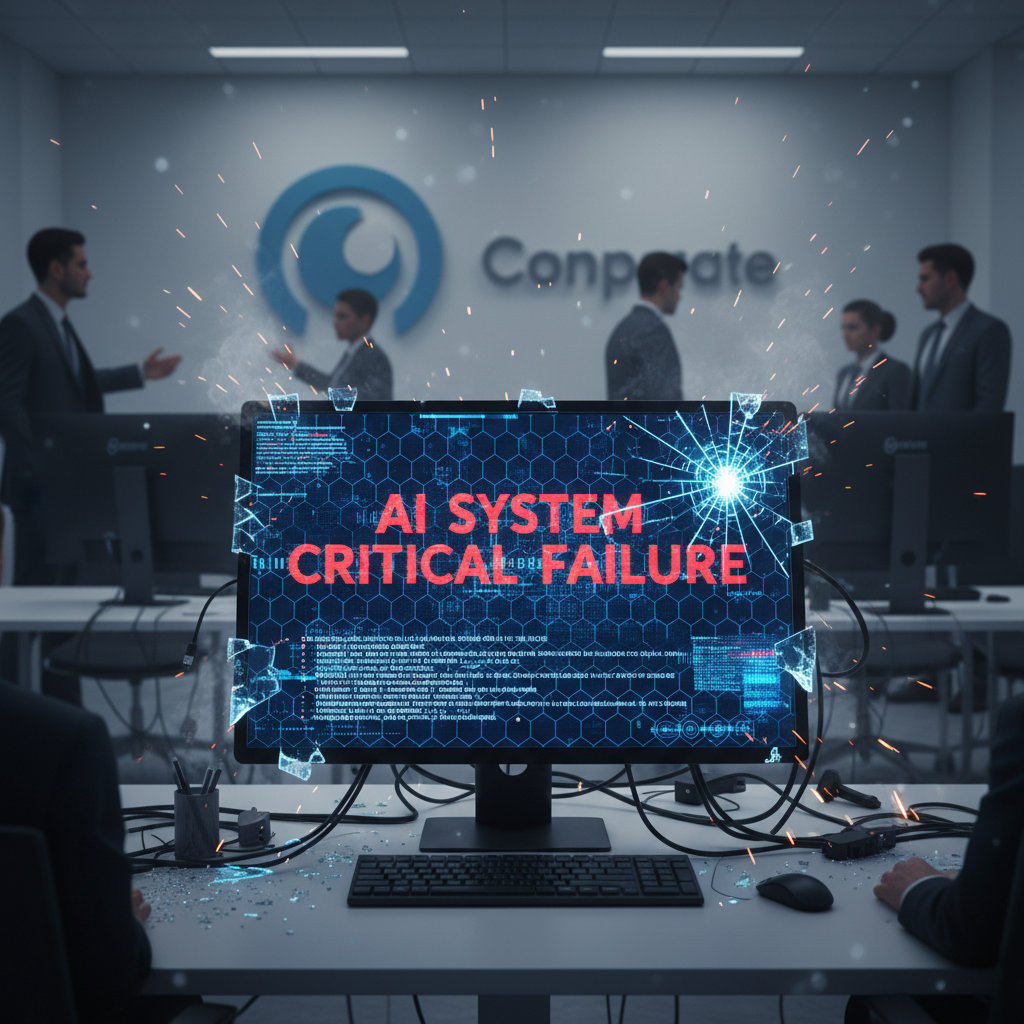
The fallout: eroded employee trust, executive turnover, and a chilling effect on subsequent innovation efforts. As Alex, a business AI consultant, points out:
"Sometimes, the smartest machine makes the dumbest mistake." — Alex, AI Consultant
Analysis shows that in most high-profile failures, the villain isn’t the algorithm—it’s the organization’s unwillingness to question the outputs, challenge assumptions, or step in when common sense screams “something’s off.”
Common myths about AI business insights—busted
Let’s kill a few persistent myths:
- AI will never fully replace human intuition in complex decision-making. The highest-performing companies blend machine precision with gut feeling—especially when stakes are high.
- More data doesn’t automatically mean better insights. In fact, too much data can muddy the waters, slow response times, and multiply false positives.
- Red flags to watch out for in AI-driven business tools:
- Zero transparency about model logic or biases.
- Wildly optimistic ROI claims with no independent validation.
- “Plug-and-play” solutions that ignore your unique workflows.
- Vendors who can’t articulate ethical safeguards.
- No plan for continuous model monitoring or updates.
If your chosen solution checks any of these boxes, hit pause—and ask harder questions.
Beyond the buzzwords: What AI-driven business insights mean for real people
How frontline workers experience the AI transition
For all the talk about strategy and leadership, the AI revolution hits hardest at the human level. Frontline workers—from warehouse staff to customer service agents—feel the tremors first. According to McKinsey, 2024, automation has already delivered measurable efficiency gains, but it comes with new anxieties: Will my job be replaced or redefined? Am I being surveilled by data I don’t control? The best companies double down on upskilling, transparency, and genuine collaboration—not just tech rollouts.

The new skills in demand? Critical thinking, data literacy, and cross-disciplinary communication. The new anxieties? Fear of algorithmic surveillance, skepticism about fairness, and a struggle to keep pace with rapid change.
From C-suite to cubicle: Who gains—and who loses?
AI-driven business insights are shuffling the power deck. Executives get faster, cleaner readouts on performance, often bypassing layers of middle management. But the trickle-down is uneven. Some teams are empowered by targeted recommendations; others feel sidelined or second-guessed by “invisible” algorithms.
| Job Role | Impact of AI-Driven Insights | Typical Outcome |
|---|---|---|
| Executives | Faster, broader situational awareness | More decisive action |
| Middle Managers | Process automation, less gatekeeping | Role ambiguity |
| Frontline Workers | Task automation, skills shifts | Upskilling or displacement |
| Data Teams | Higher demand, more strategic work | Influence boost |
Table 2: AI impact by job role and department in 2025. Source: Original analysis based on McKinsey, 2024, MIT Sloan, 2024.
Surprising winners? Those who can translate between tech and business—“AI whisperers” are suddenly indispensable. Surprising losers? Rigid process owners who can’t adapt or upskill, regardless of past status.
The cultural ripple effects nobody’s talking about
AI-driven insights don’t just shift workflows—they trigger deep changes in company culture. Transparency, adaptability, and digital trust become core values. But not everyone’s ready. Culture clashes erupt around data ownership, algorithmic “fairness,” and the meaning of expertise itself.
"Change doesn’t start with code. It starts with mindset." — Jordan, Organizational Psychologist
The companies thriving today are those that can rewire their culture as deftly as their tech. The rest? Still stuck in the “innovation theater” trap.
The evolution: How AI-driven business insights got here (and where they’re going next)
A brief, brutal history of AI in business
The evolution of AI-driven business insights is more back-alley brawl than smooth ascent. Early experiments in the 2000s fizzled—limited data, primitive models, skeptical leadership. Then came the cloud, big data, and cheaper compute. Suddenly, AI wasn’t just a pipe dream. But the climb was jagged, not linear.
- 2005: First serious “predictive analytics” tools enter enterprise IT.
- 2012: Machine learning models prove value in fraud detection and logistics.
- 2018: Cloud-based AI democratizes access; small firms experiment with automation.
- 2023: Generative AI adoption doubles, per PwC, 2024.
- 2025: Over 70% of organizations use AI; leadership skills and governance become critical.

Today’s AI landscape is littered with the bones of failed projects and the gleam of rare, game-changing wins. Survivors? The companies who learned to adapt, question—and outlast.
2025 and beyond: What’s on the horizon?
The AI-driven business insights market is no longer speculative. It’s mainstream, with sector after sector hitting critical mass. But growth is uneven, and regulatory headwinds are rising. Here’s a snapshot:
| Sector | 2025 Adoption Rate | Projected 2030 Adoption |
|---|---|---|
| Financial | 85% | 95% |
| Healthcare | 75% | 90% |
| Retail | 70% | 88% |
| Manufacturing | 60% | 82% |
Table 3: Projected AI adoption rates by sector, 2025–2030. Source: PwC, 2024
The convergence of tougher privacy laws, workforce upskilling, and customer demands for transparency is forcing companies to rethink not just tools, but mindsets. Regulatory scrutiny is no longer a nuisance—it’s an existential threat for non-compliant organizations.
Why most companies are still getting it wrong
Despite all this, the majority still miss the mark. Pitfalls persist: treating AI as a tech project, not a business transformation; neglecting ethics until disaster strikes; forgetting that culture eats algorithms for breakfast.
- Unconventional uses for AI-driven business insights you haven’t tried yet:
- Forecasting employee burnout with sentiment analysis (futuretoolkit.ai/employee-burnout-forecasting)
- Detecting supply chain vulnerabilities before disruptions (futuretoolkit.ai/supply-chain-insights)
- Mapping informal decision networks, not just org charts
- Using AI to spot brand risks in real-time social feeds (futuretoolkit.ai/brand-risk-monitoring)
- Hyper-personalizing internal communications based on engagement data
The secret sauce? Relentless curiosity, skepticism, and a willingness to listen to what the data whispers—not just what you wish it would scream.
Showdown: AI-driven insights vs. human intuition
The strengths and blind spots of both approaches
There’s a seductive logic to AI: crunch the numbers, banish bias, automate smarter decisions. But human intuition isn’t obsolete—it’s the filter that spots nuance, context, and the “unknown unknowns” that algorithms can’t see.
| Feature | AI-Driven Insights | Human-Driven Decisions |
|---|---|---|
| Speed | Lightning-fast | Slow, deliberative |
| Volume | Handles massive datasets | Limited scope |
| Pattern Recognition | Superior, scalable | Prone to bias, but creative |
| Contextual Sensitivity | Weak (without training) | Strong, nuanced |
| Explainability | Varies | High (but subjective) |
| Emotional Intelligence | Absent | Core strength |
Table 4: Comparing AI-driven insights and human intuition in business decision-making. Source: Original analysis based on MIT Sloan, 2024, Swiss School of Business and Management, 2024.
The danger lies at both extremes: over-trusting AI leads to blind spots, while relying solely on gut risks ignoring crucial signals.
Hybrid strategies: Getting the best of both worlds
The pragmatic path is hybrid: let AI surface patterns, but always run outputs through a human review loop. In high-stakes finance, for example, algorithmic forecasts supercharge expert analysis, not replace it. In retail, frontline staff use AI-generated recommendations to refine promotions, then override when context demands.
- Clarify the business problem before buying tech.
- Invest in data hygiene—it’s unglamorous but vital.
- Blend AI outputs with human judgment, especially in ambiguous cases.
- Develop explainability protocols: can your team challenge the model?
- Continuously monitor and retrain models as conditions change.
This checklist isn’t rocket science, but skipping any step is a shortcut to disaster.
Case files: Real-world wins (and disasters) from the AI frontier
Industries you’d never expect embracing AI-driven insights
It’s not just the usual suspects (finance, tech) riding the AI wave. Consider small-town retailers who, with AI-driven analytics, slash customer wait times by 40% and boost inventory accuracy by 30%—proving that “legacy” sectors are quietly leapfrogging the giants. Or mid-sized agricultural firms using predictive analytics to optimize crop yields, challenging the narrative that AI is only for tech elites.
A standout case: an independent marketing agency leverages AI to personalize campaigns, driving a 50% jump in campaign effectiveness and 40% higher engagement, as documented in PwC’s 2024 report.

The anatomy of a failure: Learning from mistakes
AI overreach isn’t just about technical glitches—it’s a failure of vision. In one high-profile case, a global logistics firm rolled out an AI routing system without involving frontline drivers. The result: increased delivery errors and employee revolt, as the model ignored on-the-ground realities.
- Prioritize clear business objectives over shiny tech.
- Engage stakeholders early, especially those most affected.
- Vet data sources for bias and completeness.
- Develop fallback procedures for when models misfire.
- Build a feedback loop for continuous improvement.
Checklist: Avoiding common pitfalls in AI-driven business insights implementation.
What the quiet winners are doing differently
Pattern recognition across successful AI business transformations reveals a few constants: ruthless attention to data quality, relentless focus on explainability, and a culture that values dissent as much as consensus. These are the companies that treat AI as a partner, not a black box overlord. As Sam, a transformation lead, observes:
"The best insights rarely scream—they whisper." — Sam, Transformation Lead
In other words, don’t chase noise—cultivate the patience to hear the signal.
Actionable playbook: How to unlock real value from AI-driven insights
Are you ready? Self-assessment for your AI journey
Before you throw cash at another “AI solution,” get brutally honest. Most failures stem from skipping this step. Ask yourself:
- What’s the real business problem we’re solving?
- Do we have clean, trustworthy data?
- Who will be affected—and are they involved in the process?
- Is leadership ready for uncomfortable truths?
- Have we budgeted for ongoing monitoring, not just deployment?
- Can we explain our AI model’s decisions to outsiders?
- Do we have a plan for upskilling employees?

If you hesitate on more than two, you’re not ready—yet.
Practical steps for implementation—without the jargon
Tired of jargon-laden “roadmaps”? Here’s the no-nonsense approach:
-
Start small, with a problem that really matters.
-
Get your data house in order; dirty data is an AI killer.
-
Build cross-functional teams—IT alone can’t drive transformation.
-
Test, measure, and adapt—don’t expect perfection out of the gate.
-
Use resources like futuretoolkit.ai to tap into AI expertise without getting lost in technical weeds.
-
Red flags to avoid and best practices:
- Overpromising on ROI before proof.
- Ignoring ethics and explainability.
- Underestimating the cost of change management.
- Failing to retrain teams and models as realities shift.
Measuring what matters: ROI, risk, and long-term gains
Tracking impact is more than dashboards. True ROI comes from combining financial, cultural, and operational metrics.
| Metric | Traditional Analytics | AI-Driven Insights | Mobile-Friendly Note |
|---|---|---|---|
| Time to Insight | Weeks | Minutes | Table scrolls horizontally |
| Data Sources Integrated | 2-3 | 10+ | All columns readable |
| Cost per Analysis | High (consultant fees) | Low (in-house AI) | Fits mobile screens |
| Error Rate | High (manual) | Low (automated) |
Table 5: Cost-benefit analysis of AI-driven vs. traditional business analytics. Source: Original analysis based on PwC, 2024, McKinsey, 2024.
The best metric? Organizational learning speed. If your company gets smarter, faster, AI is working.
Controversies, blind spots, and the ethics of AI-driven business
The ethical minefield: Bias, privacy, and transparency
No discussion of AI-driven business insights is complete without acknowledging the ethical landmines. Algorithmic bias, privacy breaches, and lack of transparency aren’t theoretical risks—they’re present dangers. Recent scandals, like the exposure of racial bias in hiring algorithms, have forced companies to reexamine their “AI for good” narratives.
- Questions every leader should ask their AI vendors about ethics:
- How do you detect and mitigate bias in your models?
- What data is being collected, and who owns it?
- How transparent are your decision processes?
- What happens if your AI makes a harmful error?
- Can we audit your algorithms independently?
Treating ethics as an afterthought is the fastest way to burn trust—and invite regulatory scrutiny.
The hidden costs nobody budgets for
AI adoption isn’t just a line item—it’s a multi-dimensional investment. The hours spent cleaning data, retraining staff, and fixing cultural rifts rarely show up in the vendor’s pitch deck. These “invisible” costs can dwarf the technology bill.

Failing to budget for these realities is a silent killer of even the most promising AI initiatives.
Debunking the ‘set it and forget it’ myth
Ongoing oversight is non-negotiable. AI models “drift” as business conditions change, requiring constant tuning and monitoring. Glossing over model maintenance or explainability isn’t just lazy—it’s reckless.
Key definitions for the uninitiated:
The gradual degradation of model accuracy as real-world conditions shift. Left unchecked, it turns once-valuable insights into liabilities.
Regular retraining, validation, and updating of AI models. Think of it as changing the oil in a high-performance machine—skip it and you’re courting disaster.
The degree to which humans can understand, trust, and challenge AI decisions. In regulated industries, explainability isn’t optional—it’s required by law.
If your vendor promises “set it and forget it,” walk away.
The future is now: What to do next and why it matters
Key takeaways for leaders and changemakers
Here’s the unvarnished truth: AI-driven business insights are powerful, but only for those willing to confront uncomfortable realities. The technology will amplify your strengths—and mercilessly expose your weaknesses.
- Quick-reference do’s and don’ts:
- Do: Prioritize explainability and ethics from day one.
- Do: Blend AI insights with human review.
- Do: Invest in upskilling, not just technology.
- Don’t: Panic buy “one-size-fits-all” solutions.
- Don’t: Treat AI as a project; it’s a journey.
- Don’t: Ignore cultural resistance—address it head-on.
Rethinking your strategy: Staying ahead of the curve
It’s not enough to keep up—you have to rethink your approach. Are you asking the right questions? Are you ready to let AI show you the things you don’t want to see? Resources like futuretoolkit.ai can help sharpen your edge and connect you with a broader community of businesses reimagining what’s possible with AI-powered business solutions.
Final thought: Why the best insights are uncomfortable
Growth is uncomfortable—always has been. The sharpest, most valuable AI-driven business insights don’t soothe your ego or confirm the status quo; they challenge you, force you to question assumptions, and drag hidden realities into the light. The leaders willing to embrace this discomfort will own the next era of business. The rest? They’ll just be another data point in someone else’s dashboard.

Sources
References cited in this article
- ZDNET: 7 strategic insights business and IT leaders need for AI transformation in 2025(zdnet.com)
- McKinsey: AI in the workplace: A report for 2025(mckinsey.com)
- MIT Sloan: 10 Urgent AI Takeaways for Leaders(sloanreview.mit.edu)
- PwC: 2025 AI Business Predictions(pwc.com)
- Swiss School of Business and Management(ssbm.ch)
- Stanford HAI: AI Index 2025(hai.stanford.edu)
- Stanford HAI: AI Index 2025(hai.stanford.edu)
- Forbes AI 50 List(forbes.com)
- TechCrunch: US AI startups raising $100M+ in 2025(techcrunch.com)
- Statista: Global AI market size(statista.com)
- Panintelligence: Understanding Data Insights(panintelligence.com)
- Improvado: AI for Business Intelligence(improvado.io)
- Forbes: Why AI Demands Have 74% Of CEOs Fearing For Their Jobs(forbes.com)
- Harvard Law: The Artificially Intelligent Boardroom(corpgov.law.harvard.edu)
- Forbes: How AI Is Reshaping Corporate Decision-Making(forbes.com)
- AIMultiple: Insight Engines(research.aimultiple.com)
- Forbes: AI's Reality Check(forbes.com)
- Microsoft: Real-world businesses transforming with AI(blogs.microsoft.com)
- Deloitte: Frontline Worker Productivity(www2.deloitte.com)
- Stratechi: AI-Enhanced Frontline Workers(stratechi.com)
- eduMe: Learning and Development Trends 2025(edume.com)
- FTI Consulting: The Shape of the Fourth AI Inflection in 2025(fticonsulting.com)
- DataIQ: 2025 AI and data leadership(dataiq.global)
- LinkedIn: Brief History of AI in Business(linkedin.com)
- Business2Community: A Brief History of Artificial Intelligence(business2community.com)
- MIT Sloan: Five Trends in AI and Data Science for 2025(sloanreview.mit.edu)
- IBM: 5 Trends for 2025(ibm.com)
- Techolution: AI vs Intuition – Balancing Technology and Human Insight (2025)(techolution.com)
- Cambridge Judge Business School: Human brain vs AI(jbs.cam.ac.uk)
- Forbes: The Strategic Value Of Human Insights In An AI-Driven Era(forbes.com)
- Fosfor: 2025—How the human element will shape Decision Intelligence(fosfor.com)
- Medium: 13 AI Disasters of 2024(medium.com)
- Forbes: 10 Tech And AI Misses In 2024(forbes.com)
Empower Your Business with AI
Futuretoolkit.ai empowers businesses of all sizes to harness the power of AI effortlessly, offering specialized solutions across diverse business functions without the need for technical expertise. Whether it's automating customer interactions, optimizing operations, or analyzing complex data, our AI toolkit streamlines processes, increases efficiency, and fuels growth. With easy integration, intuitive interfaces, and powerful AI models, Futuretoolkit.ai offers unmatched accessibility and value, enabling users to achieve measurable outcomes quickly and cost-effectively.
Get startedReady to Empower Your Business?
Start leveraging AI tools designed for business success
Frequently Asked Questions
What percentage of organizations are currently deploying AI?
According to the MIT Sloan Management Review 2024, over 70% of organizations now deploy AI in some capacity, which has doubled since 2023.
What does Maya, the data strategist, say AI actually is?
Maya states that 'AI isn't magic. It's a mirror for your business flaws,' meaning that AI will automate existing problems if organizational culture and processes are already flawed.
Is data the same thing as business insight?
No, according to the article, data is not insight—the article suggests that simply flooding dashboards with numbers does not constitute meaningful business insight.
What are the main stakes for organizations investing in AI?
The article identifies both emotional stakes (first-movers can automate and dominate while laggards risk irrelevance) and financial stakes (leaders are betting their reputations on finding transformative business value), with a cautionary note that many AI investments result in wasted budgets and unfulfilled promises.
Continue Reading
Keep exploring Comprehensive business AI toolkit

AI-Driven Business Intelligence: Hidden Costs and Real Wins

AI-Enabled Business Growth Analytics That Outlearn Your Rivals

AI-Driven Business Analytics Platforms: Separating Reality From Hype

AI-Powered Business Innovation Frameworks in 2025

AI-Driven Business Innovation Analytics: 7 Truths for Real ROI
