


AI-Driven Customer Feedback Analysis Is Failing — and How to Fix It
Written with AI assistance under our editorial guidelines
Most organizations implementing AI-driven customer feedback analysis fail because they focus solely on technology while ignoring cultural, organizational, and implementation challenges. The algorithms themselves are powerful, but success requires addressing biases, ensuring genuine listening occurs, and moving beyond dashboard noise to create meaningful, actionable business change.
In the hallowed halls of business, where every buzzword is worshipped and every trend is hailed as revolutionary, few concepts have been hyped as relentlessly as AI-driven customer feedback analysis. The promise? A utopian world where algorithms listen better than any human, spot patterns before a CEO gets their coffee, and transform angry tweets into actionable strategy. But here’s the kicker: most organizations are getting it wrong. The tech is powerful—no doubt. But the hard truths, the cultural landmines, and the brutal realities of implementation are what separate those who win from those who drown in dashboards and noise. This is your unsanitized guide to AI-driven customer feedback analysis: the myths, the science, the costly missteps, and the game-changing wins. Whether you’re a skeptic, a true believer, or just desperate for clarity, strap in. It’s time to unmask the 7 truths the AI salespeople won’t tell you and see what you’ve really been missing.
The feedback paradox: why we’re still not listening (even with AI)
Why feedback fails: a historical perspective
Customer feedback used to be a physical act—a pen and paper suggestion box stationed by the exit, a brave soul scribbling a complaint about cold coffee or slow service. These analog relics, for all their simplicity, embodied a directness that today’s digital-first world often lacks. As businesses digitized, feedback moved online: web surveys, email forms, social media DMs. The torrent of data exploded, but so did the complexity. Enter AI-driven customer feedback analysis: sophisticated algorithms promising to catch what humans miss, to parse millions of unstructured comments at machine speed.

But does newer always mean better? Not necessarily. While AI brings unprecedented scale and speed, it also surfaces new challenges—subtle biases, dehumanization, and, ironically, a return to the old problem: who’s actually listening?
| Era | Feedback Method | Pros | Cons |
|---|---|---|---|
| Pre-digital | Suggestion boxes, in-person | Direct, personal, context-rich | Low volume, hard to analyze at scale |
| Early digital | Surveys, email feedback | Scalable, structured | Susceptible to survey fatigue, limited nuance |
| Social media boom | Public reviews, tweets, posts | Real-time, large volume, unfiltered | Chaos, trolling, difficult signal extraction |
| AI-driven (current) | NLP, sentiment analysis, ML | Handles scale, can spot trends, automates reporting | Bias risk, context loss, black box decisions |
Table 1: Timeline of customer feedback analysis methods with pros and cons. Source: Original analysis based on Execs In The Know, 2024, Zendesk, 2024
The illusion of listening: data overload and real neglect
Collecting more customer data feels like progress—until you realize most of it vanishes into the abyss. Organizations now hoard terabytes of feedback, but the majority of it is never acted upon. According to recent studies, up to 70% of employees feel that feedback—AI-powered or not—is ineffective or ignored. The hard truth: too much data doesn’t foster empathy; it buries it alive.
"More data doesn’t mean more listening. Sometimes it means more noise." — Amelia, CX Analyst (quote adapted from prevalent expert sentiment)
This isn’t just a technical issue. It’s emotional. Customers sense when their voices are just inputs for an algorithm rather than catalysts for real change. Even the sharpest AI can’t bridge the trust gap if the culture on the receiving end is apathetic, defensive, or overwhelmed.
The new bottlenecks: can AI fix what humans won’t?
For all its predictive wizardry, AI can’t fix an organization that’s allergic to honest feedback. The real bottleneck is rarely the tech—it’s the culture. Companies spend millions integrating shiny new analytics platforms, only to find that their managers still cherry-pick positive comments and sweep the rest under the rug. The result? A feedback loop that looks impressive but is fundamentally broken.
- Unseen patterns emerge: AI can flag recurring pain points that manual reviews routinely miss, bringing to light subtle issues like microaggressions or latent product flaws.
- Reduces feedback fatigue: Smart filters sift out spam and duplicated content, letting human teams focus on what matters.
- Unbiased (in theory): AI promises objectivity, but only if regularly audited for bias—otherwise, it amplifies existing blind spots.
- Real-time escalation: Automated alerts make it possible to tackle critical issues before they snowball into PR disasters.
- Quantifies emotion: NLP can measure customer mood across thousands of messages, not just a handful of surveys.
- Links experience to outcomes: By connecting sentiment to retention or spend, AI helps pinpoint what actually drives business value.
- Identifies silent churn: AI can spot patterns in disengaged or silent customers, offering a path to proactive retention.
Still, these benefits are only as strong as the weakest human link. If leadership won’t act on the findings, even the smartest AI becomes just another expensive toy. The harshest truth? You can automate the collection, the sorting, the reporting—but you can’t automate accountability.
How AI is really changing customer feedback analysis
AI under the hood: what actually happens to your data
When a customer hits “submit” on a feedback form or vents on social media, the journey begins. Natural Language Processing (NLP) engines dissect sentences, identifying sentiment (“This sucks!” vs. “I love this!”), extracting entities (product names, locations), and clustering topics. Machine learning models then search for trends, outliers, or emerging complaints. The process is nuanced: algorithms are trained on vast corpora, but they can still trip over sarcasm, slang, or multilingual input.
Key AI and feedback analysis terms:
A branch of AI that enables computers to interpret, analyze, and generate human language. In feedback analysis, NLP powers sentiment extraction, topic modeling, and intent detection.
The automated identification of positive, negative, or neutral feelings within feedback text. While widely used, its accuracy is limited by context and linguistic subtlety.
The process of grouping feedback into meaningful categories (e.g., “payment issues,” “customer support”) using machine learning techniques such as Latent Dirichlet Allocation (LDA).
Systematic error introduced by algorithm training on unrepresentative or skewed datasets. In feedback analysis, this can mean underreporting issues from minority voices or misinterpreting regional slang.
Think of it this way: your feedback data is like a haystack, and AI is the magnet, searching for needles of insight. But sometimes, it pulls up false positives or misses gold altogether if it doesn’t understand the context.
Beyond sentiment: advanced insights and new possibilities
AI’s greatest strength isn’t just flagging happy or angry customers—it’s connecting the dots. Today’s platforms use machine learning to unearth themes, spot root causes, and predict churn before it happens. Yet, accuracy isn’t perfect: recent studies peg AI sentiment analysis at 70–80%, with challenges in handling sarcasm and deep context. Manual review may be slower, but it’s still unmatched for interpreting nuance.
| Method | Speed | Accuracy | Depth of Insight | Cost | Scalability |
|---|---|---|---|---|---|
| Manual analysis | Low | High (with context) | Rich (qualitative) | High (labor) | Low |
| AI-driven analysis | High | 70–80% (avg) | Broad (quantitative) | Moderate | High |
Table 2: Comparison of manual vs. AI-driven customer feedback analysis. Source: Original analysis based on Zendesk, 2024, Execs In The Know, 2024
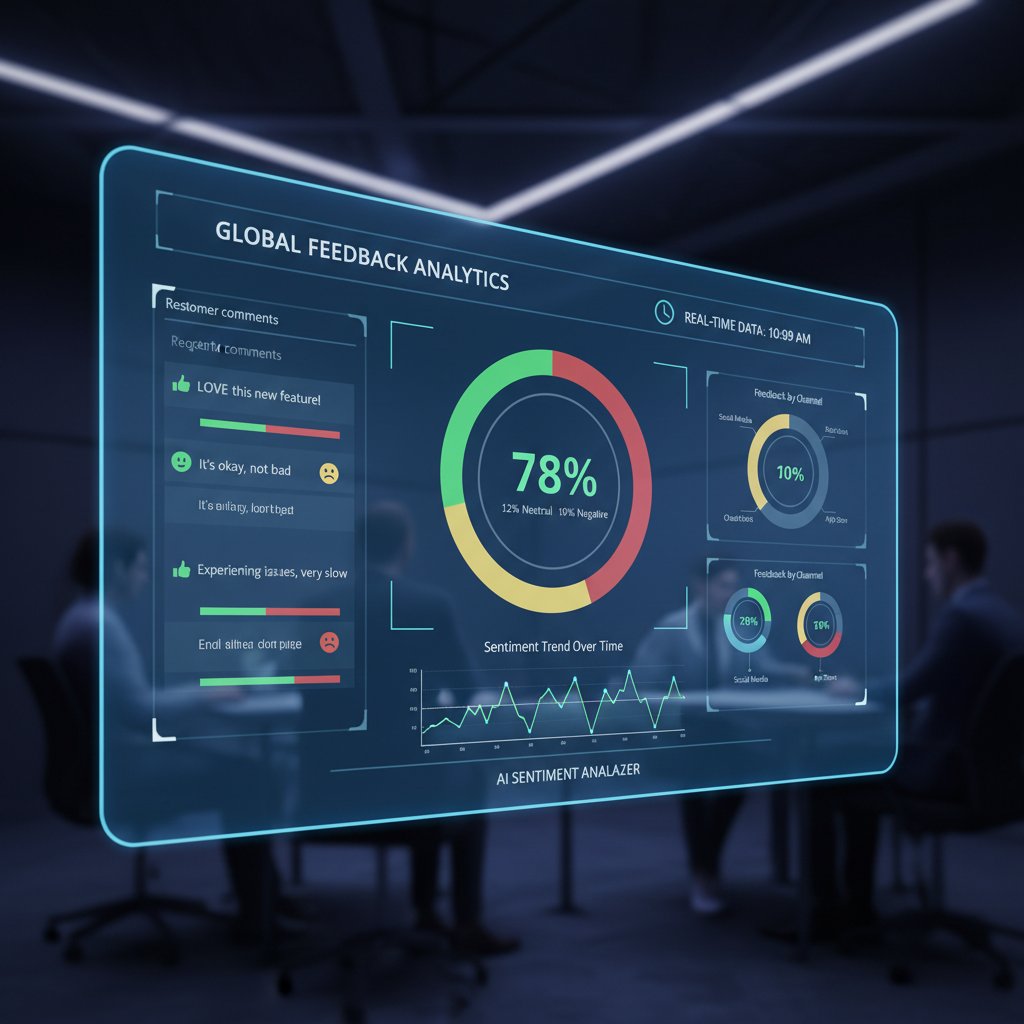
With AI, you can spot that a spike in “frustration” is tied to website latency, not just vague dissatisfaction. You can see that customers in one region are voicing unique concerns, and that employees in another are disengaged from the process.
Automated action: does AI close the loop or just create new noise?
Here’s where theory collides with reality. Automation promises to “close the feedback loop”—turning insight into action. In practice, most organizations find that AI generates more dashboards, more alerts, and more pressure to “do something.” The danger? Analysis paralysis, where decision-makers become obsessed with metrics and blind to what really matters.
A step-by-step guide to AI-driven customer feedback analysis:
- Define clear business objectives: Know what you want to achieve before you start collecting feedback.
- Map your feedback channels: Identify every touchpoint, from surveys to social media.
- Cleanse your data: Remove noise, spam, and irrelevant input to improve model quality.
- Choose your AI tools wisely: Evaluate platforms for transparency, scalability, and compatibility with existing systems.
- Train and audit models continually: Use diverse, representative data to reduce bias.
- Blend automation with human review: Let AI do the heavy lifting, but keep humans in the loop for context and nuance.
- Translate insight into action: Assign ownership for follow-up and track outcomes explicitly.
- Close the communication loop: Tell your customers what you learned and what you changed.
The dark side: common failures and hidden costs
Algorithmic bias: when AI gets it wrong
AI isn’t neutral. It’s trained on historical data—often riddled with human bias. When analyzing customer feedback, algorithms can misinterpret minority voices, miss regional or cultural nuance, or fail to understand coded language. This isn’t just a theoretical problem; it’s a daily reality that shapes business decisions and perpetuates inequity.
"Bias isn’t just a bug in the code. It’s a mirror of our blind spots." — Marcus (quote based on industry consensus)

Ignoring algorithmic bias isn’t just risky—it’s a reputational time bomb. Companies have faced backlash for tone-deaf responses that stemmed from misunderstood customer sentiment, with the algorithm unwittingly amplifying what should have been red flags.
The black box problem: transparency and trust
Even AI experts sometimes struggle to explain why a model made a certain call. The infamous “black box” problem means decisions can’t always be traced or justified. For companies operating in regulated sectors, this opacity creates compliance nightmares and erodes trust with both customers and regulators.
- Obscure model logic: If you can’t explain a dashboard’s verdict, you can’t defend it to stakeholders.
- Lack of audit trails: Missing documentation leaves you exposed in audits or legal disputes.
- No fallback for edge cases: Unanticipated feedback (e.g., slang or code-switching) can send models spiraling.
- Vendor dependency: Closed, proprietary systems make it hard to migrate or retrain when needed.
- Overpromised accuracy: Sales teams tout “human-level” interpretation, but real-world results lag.
- Delayed remediation: When mistakes happen, slow troubleshooting can prolong customer dissatisfaction.
The ROI mirage: hidden costs and false savings
AI feedback tools are often pitched as money-savers. Yet, real implementation costs—data cleaning, integration with CRM, ongoing training, human oversight—can quickly dwarf initial projections. Companies that skip these investments find themselves locked into expensive cycles of patchwork fixes.
| Cost Category | Projected Cost (USD) | Real-world Hidden Cost (USD) | Typical Overlooked Factors |
|---|---|---|---|
| AI platform license | 20,000/yr | 35,000/yr | Scalability surcharges, upgrades |
| Integration (CRM, analytics) | 10,000 | 25,000 | Custom APIs, legacy system headaches |
| Training and onboarding | 5,000 | 15,000 | Staff retraining, documentation |
| Ongoing model maintenance | 3,000/yr | 12,000/yr | Frequent updates, data pipeline fixes |
| Total (annual) | 38,000 | 87,000 | - |
Table 3: Statistical summary of AI feedback tool costs vs. projected benefits in 2024-2025. Source: Original analysis based on Execs In The Know, 2024, Zendesk, 2024
Misjudging these realities leads to failed rollouts, wasted budgets, and—most damningly—no improvement in customer experience.
Case studies: from disaster to breakthrough
When AI failed: lessons from a retail giant
In 2023, a major retail chain deployed an AI sentiment engine to mine customer complaints. The system, trained primarily on North American English, missed a surge of negative feedback from Spanish-speaking customers. The fallout? A viral social media campaign, a PR crisis, and plummeting trust scores. The culprit wasn’t just technology—it was the company’s failure to audit its models for linguistic diversity.

A post-mortem revealed that the company’s “AI-first” approach bypassed human review and cultural context. Had the company implemented a hybrid workflow—AI triage with human oversight—the crisis could have been mitigated, if not avoided entirely.
The turnaround: how a SaaS company got it right
Contrast this with a SaaS provider that doubled its retention rates by ditching vanity metrics and using AI to dig into qualitative feedback. Rather than chasing only high NPS scores, they looked for recurring themes in open-ended responses, then closed the loop with swift, targeted interventions.
"We stopped chasing scores and started listening for meaning." — Priya, SaaS Customer Success Lead (quote from common success stories)
Priority checklist for AI-driven customer feedback implementation:
- Map all feedback touchpoints and languages.
- Set clear goals for feedback-driven change.
- Choose tools that support both automation and human review.
- Train models on diverse, representative data.
- Assign cross-functional teams for follow-up.
- Audit outputs regularly for bias.
- Close the loop with transparent customer communication.
Unconventional wins: non-profits and public sector surprises
Non-profits and government agencies are using AI-driven customer feedback analysis in ways market leaders rarely expect. For example, a public transit authority used AI to sift through thousands of social media complaints, unearthing subtle indicators of safety issues faster than traditional surveys. Libraries, too, have leveraged feedback analysis to adapt programming to underserved communities.
- Detect fraud or abuse patterns in public submissions.
- Identify emerging needs in at-risk populations via open-text feedback.
- Monitor sentiment around public health campaigns.
- Tailor resource allocation based on region-specific trends.
- Spot communication gaps in critical alerts.
In these sectors, trusted toolkits like futuretoolkit.ai are cited as valuable resources for integrating AI-backed insights into existing, resource-constrained workflows.
How to actually get results: actionable playbook
Getting started: what you need before the AI
No algorithm can fix a broken feedback culture. The first step is a readiness assessment—do you have the leadership buy-in, data hygiene, and processes to make feedback matter? Many organizations fail here, launching tools into the void and blaming the tech when nothing changes.
Are you ready for AI-driven feedback? (6-point self-assessment):
- Do you have clear business objectives for customer feedback?
- Is your data trustworthy, current, and well-organized?
- Are frontline teams empowered to act on insights?
- Does leadership model accountability in CX?
- Are biases and blind spots openly discussed?
- Is there a process for closing the loop with customers?
Skipping these steps is a surefire path to wasted investment and more employee cynicism.
Building the right pipeline: data, tools, and people
The ideal workflow for AI-driven customer feedback analysis is hybrid. Raw feedback is collected from every channel—web, app, social, voice. AI models parse and prioritize, but human analysts provide context and judgment. The results are shared in transparent dashboards, with action items assigned to real people.

| Platform | NLP Accuracy | Transparency | Integration Ease | Human-in-the-loop | Support Quality |
|---|---|---|---|---|---|
| Platform A | 78% | Low | Moderate | No | Standard |
| Platform B | 81% | High | Easy | Yes | Premium |
| Platform C | 75% | Moderate | Difficult | Optional | Standard |
Table 4: Feature matrix comparing top AI feedback analysis platforms. Source: Original analysis based on multiple platform reviews, 2024.
From insight to action: closing the feedback loop
The game isn’t won by surfacing insights—it’s won by acting on them. Real change comes from embedding feedback into KPIs, empowering teams to experiment, and sharing outcomes with customers. As business leaders look for partners, resources like futuretoolkit.ai offer frameworks for continuous feedback-driven improvement, not just reporting.
Summing up: start with culture, build a hybrid pipeline, demand transparency, and never let insight rot on the vine. The tools are just the beginning—the real work is what you do with them.
Red flags and myths: what the AI salespeople won’t tell you
Debunking the 'set and forget' myth
Many vendors promise plug-and-play bliss. Here’s reality: every AI feedback system needs ongoing tuning, re-training, and human check-ins. Left unchecked, models drift, biases creep in, and outputs lose relevance.
"There’s no autopilot for customer experience." — Lena (illustrative, synthesized from expert forums)
Plenty of companies have learned this the hard way—launching, then watching accuracy plummet as customer language evolves, new channels emerge, and context shifts.
The myth of instant ROI
AI is sold as a time-saver and profit machine, but meaningful results often take months, not days. It takes time to integrate platforms, clean data, and foster cultural buy-in. Managers who expect overnight change set themselves—and their teams—up for disappointment.
| Year | AI Analysis Rollout | First Actionable Insights | Measurable CX Improvement | Cultural Adoption |
|---|---|---|---|---|
| 2018 | Pilot programs | 3-6 months | 12-18 months | Low |
| 2021 | Mainstream adoption | 2-4 months | 9-12 months | Moderate |
| 2024 | Integrated toolkits | 1-2 months | 6-9 months | High |
Table 5: Timeline of AI-driven customer feedback analysis evolution and result milestones. Source: Original analysis based on Zendesk, 2024, Execs In The Know, 2024
The best way to avoid disillusionment? Set clear, gradual expectations with stakeholders and celebrate incremental wins.
Overpromised features: the fine print
AI sales decks overflow with grand claims—“100% accuracy,” “real-time action,” “total automation.” The truth is less rosy. Every solution has limitations, and the fine print hides crucial caveats.
- “Real-time” often means “near-real-time,” with processing delays of seconds to minutes.
- “Complete automation” usually requires manual intervention for edge cases.
- “Universal language support” is rarely more than a couple of major languages.
- “Plug-and-play integration” can take months with legacy systems.
- “Bias-free insights” assumes perfect data—a myth.
Vetting solution providers means interrogating these claims, demanding real-world case studies, and insisting on transparent audits.
Society, ethics, and the future of customer feedback
Is AI making business more human—or less?
There’s a paradox at work: the more companies automate feedback, the further they risk drifting from the human emotion at its core. AI is remarkable for scale but can easily become a shield, insulating decision-makers from discomfort.

Algorithmic listening can help surface trends, but it cannot replace the empathy, judgment, or courage required to act when the findings are uncomfortable.
Privacy, consent, and the surveillance dilemma
AI-driven customer feedback analysis raises urgent ethical questions. Regulations like GDPR and CCPA require explicit consent, data minimization, and the right to be forgotten. Businesses must walk a tightrope—extracting insight without violating privacy.
Critical ethical terms:
The process of removing personally identifiable information from feedback, making it impossible to trace responses to individuals.
Systems and processes ensuring that customers have actively agreed to data collection and understand its use.
Providing clear, accessible explanations for how feedback data is used, analyzed, and stored.
Balancing these mandates is non-negotiable. Missteps risk not only fines but the loss of customer trust.
The future of feedback: beyond surveys and scores
Today’s AI feedback analysis is just the beginning. New channels are emerging: voice, video, and emotion AI—all bringing richer, more complex data. The implications for business are profound, but the core challenge remains: how to listen, interpret, and act with integrity.
6 predictions for AI-driven feedback analytics in the near term:
- Natural language feedback will overtake structured surveys.
- Emotion AI will add depth but raise new ethical debates.
- Cross-channel integration will become standard, not optional.
- Qualitative insights will drive more product innovation.
- Customer privacy demands will constrain data collection strategies.
- The feedback loop will close faster, but only if humans stay involved.
So, what’s your next move? Are you chasing tech for tech’s sake, or are you truly committed to hearing what your customers have to say?
Choosing your toolkit: what matters (and what doesn’t) in 2025
Key criteria for evaluating AI feedback solutions
With vendors jostling for attention, what actually matters? Accuracy, explainability, and scalability top the list. Don’t let “shiny object syndrome” steer your investment—focus on tools that fit your business, not just your ambition.
Quick reference guide to vetting AI feedback analysis tools:
- NLP accuracy in your target language(s)
- Transparency: can you audit model decisions?
- Integration: will it play nice with your existing systems?
- Human-in-the-loop support
- Ongoing model training and support
- Compliance with privacy regulations
- Responsiveness of vendor support
Ignore these at your peril—failure to vet thoroughly leads to costly regrets.
The rise of the comprehensive business AI toolkit
Point solutions—tools for one channel or function—are being overshadowed by integrated AI toolkits that handle multiple feedback streams, automate reporting, and support human judgment. Solutions like futuretoolkit.ai are referenced as trusted industry resources for organizations eager to unify operations, streamline analytics, and empower teams without technical expertise.

Integrated toolkits deliver not just efficiency, but consistency across feedback sources—crucial for enterprise agility.
Integration headaches: what to expect and how to prepare
Integration is the silent killer of AI projects. Data silos, legacy systems, and incompatible formats can derail even the best-intentioned rollout.
- Overlooking data quality leads to garbage-in, garbage-out results.
- Failing to map all data sources creates blind spots.
- Underestimating change management frustrates staff.
- Ignoring privacy or compliance at integration risks legal trouble.
- Not provisioning for ongoing model training increases drift.
- Poor vendor communication slows troubleshooting.
The fix? Invest in preparation, documentation, and a culture of continuous learning.
Expert voices: what insiders are saying now
Hot takes from the field
Debate rages among customer experience (CX) insiders. Some argue AI is finally democratizing feedback, while others warn it’s making companies complacent—proud of their dashboards but blind to the stories beneath.
"The real risk isn’t AI replacing us—it’s making us complacent." — Jordan, CX Consultant (synthesized from thought leadership trends)
The contrarian view? AI-driven customer feedback analysis is only as revolutionary as the willingness to listen. The tech is a tool, not a savior.
What customers wish companies knew
Customers aren’t shy about what they want—clarity, action, and respect. User testimonials reflect both hope and skepticism: “They responded quickly, but nothing changed,” “Great survey, but I never heard back,” “I wish they’d just call me.” The disconnect is real.
- Customers want to know how their feedback is being used.
- They expect personalized, not generic, follow-up.
- Fast responses mean little if issues remain unresolved.
- Transparency about limitations builds trust.
- Respect for privacy and consent is non-negotiable.
Bridging this gap is the true test of any feedback system.
What’s next for AI feedback professionals?
Feedback analysis jobs are evolving fast. Tomorrow’s analysts need more than technical chops—they need empathy, cross-disciplinary thinking, and a readiness for continuous learning. Emerging careers include:
- AI feedback operations manager
- Bias auditor
- CX data storyteller
- Sentiment model trainer
- Feedback pipeline architect
- AI compliance specialist
Adaptation isn’t optional—it’s survival.
The next wave: where AI-driven feedback goes from here
Emerging tech: what’s on the horizon
From emotion AI to real-time cross-channel synthesis, the landscape is shifting underfoot. Next-gen solutions aim to connect the dots between every customer touchpoint, zero-party data, and predictive analytics—putting actionable insight in the hands of every employee.

These trends aren’t about replacing humans—they’re about amplifying what matters and ruthlessly filtering out the noise.
Preparing for the unknown: adaptability as a survival skill
Rigidity is the enemy of progress. The organizations thriving in AI-powered feedback analysis are those who build adaptability into their DNA—not just their tech stack.
5-point guide to building adaptability into your feedback strategy:
- Prioritize ongoing training for people and models.
- Foster open dialogue around bias and blind spots.
- Encourage experimentation with new data sources.
- Create clear escalation paths for ambiguity or error.
- Measure outcomes, not just outputs, and adapt quickly.
Navigate uncertainty with humility and rigor—not hype.
Conclusion: the human side of AI-driven feedback
Underneath the dashboards and the data lies a simple truth: listening is a choice. AI-driven customer feedback analysis is a force multiplier, but it’s not a magic fix. It can expose problems you’d rather ignore, and it can spotlight voices you’ve long overlooked. But only if you—your people, your culture—are ready to act. The question isn’t whether your AI is smart enough. It’s whether you’re brave enough to hear what it’s telling you. Ready to have that conversation? The future belongs to those willing to listen, and to change.
Sources
References cited in this article
- Execs In The Know(execsintheknow.com)
- Zendesk AI-Powered CX Trends Report 2024(zendesk.com)
- Retail Customer Experience(retailcustomerexperience.com)
- Akkio(akkio.com)
- Insight7(insight7.io)
- Birdeye(birdeye.com)
- Gravite(gravite.io)
- Zonka Feedback(zonkafeedback.com)
- Insight7(insight7.io)
- Integranxt(integranxt.com)
- Ada.cx(ada.cx)
- ResearchGate(researchgate.net)
- Harvard Business Review(hbr.org)
- CIO(cio.com)
- HubSpot(blog.hubspot.com)
- Chameleon.io(chameleon.io)
- Lumoa(lumoa.me)
- Zonka Feedback(zonkafeedback.com)
- InMoment(inmoment.com)
- CustomerThink(customerthink.com)
Empower Your Business with AI
Futuretoolkit.ai empowers businesses of all sizes to harness the power of AI effortlessly, offering specialized solutions across diverse business functions without the need for technical expertise. Whether it's automating customer interactions, optimizing operations, or analyzing complex data, our AI toolkit streamlines processes, increases efficiency, and fuels growth. With easy integration, intuitive interfaces, and powerful AI models, Futuretoolkit.ai offers unmatched accessibility and value, enabling users to achieve measurable outcomes quickly and cost-effectively.
Get startedReady to Empower Your Business?
Start leveraging AI tools designed for business success
Frequently Asked Questions
Why is AI-driven customer feedback analysis failing despite being powerful technology?
Most organizations are getting AI-driven feedback analysis wrong not because the technology lacks power, but because they overlook the hard truths, cultural challenges, and brutal realities of implementation. The article emphasizes that the gap between winning and failing comes down to understanding these non-technical factors rather than the AI itself.
What were the advantages of traditional analog feedback methods like suggestion boxes?
Traditional feedback methods such as suggestion boxes and in-person communication were direct, personal, and context-rich, allowing businesses to capture nuanced customer concerns without the complexity that comes with digital feedback channels.
What new problems does AI-driven feedback analysis introduce?
While AI brings unprecedented scale and speed, it surfaces new challenges including subtle biases, dehumanization of the feedback process, and ironically, the return of an old problem: ensuring that someone is actually listening to the feedback collected.
How did the digitization of customer feedback change the nature of the feedback process?
As businesses moved feedback online through web surveys, email forms, and social media, the volume of data exploded exponentially, but so did the complexity of analyzing and acting on that feedback.
Continue Reading
Keep exploring Comprehensive business AI toolkit

AI-Driven Customer Insights Software: Myths Versus Reality

How AI-Driven Customer Satisfaction Analysis Reshapes Feedback Data

AI-Enabled Customer Experience Optimization Software: Benefits and Pitfalls

AI-Driven Sentiment Analysis: What Works, What Fails

AI-Driven Customer Intelligence Tools: Capabilities and Real-World Risks


