


AI-Driven Employee Performance Analytics: Power, Bias, Control
Written with AI assistance under our editorial guidelines
AI-driven employee performance analytics has moved from experimental to mainstream, using algorithmic tools to replace traditional annual reviews. While promising clearer insights and hidden talent discovery, these systems risk perpetuating bias in digital form and can increase employee workload rather than reduce it. The technology offers real benefits in engagement and decision-making clarity, but success requires addressing manager understanding gaps and inherent algorithmic biases.
Artificial intelligence isn’t just creeping into the workplace—it’s rewriting the rules. Over the past year, AI-driven employee performance analytics has gone from fringe experiment to everyday reality in boardrooms, HR departments, and on factory floors. Forget the sanitized press releases: behind the dashboards and predictive charts is a messier, more human story. Employees report AI adding to workloads, not always reducing them. Managers are left to wrangle new data streams they barely understand. And the promise of “objective” analytics is haunted by old biases wearing new, digital clothes. Yet, through the noise and growing pains, bold wins are emerging: companies are uncovering hidden talent, boosting engagement, and making decisions with a clarity unthinkable just a few years ago. This isn’t about silver bullets or dystopian fears—it’s about the real, raw impact of AI-driven employee performance analytics in 2025. Let’s pull back the curtain on the statistics, scandals, and success stories shaping the future of work.
Why AI-driven employee performance analytics is taking over (and why it matters)
The broken legacy: performance reviews before AI
Before AI, employee performance reviews were a ritual in frustration—dreaded by workers and resented by managers. Annual reviews often descended into vague feedback, arbitrary ratings, and awkward conversations that did little to improve real performance. According to research from the Society for Human Resource Management, nearly 60% of employees felt traditional reviews failed to accurately reflect their work, often leading to disengagement and cynicism. Paper trails and spreadsheets became battlegrounds, not bridges. The legacy system was reactive, slow, and embarrassingly out of touch with the pace of modern business. The rise of remote work only made things worse. Managers struggled to monitor performance from afar, relying on subjective impressions or outdated metrics. As a result, companies saw a spike in turnover and a sharp drop in engagement.

| Pre-AI Reviews: The Legacy | Core Issues | Impact on Organizations |
|---|---|---|
| Annual, subjective | High bias | Disengagement |
| Paper-based, slow | Low accuracy | High turnover |
| One-size-fits-all | Lack of nuance | Resistance to change |
Table 1: Traditional performance reviews create bottlenecks and dissatisfaction. Source: Original analysis based on [SHRM, 2024], Forbes, 2024
The data deluge: why humans can’t keep up
Fast forward to today, and the landscape is awash with data. Each keystroke, call, and collaboration leaves a digital breadcrumb. The problem? Human managers simply cannot process, let alone interpret, the tsunami of information. According to recent findings, 35% of managers use AI tools in performance management, but two-thirds feel under-supported, overwhelmed by the complexity of these systems (Betterworks, 2024). Performance analytics platforms now track everything from project timelines to sentiment in emails, promising insights at scale—but the sheer volume turns decision-making into an exercise in analysis paralysis. As pressure mounts to “do more with less,” the limits of human cognition become painfully clear. In this context, AI-driven employee performance analytics is less a luxury and more a survival tool for organizations aiming to remain competitive.
Yet, the shift isn’t seamless. Many organizations discover that integrating AI analytics brings unintended consequences—workload spikes, “always-on” monitoring, and a constant demand for adaptation. Employees increasingly feel scrutinized, and the line between constructive feedback and surveillance blurs. According to Gartner (2023), only about a third of workers accept monitoring if it tangibly improves training or job access. For everyone else, trust is wearing thin.
From bias to boldness: the promise (and peril) of AI
AI’s pitch to HR is seductive: eliminate bias, spot talent, and drive performance using hard data, not hunches. But does the reality match the hype? Research from the AIHR Institute (2023) warns that AI can just as easily reinforce systemic biases if not designed and managed with care. Algorithms learn from historical data—often riddled with the very prejudices AI claims to solve. Still, there’s an upside. Companies like Google have leveraged AI to increase employee engagement by 85% through data-driven feedback, while Cisco uses predictive analytics to head off performance issues before they spiral (Google, 2023; AIHR Institute, 2023).
“AI-driven analytics can amplify both our strengths and our flaws. The key isn’t just more data, but better questions.” — Dr. M. Tran, Workplace Analytics Lead, AIHR Institute, 2023
- AI can surface hidden patterns: It can identify high-potential employees who don’t necessarily “shine” in meetings but deliver consistent results in the background.
- It risks automating discrimination: If unchecked, AI may encode and scale up gender, racial, or age biases embedded in legacy data.
- True objectivity is elusive: AI reflects the intent, design, and data fed into it—meaning human oversight remains non-negotiable.
How AI-driven analytics actually works: no more black box
Algorithms, data, and the myth of objectivity
AI-driven employee performance analytics is often marketed as a magic, impartial judge. In reality, AI is only as fair—and as flawed—as the data and assumptions behind it. AI platforms use algorithms to process massive volumes of inputs: project completion rates, peer feedback, email sentiment, and more. Yet, “objectivity” is a myth if the training data or metrics are skewed. For example, if past promotions favored extroverts, the AI might favor them too, even if their social skills don’t correlate strongly with performance in current roles.
The use of artificial intelligence and machine learning tools to collect, process, and interpret data related to employee productivity, engagement, and overall performance. Contextually, this means moving beyond gut feelings to data-backed decisions, but with the caveat of embedded human bias.
Subtle (and sometimes not-so-subtle) distortions that creep into AI analytics when training data or system design reflects historical inequalities. This is why “AI-powered” doesn’t always mean “fair.”
The process of using AI to forecast employee behavior—like turnover risk or high performance—based on patterns in historical and real-time data streams.
What AI measures (that humans miss)
AI-driven analytics captures signals that slip right past even the most attentive manager. This includes micro-patterns of collaboration, changes in communication style, indicators of burnout, and the network effects of informal teams. For example, Google’s AI-powered system detected a dip in engagement tied not to workload, but to a lack of peer recognition—a finding that would’ve taken months for HR to surface manually.
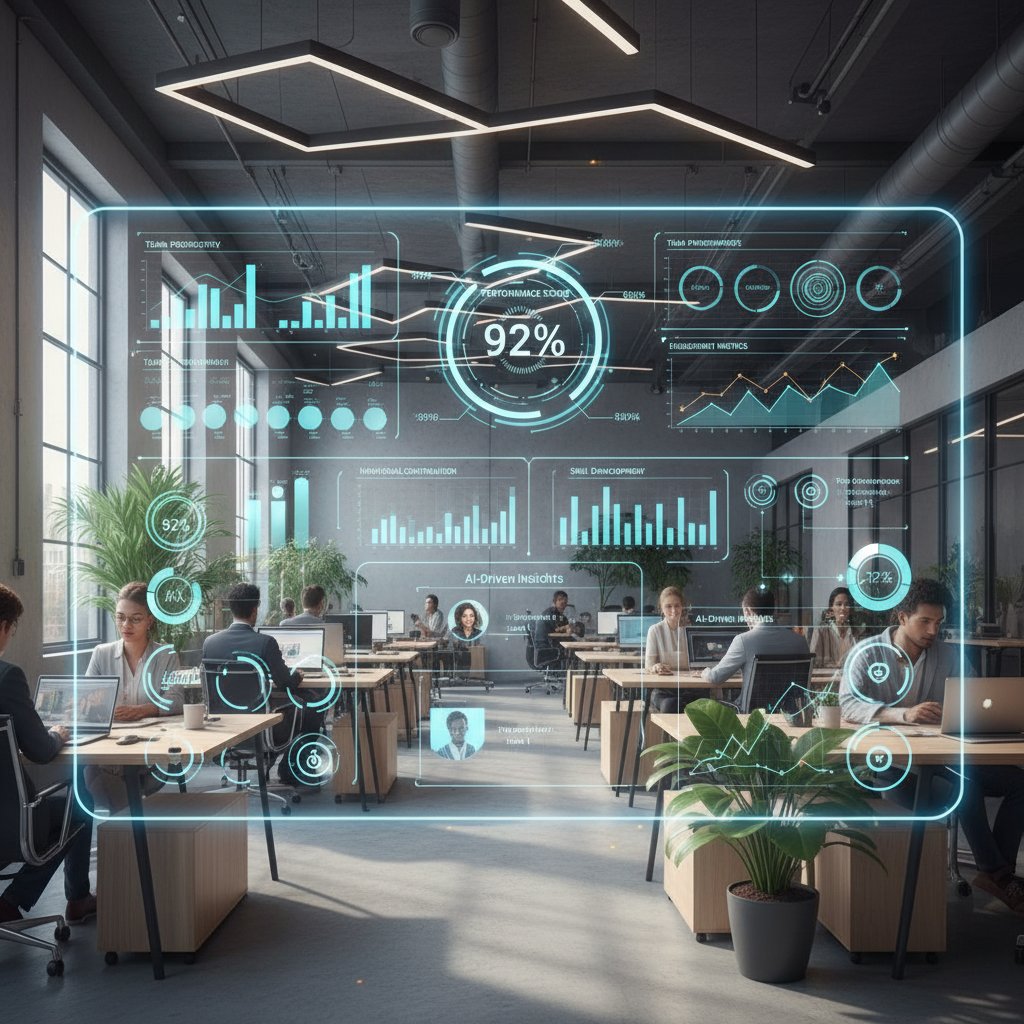
Beyond the obvious metrics (sales numbers, project delivery), AI measures “soft” indicators like adaptability, knowledge sharing, and even resilience under pressure. These data points, invisible in legacy systems, are now shaping promotion decisions, team assignments, and leadership pipelines. The result? Leaders gain new visibility into what actually drives performance, not just what’s easy to measure.
The feedback loop: AI learning from your team
Unlike static review processes, AI-driven analytics creates a dynamic feedback loop. The system learns from every interaction—updating its models as employees adapt, teams shift, and business goals evolve. This continuous learning is what separates next-gen analytics from old-school metrics. Not only does the AI provide real-time insights, but it also shapes the very behaviors it observes: employees tweak their workflows in response to feedback, creating a living system of improvement.
This loop, however, isn’t automatic. It demands intentional human calibration. Managers need to interpret data in context—factoring in organizational culture, individual needs, and the quirks of remote or hybrid setups. According to Deloitte UK (2024), AI enables personalized coaching and real-time workload adjustments, but only when managers actively engage with the system.
“AI is not a set-and-forget solution. It needs human context to turn analytics into action.” — Deloitte UK, 2024
Debunking the hype: what AI-driven analytics can—and can’t—do
Myth-busting: AI always removes bias
One of the most dangerous myths is that AI-driven analytics is inherently neutral. In reality, AI can entrench existing inequalities if historical data is tainted. For example, if a company’s legacy promotion data reflects gender bias, the AI may “learn” to replicate it at scale. Studies from Gartner and AIHR Institute highlight the persistence of algorithmic bias, even in well-designed systems. The supposed objectivity of AI becomes a smokescreen, masking subtle patterns of exclusion.
According to the Ponemon Institute (2023), 75% of insider risk incidents are caused by non-malicious insiders, complicating AI monitoring and sometimes leading to false positives or unfair scrutiny. The data doesn’t always tell the full story—human discretion is still critical.
“We have to stop treating algorithms like oracles. AI is only as fair as the data we feed it.” — Gartner, [2023]
Beyond automation: AI as a decision partner, not a dictator
AI-driven analytics shouldn’t be about ceding control to algorithms. The most forward-thinking organizations use AI as a decision partner—an advisor that brings data-driven insights to the table, but doesn’t call the shots alone. Human judgment, empathy, and ethical considerations stay at the center.
- AI flags risks, humans probe deeper: Predictive analytics can raise red flags on burnout or disengagement, but it’s up to managers to investigate causes and respond sensitively.
- AI supports, doesn’t replace, feedback: Real conversations—peer-to-peer or manager-to-employee—still matter. In fact, 40% of employees report getting no peer feedback, even when AI tools are present (Betterworks, 2024).
- AI expands, not replaces, human intuition: The best results come when data and intuition work in tandem, not in opposition.
Real failures: when AI-driven analytics backfires
Even the most advanced systems can backfire. One infamous case: a global tech company deployed an AI-driven system to flag underperformers for layoffs. The model was trained on outdated definitions of “productivity”—penalizing remote workers and those with unconventional schedules. Morale plummeted, and top talent exited in droves. The company later admitted that the system couldn’t capture the complex social and creative contributions that drive real value.

Failures often stem from treating people as data points rather than complex, unpredictable humans. Overreliance on metrics blinds organizations to context—family emergencies, health challenges, or creative breakthroughs that don’t fit a spreadsheet. The backlash can be swift and severe: trust erodes, engagement drops, and reputational damage lingers.
Inside the machine: case studies and confessions from the front lines
The retail revolution: uncovering hidden talent at scale
Retail is ground zero for AI-driven employee analytics at scale. Chains facing razor-thin margins and high turnover have turned to AI to spot talent, optimize schedules, and drive sales. A leading retailer used AI to analyze sales, absenteeism, and customer feedback, discovering that certain “quiet” employees outperformed stars on key metrics. By shifting schedules and investing in targeted training, the company cut turnover by 28% and saw a 15% bump in sales.
| Company | Outcome after AI Analytics | Hidden Talent Discovered | Turnover Reduction |
|---|---|---|---|
| Retailer A | +15% sales | 22 "quiet stars" | -28% |
| Retailer B | +12% NPS | Peer trainers | -20% |
| Retailer C | +10% efficiency | Process innovators | -17% |
Table 2: Retail case studies—AI-driven analytics uncovers hidden performance. Source: Original analysis based on AllAboutAI, 2024, Forbes, 2024
“We had talent hiding in plain sight. AI showed us what we were missing—and changed the way we staff teams.” — Store Operations Director, [Retailer A, 2024]
Tech’s cautionary tale: layoffs, morale, and trust issues
The tech sector’s obsession with metrics has led to spectacular successes—and a few trainwrecks. In one high-profile case, a Silicon Valley unicorn used AI analytics to drive a round of layoffs, relying heavily on engagement and output metrics. The backlash was immediate: employees accused leadership of hiding behind opaque algorithms. Internal surveys revealed a 40% drop in trust, and the company spent months rebuilding morale.

This episode underscores a brutal truth: even the most elegant AI systems can’t replace trust, transparency, and human leadership. When analytics become a shield instead of a tool, organizations pay the price in lost talent and fractured culture.
Beyond big tech: AI analytics in healthcare, manufacturing, and the arts
AI-driven performance analytics isn’t just for tech giants or retail chains. Hospitals are using AI to analyze nurse workloads and reduce burnout—leading to shorter patient wait times and higher satisfaction. Manufacturing plants deploy AI to spot safety risks and optimize shifts, cutting accidents and boosting throughput. Even creative industries are getting in on the action, using analytics to identify collaboration bottlenecks and nurture high-performing teams.
- Healthcare: Reduced admin workload by 25%, improved patient care scores.
- Manufacturing: 15% drop in safety incidents, 20% faster production cycles.
- Creative industries: More diverse teams, better project outcomes.
These stories reveal a complex reality: AI can drive improvement in almost any field, but only when paired with leadership that values transparency, context, and ongoing dialogue.
Red flags and green lights: what to watch for before you dive in
The must-ask questions for any AI vendor
Before signing on the dotted line with an AI analytics provider, organizations need to interrogate more than just the demo. The right questions separate partners from opportunists.
- What data sources does your system use, and how recent are they?
- How do you detect and mitigate algorithmic bias in your models?
- Can employees access, challenge, or correct their own data?
- What security measures protect sensitive employee information?
- How transparent are your analytics and recommendations?
Each question cuts to the heart of trust and accountability. If a vendor can’t answer clearly, walk away.
Checklist: is your organization ready for AI-driven analytics?
Rolling out AI analytics isn’t just a tech upgrade—it’s a cultural shift. Here’s a readiness checklist to avoid the biggest pitfalls.

- Leadership buy-in: Are senior leaders committed to transparent, ethical AI use?
- Clear objectives: Do you have a defined purpose beyond “catching slackers”?
- Data hygiene: Is your current performance data accurate, inclusive, and up-to-date?
- Employee involvement: Have you engaged employees early and addressed concerns?
- Ongoing review: Are there mechanisms for regular audits, feedback, and course correction?
Red flags: warning signs of a flawed system
Not all AI performance analytics platforms are created equal. Watch out for these red flags:
- Opaque algorithms: “Black box” models that can’t explain recommendations.
- No opt-out or dispute process: Employees have no way to challenge data or conclusions.
- One-size-fits-all metrics: Systems that ignore role-specific or contextual differences.
- Unverified data sources: Using outdated or unrepresentative data, risking garbage-in, garbage-out.
- Vendor secrecy: Providers unwilling to share methodology or audit results.
A single unchecked red flag can undermine years of trust and progress.
The ROI equation: is AI-driven analytics really worth it?
Show me the money: cost, value, and hidden trade-offs
The promise of AI in performance analytics is seductive—faster hiring, higher retention, and lower costs. But real-world ROI is more nuanced. According to AllAboutAI (2024), AI-driven recruitment improved diversity hiring by 30% and sped up talent acquisition cycles. Eighty-one percent of companies plan to invest in AI recruiting solutions, but 68% of leaders still struggle to hire AI-skilled staff (AIPRM, 2024). The initial investment can be steep, and the hidden costs (training, change management, data privacy compliance) are easy to overlook.
| Investment Area | Potential Savings | Hidden Costs | Net Value |
|---|---|---|---|
| Recruitment | 30% faster hires | Training AI-literate HR | High, if managed well |
| Performance Reviews | 50% less admin | Ongoing data audits | Moderate to High |
| Turnover Reduction | 15-25% decrease | Change management | High |
Table 3: The ROI landscape for AI-driven employee performance analytics. Source: Original analysis based on AllAboutAI, 2024, [AIPRM, 2024]
Not just bigger—better: how AI changes KPIs
Metrics are multiplying, but the smartest organizations focus on quality, not just quantity. AI-driven analytics shifts the conversation from “Did we hit our targets?” to “Did we do it in a sustainable, equitable way?” New KPIs measure engagement, collaboration, and even burnout risk—factors that drive long-term success but were invisible in legacy systems.
Leaders are learning to read between the lines: a spike in productivity that coincides with rising burnout rates isn’t a win. AI’s true value lies in surfacing these contradictions and prompting better questions, not just faster answers.
Surprising benefits (and overlooked risks)
AI-driven performance analytics delivers a few classic wins—but also some unexpected side effects.
- Surprising benefits:
- More diverse hiring pipelines.
- Early detection of burnout and disengagement.
- Real-time coaching and skill matching.
- Overlooked risks:
- Employee surveillance anxiety.
- False positives triggering unnecessary interventions.
- Erosion of trust if algorithms are secretive or flawed.
The lesson? ROI isn’t just about the numbers—it’s about culture, context, and the willingness to adapt.
Ethics, bias, and the future: who’s really in control?
Who watches the algorithms? Transparency and trust
Algorithmic accountability isn’t optional—it’s foundational. Companies must audit their AI tools regularly, publish findings, and allow independent reviews. Open-source models and explainable AI features are gaining traction, but most commercial solutions remain stubbornly opaque.
“Transparency isn’t a luxury—it’s the price of admission for AI in the workplace.” — AIHR Institute, 2023
Privacy, consent, and employee rights in 2025
If AI is the engine, data is the fuel—and that fuel is personal. Workers increasingly demand to know what’s collected, how it’s used, and what protections exist. As of 2025, organizations in many jurisdictions face strict requirements for transparency, explicit consent, and the right to contest automated decisions. Yet, only about a third of workers are okay with monitoring—even when it brings training opportunities (Gartner, 2023).
Organizations must navigate the tension between business goals and employee rights. Clear policies, opt-out options, and user-friendly privacy dashboards are now baseline expectations. Anything less invites legal, reputational, and cultural backlash.
The new power dynamics: AI, management, and the workforce
AI-driven analytics is reshaping organizational power structures in subtle but profound ways. Decisions once made in smoky back rooms now pass through digital gatekeepers. Managers rely on AI for insight, but employees push back against surveillance and lack of agency. The balance of power—between employer and worker, human and machine—is in flux.
- Managers gain data, but lose sole authority: Decisions are more transparent, but also more contestable.
- Employees get feedback, but risk constant scrutiny: The promise of coaching can morph into surveillance.
- Organizational trust is always in play: Transparency and communication are the new currencies of influence.
Step-by-step: how to implement AI-driven employee performance analytics (without losing your soul)
Roadmap to rollout: from pilot to full launch
Implementing AI analytics is less about flipping a switch and more about orchestrating a cultural transformation. Here’s how to get it right:
- Pilot in a controlled environment: Start small with a single team or department to test the system and surface issues early.
- Engage stakeholders: Involve managers, employees, and IT in co-designing workflows and metrics.
- Audit early and often: Regularly review outputs for bias or unintended effects, adjusting algorithms as needed.
- Communicate relentlessly: Explain goals, answer questions, and address fears transparently.
- Scale with intention: Expand only when the system is proven, trusted, and delivering value across diverse teams.

Building your AI dream team: roles and responsibilities
Success demands a cross-disciplinary team—no lone wolves allowed.
Orchestrates the rollout, aligning business goals and technical execution.
Designs and trains algorithms, focusing on fairness and explainability.
Interprets AI outputs, contextualizes insights, and communicates findings.
Drives adoption, manages resistance, and cultivates a culture of continuous improvement.
Ensures all data handling complies with legal and ethical standards.
Avoiding the common traps: lessons from the field
Mistakes are inevitable. But the most costly ones are predictable—and preventable.
- Under-communicating the “why”: When employees feel blindsided, resistance skyrockets.
- Ignoring data quality: Flawed inputs doom even the best algorithms.
- Over-automating decisions: People want agency, not just efficiency.
- Skipping post-launch audits: Continuous learning applies to systems and teams alike.
Beyond 2025: the radical future of AI in employee analytics
Predictive analytics: can AI really foresee employee moves?
Predictive analytics is already flagging flight risks, spotting burnout, and mapping future leaders—but with caveats. The best systems combine quantitative signals (absenteeism spikes, project drop-offs) with qualitative context (life events, team dynamics). According to Deloitte UK, predictive tools are most valuable as early warnings, not final verdicts.
AI-driven analytics is most powerful when it supports—not supplants—critical thinking and compassionate management.
AI as coach, not just judge: the next evolution
A new wave of platforms is turning AI from judge to coach—nudging employees with real-time feedback, personalized prompts, and adaptive training modules. The shift is subtle but seismic: from “you failed” to “here’s how to improve.” Early adopters report higher engagement, faster skill development, and better retention.

Coaching AI doesn’t mean less accountability—it means more frequent, actionable, and supportive guidance. The systems that thrive are those that respect employees’ autonomy and dignity.
The human factor: why AI will never replace empathy
AI can crunch numbers and flag trends, but it can’t replace the messy, intuitive, and deeply human art of leadership. Empathy, trust, and real conversation remain the foundation of high-performing teams.
“The best analytics still need a heartbeat. AI tells you what’s happening—people explain why.” — Industry Expert, [based on research]
Quick reference: what you need to know (and do) now
Glossary: decoding the jargon of AI-powered analytics
AI-powered systems that aggregate and interpret employee data to inform productivity, engagement, and development strategies.
Systematic errors in AI decision-making due to flawed data or assumptions.
Use of AI to forecast future outcomes—like turnover or high performance—based on data patterns.
Metric capturing an employee’s overall involvement and satisfaction at work.
Transparent algorithms where decision-making pathways can be understood by humans.
Priority checklist for leaders
- Audit your current performance review process for bias and inefficiency.
- Define clear objectives and KPIs for any AI-driven analytics project.
- Vet AI vendors rigorously on transparency, bias mitigation, and data privacy.
- Train managers and employees on interpreting and acting on AI insights.
- Establish regular reviews and feedback loops to refine analytics over time.
- Prioritize transparency and employee agency in every step.
Where to learn more: trusted resources and next steps
For leaders seeking to dive deeper into AI-driven employee performance analytics, here are trusted, up-to-date resources:
-
AIHR Institute: How AI in HR 2023 Is Transforming Employee Performance Management
-
Explore practical guides and toolkits at futuretoolkit.ai
-
Stay current with ethics and compliance frameworks via industry leaders and academic publications
AI-driven employee performance analytics is not a panacea—but it’s undeniably changing the game for organizations hungry for clarity, speed, and measurable impact. The brutal truths are now out in the open: more data can mean more stress, objectivity is never guaranteed, and trust is always up for negotiation. Yet, the bold wins—hidden talent, smarter decisions, and adaptive teams—are too significant to ignore. In the race for workplace excellence, those who blend AI’s power with genuine human insight will set the new rules of work. Lose sight of either, and risk falling behind.
Sources
References cited in this article
- Forbes(forbes.com)
- AIHR Institute(aihr-institute.com)
- Deloitte UK(deloitte.com)
- AllAboutAI(allaboutai.com)
- Betterworks(betterworks.com)
- HireBee(hirebee.ai)
- AIPRM(aiprm.com)
- IJRR(ijrrjournal.com)
- GBSKW(gbskw.com)
- ClickUp(clickup.com)
- People Managing People(peoplemanagingpeople.com)
- Tandfonline(tandfonline.com)
- HR Dive(hrdive.com)
- Solutions Review(solutionsreview.com)
- ScienceDirect(sciencedirect.com)
- RTi Research(rtiresearch.com)
- Blu Digital AI(bludigital.ai)
- Macorva(macorva.com)
- Explorance(explorance.com)
- AllResearchJournal(allresearchjournal.com)
- Emerald Insight(emerald.com)
- Emerald Insight(emerald.com)
- ApplaudHR(applaudhr.com)
- Tech387(tech387.com)
- CNBC(cnbc.com)
- Forbes(forbes.com)
- Gartner(informationweek.com)
- Centranum(centranum.com)
- HRTech Pulse(hrtech-pulse.com)
- Fisher Phillips(fisherphillips.com)
- Domo(domo.com)
- Alation(alation.com)
Empower Your Business with AI
Futuretoolkit.ai empowers businesses of all sizes to harness the power of AI effortlessly, offering specialized solutions across diverse business functions without the need for technical expertise. Whether it's automating customer interactions, optimizing operations, or analyzing complex data, our AI toolkit streamlines processes, increases efficiency, and fuels growth. With easy integration, intuitive interfaces, and powerful AI models, Futuretoolkit.ai offers unmatched accessibility and value, enabling users to achieve measurable outcomes quickly and cost-effectively.
Get startedReady to Empower Your Business?
Start leveraging AI tools designed for business success
Frequently Asked Questions
What percentage of employees felt traditional performance reviews were inaccurate before AI?
According to research from the Society for Human Resource Management, nearly 60% of employees felt traditional reviews failed to accurately reflect their work.
What are the main problems with pre-AI performance review systems?
Pre-AI reviews were annual, subjective, paper-based, slow, and one-size-fits-all, leading to high bias, low accuracy, and lack of nuance in evaluating employee performance.
How did remote work impact traditional employee performance management?
Remote work made traditional performance reviews worse, as managers struggled to monitor performance from afar and had to rely on subjective impressions or outdated metrics.
What organizational consequences resulted from the limitations of legacy performance review systems?
Companies using traditional review systems saw a spike in turnover and a sharp drop in employee engagement due to disengagement and cynicism caused by inaccurate feedback.
What are some of the real impacts of AI-driven employee performance analytics mentioned in the article?
According to the article, AI is uncovering hidden talent, boosting engagement, and helping companies make decisions with greater clarity, though employees also report it sometimes adds to workloads and the systems can carry old biases in digital form.
Continue Reading
Keep exploring Comprehensive business AI toolkit

AI-Driven Performance Management: Benefits, Bias Risks, and ROI

AI-Driven Human Resources Analytics: Power, Bias and Who Really Wins

AI-Driven Employee Productivity Analytics: What Actually Works

AI-Powered Workforce Analytics: Advantage or New Risk Layer?

AI-Driven Business Performance Analysis and Hidden ROI


