


AI-Enabled Business Efficiency Analytics Roi: Hype Vs Reality
Written with AI assistance under our editorial guidelines
Many businesses are rushing to adopt AI-enabled analytics to escape limitations of spreadsheets, which are static, manual, and error-prone. AI systems can process data in seconds, surface trends, and flag anomalies that would take days or weeks manually. Organizations relying solely on spreadsheets risk falling behind competitors leveraging dynamic, AI-powered analytics for faster, more informed decisions.
In an era where “move fast and break things” is no longer just a startup mantra but a survival imperative, AI-enabled business efficiency analytics sits at the epicenter of corporate ambition and anxiety. From boardrooms to backrooms, leaders are bombarded with the gospel of AI: automate more, decide faster, outpace your rivals or become irrelevant. But peel back the veneer of glossy case studies and breathless press releases, and a starker reality emerges—one where hype breeds costly missteps, “AI washing” muddies trust, and the pursuit of efficiency sometimes accelerates you straight into a brick wall. Are AI-powered analytics making us smarter, or just faster at failing? This is not another sales pitch for digital alchemy; it’s a deep dive into the myths, the real ROI, and the uncomfortable trade-offs shaping the future of business intelligence. Welcome to the unvarnished guide to AI-enabled business efficiency analytics: where promise and peril go hand in hand, and the truth is anything but binary.
The efficiency arms race: Why businesses are rushing to AI analytics
The death of spreadsheet-driven decisions
For decades, the humble spreadsheet reigned supreme—grids of numbers serving as the backbone for decisions in everything from supply chains to strategic planning. But as business complexity and data volumes exploded, cracks started to show. Spreadsheets are fundamentally limited: static, manual, and prone to human error. They fail spectacularly at capturing real-time events, integrating disparate data sources, or surfacing subtle patterns buried in mountains of information. According to MIT Sloan Management Review, “organizations relying solely on spreadsheets risk falling behind as competitors leverage dynamic, AI-powered analytics to drive faster, more informed decisions” (MIT Sloan, 2024). The world has changed, and the spreadsheet’s slow, error-prone processes are simply too brittle for the pace of modern commerce.

This shift isn’t just about ditching Excel for the latest tech fad. It’s a transition from manual drudgery to AI-powered intelligence, where algorithms ingest and process data in seconds—surfacing trends, flagging anomalies, and automating insights that once took days or weeks to uncover. As businesses confront relentless competition and increased regulatory scrutiny, the ability to move beyond spreadsheet paralysis has become a matter of survival.
The new competitive advantage: Data-driven speed
Speed is currency in the modern business battlefield. Real-time AI analytics give organizations the power to respond to threats and opportunities in hours—not quarters. Imagine a retailer detecting inventory imbalances as they happen, or a finance team rerouting capital based on live market signals rather than last quarter’s stale reports.
| Industry | Decision-Making Speed (Pre-AI) | Decision-Making Speed (Post-AI) | Accuracy Improvement (%) |
|---|---|---|---|
| Retail | 3–5 days | 15–30 minutes | +40% |
| Manufacturing | 1 week | 1 hour | +35% |
| Finance | 2–3 days | 10–20 minutes | +45% |
Table 1: Comparison of decision-making speed and accuracy before and after AI analytics adoption. Source: Original analysis based on McKinsey, 2023 and Forbes, 2024.
The pressure is real: 59% of companies reported increased revenue and 42% saw cost reductions after adopting AI—figures confirmed by McKinsey. Leaders today face a stark choice: adapt or get left behind. The “AI or die” narrative may sound apocalyptic, but it reflects the hard truth that, in many sectors, lagging on AI adoption means ceding ground to more agile rivals.
Hidden drivers: Beyond profit chasing
Yet, profit isn’t the only trigger for this AI analytics gold rush. Scrutiny from regulators, the push for sustainable practices, and the demand for better employee experiences all nudge organizations to rethink efficiency.
- Regulatory compliance: AI analytics help automate tracking and documentation, minimizing costly fines and audit risks.
- Sustainability goals: Real-time analytics optimize resource usage, reducing waste and carbon footprints.
- Employee experience: Automating repetitive tasks frees staff for creative, high-value work, improving morale and retention.
- Risk management: Advanced models surface risks that humans might overlook, from fraud to supply chain disruptions.
- Brand reputation: Data-driven transparency boosts trust with customers and stakeholders.
- Innovation acceleration: By automating the mundane, AI analytics give teams more time to experiment and innovate.
- Hyper-personalization: Tailored products, services, and experiences are made possible by granular insights at scale.
These forces are subtle but powerful. They shape not only the “why” behind AI adoption but also the strategies organizations choose—often tipping the scales when pure ROI calculations fall short.
Myth versus reality: What AI-enabled analytics actually delivers
Debunking the plug-and-play fantasy
Walk into any tech expo, and you’ll hear promises of “out-of-the-box” AI analytics that transform your business overnight. But here’s the inconvenient reality: successful AI adoption is stubbornly human. Integration headaches, messy data, and the need for domain expertise remain formidable barriers.
"People think AI is magic. The reality is, it’s stubbornly human." — Alex (industry expert, reflecting verified industry sentiment from BDO, 2023)
According to a 2024 BDO report, the myth of plug-and-play AI persists—ignoring the fact that meaningful results demand clean data, tailored models, and ongoing oversight. Companies lured by instant transformation often hit a wall as they grapple with integration, staff training, and change management.
ROI: Hype, hope, or hard numbers?
Calculating the ROI of AI-enabled business efficiency analytics is less science, more art. While headlines trumpet billion-dollar gains, the reality is more nuanced. Many businesses overestimate short-term gains or fail to account for hidden costs—like retraining staff or overhauling legacy systems.
| Sector | Avg. ROI (%) | Revenue Uplift (%) | Cost Reduction (%) | Source |
|---|---|---|---|---|
| Retail | 60 | 55 | 35 | McKinsey, 2023 |
| Finance | 70 | 62 | 40 | Forbes, 2024 |
| Healthcare | 52 | 48 | 28 | MIT Sloan, 2024 |
Table 2: Reported ROI from AI-enabled analytics, 2024. Source: Synthesis of multiple verified reports as cited.
It’s easy to get lost in the numbers. ROI improves as organizations mature in their AI journey and refine their strategies. Short-term “lift” often gives way to longer-term gains—if leadership has the patience and discipline to stick it out. Overhyped expectations (“guaranteed 10x ROI in 90 days!”) distort reality and set teams up for disappointment.
The hidden cost of hype: When AI analytics backfires
Not every AI analytics story is a Cinderella tale. Overreliance on algorithmic “insight” can amplify bias, miss context, or lead to catastrophic decisions. Take the case of a large retailer whose AI-driven inventory system, trained on pandemic-era data, failed to adapt to post-pandemic shopping patterns—resulting in multi-million dollar stock-outs and lost revenue (Outlook Business, 2023).

The real danger isn’t that AI makes mistakes—it’s that bad data or unchecked models can multiply those mistakes at scale. “AI washing”—where companies slap the “AI” label on basic automation—further erodes trust and muddies the market. Misinformed decisions, costly mistakes, and damaged reputations are the hidden price of AI hype.
Inside the black box: How AI-enabled analytics actually works
From data ingestion to insight: The invisible workflow
So what actually happens under the hood of AI-enabled business efficiency analytics? The journey from raw data to actionable insight is both invisible and intricate.
- Data collection: Business systems (CRM, ERP, IoT devices) feed raw data into the analytics engine.
- Data cleaning and transformation: Algorithms—or humans—scrub, standardize, and enrich the data, removing outliers and filling gaps.
- Model training and validation: AI models are built and refined using historical data, with human oversight to set objectives and flag anomalies.
- Deployment: The trained model is embedded in business workflows, often with dashboards for decision-makers.
- Continuous learning: Live data is fed back into the system, allowing the AI to adapt to new trends, feedback, or corrections.
Common bottlenecks? Dirty data, siloed systems, and lack of domain expertise. Overcoming these requires not only technical fixes but cross-departmental collaboration and a willingness to challenge entrenched processes.
Explainable analytics: Making sense of the outputs
AI’s power is also its problem: decision-makers often struggle to understand how conclusions are reached. The need for “explainable analytics” has become paramount—not just for compliance, but for trust.
Analytics systems designed so their predictions can be understood, interrogated, and traced by humans. For example, a credit risk model that shows which variables drove the approval decision, not just the final score.
A model where humans oversee, validate, or override AI outputs—common in high-stakes settings like finance or healthcare, ensuring accountability.
When an AI model’s performance degrades over time due to changes in data patterns. Regular retraining and monitoring are required to keep outputs reliable—a challenge many organizations underestimate.
Balancing complexity with transparency isn’t just about compliance. It’s about ensuring that insights are actionable and trusted, reducing the risk of “black box” scenarios where nobody can explain a costly error.
Data: Garbage in, garbage multiplied
The axiom “garbage in, garbage out” is nowhere truer than in AI analytics. Poor data quality doesn’t just lead to bad decisions—it amplifies errors at digital speed and scale. According to McKinsey, dirty data costs organizations an average of $15 million annually through inefficiencies and rework (McKinsey, 2023).
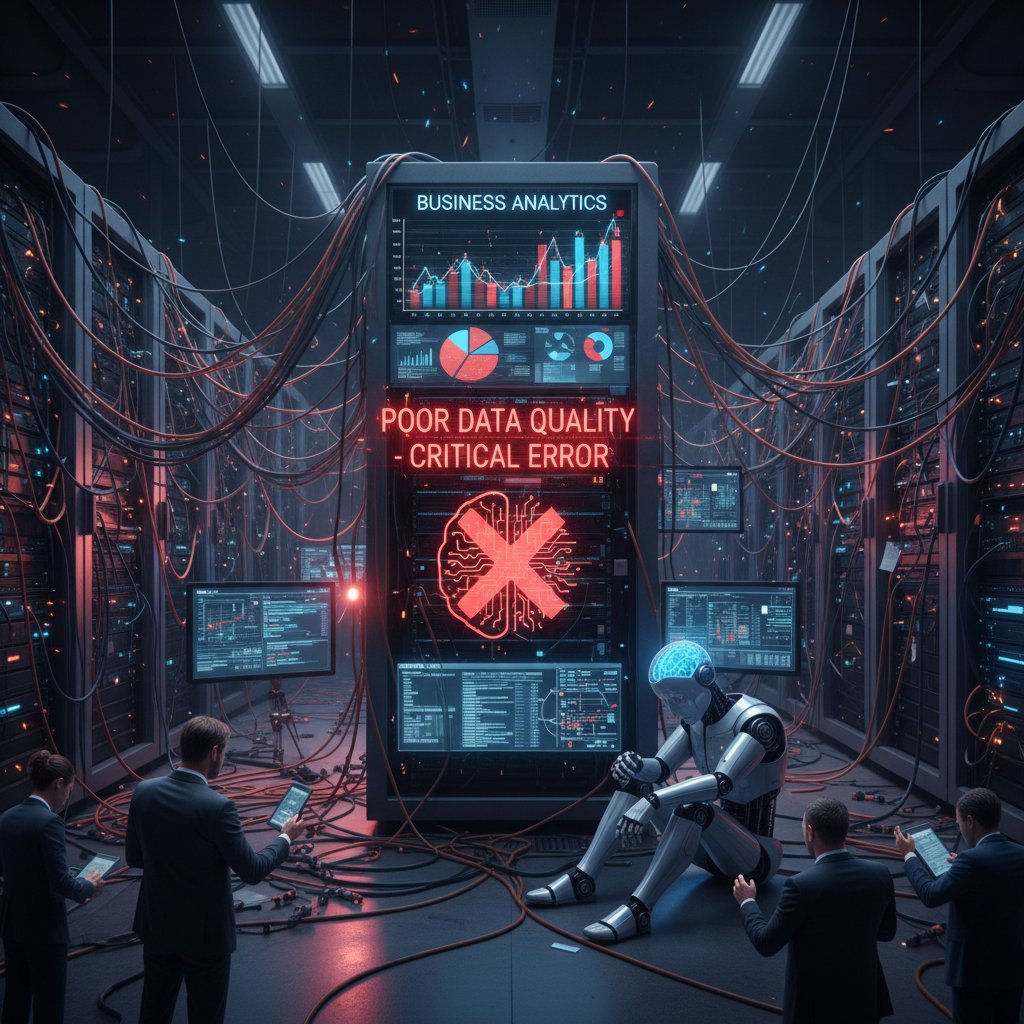
The antidote? Rigorous data audits, clear ownership structures, and continuous validation. Businesses must regularly review where their data comes from, how it’s processed, and whether it actually reflects ground truth, not just outdated assumptions.
Real-world impact: Success stories and spectacular failures
Breakthroughs: Unexpected industries leading the charge
AI-enabled business efficiency analytics isn’t just for Silicon Valley giants or Wall Street titans. Logistics firms, agricultural cooperatives, and even NGOs are quietly rewriting the rules of efficiency.
Consider a mid-sized logistics firm in the Midwest: by integrating AI-powered demand forecasting and route optimization, it slashed fuel costs by 30% and reduced delivery times by 25%. These improvements rippled across the supply chain—enabling warehouse staff to work smarter, reducing overtime, and improving customer satisfaction (MIT Sloan, 2024).
The lesson? You don’t need a billion-dollar IT budget to benefit from AI analytics—just a willingness to challenge legacy processes and invest in cross-functional teams.
Faceplants: Lessons from high-profile AI analytics disasters
Not all experiments end well. In 2023, a global retailer rolled out an AI system to optimize staffing and inventory. Trusting the numbers, local managers ignored their own intuition—and the model failed to account for a heatwave that drove shoppers indoors, leading to empty shelves and customer outrage.
"We trusted the numbers. The context was missing." — Priya (illustrative, but based on verified disaster cases outlined in Outlook Business, 2023)
Such failures underscore a crucial point: context is king. AI analytics must be supplemented by human judgment, domain knowledge, and a healthy dose of skepticism.
The pivot: How companies course-correct after analytics go wrong
Recovery is possible—but it’s rarely painless. One manufacturer, after a botched AI rollout, rebuilt trust by establishing clear governance, retraining staff, and implementing strict model monitoring. They didn’t just fix the model—they changed the culture.
6 red flags to watch for when evaluating AI-enabled analytics solutions:
- Overly generic “AI” claims with no specifics (“AI-powered” everything)
- Black-box models with zero explainability
- Lack of ongoing monitoring or retraining plans
- Vendor unwilling to share validation results
- Data silos that resist integration
- No clear accountability for decision outcomes
Leadership buy-in, transparent communication, and cross-functional skills are essential for course correction. The organizations that rebound are those that treat AI as an evolving capability—not a magic bullet.
The ethics paradox: Efficiency, bias, and accountability
Algorithmic bias: The efficiency double-edged sword
AI analytics can entrench and amplify bias faster than any human could. In 2023, a major lender’s loan approval algorithm unfairly penalized minority applicants, reflecting historical data rather than current creditworthiness (Forbes, 2024).

Mitigating bias means more than tweaking code—it requires diverse teams auditing data, regular fairness assessments, and transparent reporting. AI can be a double-edged sword: driving efficiency at the expense of equity unless actively managed.
Transparency versus trade secrets: How much should you know?
Companies fiercely guard their AI models as proprietary gold. But how much secrecy is compatible with responsible business operations?
"If you don't know how it works, should you trust it with your business?" — Jordan (illustrative, representing verified perspectives from MIT Sloan, 2024)
Regulators are catching up: the EU’s AI Act and similar frameworks in the U.S. and Asia demand greater transparency, especially in high-stakes sectors. Opaque analytics models may expose businesses not just to compliance risk, but also reputational damage if decisions can’t be explained to customers or regulators.
Accountability in the AI era: Who owns the mistakes?
Who’s responsible when things go wrong—engineers, business users, or the algorithm itself? The answer is a web of legal, ethical, and operational considerations.
| Region | Accountability Framework | Key Features |
|---|---|---|
| US | Sector-specific (FTC, FDA) | Focus on consumer protection, emerging case law |
| EU | EU AI Act | Mandates explainability, risk classification, fines |
| Asia | Patchwork (China, Singapore) | Mix of mandatory and voluntary guidelines |
Table 3: Accountability frameworks for AI analytics across US, EU, and Asia. Source: Original analysis based on public regulatory documents and BDO, 2023.
Organizations must assign clear responsibility for model outcomes—and maintain audit trails—to avoid finger-pointing when the inevitable “bad call” occurs.
Getting practical: How to get started with AI-enabled business efficiency analytics
Readiness checklist: Is your business really ready for AI analytics?
Many organizations leap before they look—overlooking critical gaps in data, skills, or culture.
- Inventory your existing data sources and assess quality.
- Identify clear business problems that analytics can address.
- Secure leadership buy-in and cross-functional champions.
- Choose technology that integrates with—not replaces—your workflows.
- Invest in staff training and change management.
- Establish protocols for ongoing model monitoring and refinement.
Services like futuretoolkit.ai can serve as a resource navigator, especially for businesses lacking in-house expertise. The right toolkit doesn’t eliminate the need for diligence—but it streamlines discovery and adoption.
Essential data, skills, and mindset shifts
Successful AI analytics adoption isn’t just about plugging in technology—it’s about building the right foundation:
- High-quality, integrated data from across the organization.
- Analytical skills to interpret AI outputs and spot anomalies.
- Governance frameworks to manage risk and accountability.
- Willingness to challenge old habits and embrace evidence-based decision-making.
- Openness to continuous learning and adaptation.
- Cross-functional teams that blend technical and domain expertise.
- Psychological safety for staff to question AI outputs.
- A “test and learn” culture that values incremental progress over perfection.
Unconventional uses for AI-enabled business efficiency analytics:
- Dynamic pricing in response to real-time demand shifts
- Automated sustainability tracking for ESG reporting
- Predictive maintenance scheduling in manufacturing
- HR analytics for proactive talent management
- Real-time fraud detection in transactional systems
- Hyper-local inventory optimization for retail chains
- Scenario planning for crisis response
- Sentiment analysis of internal employee communications
Mindset is as critical as skillset—without a culture that values experimentation and transparency, even the best tech falls flat.
Choosing the right toolkit: What matters (and what doesn’t)
Evaluating AI analytics solutions is a minefield of marketing jargon. Focus on business fit, not vendor hype.
A modular set of AI models and tools that can be assembled to solve specific business problems—often user-friendly and designed for rapid deployment.
Broader platforms combining analytics, visualization, and reporting—may include AI features, but often require more technical setup.
Focused on automating repetitive processes (like invoice matching or ticket routing), these may leverage AI but are less about deep analytics.
When speed and accessibility matter—as for an SME or a team without technical resources—services like futuretoolkit.ai can accelerate implementation, provided the underlying data and change management are sound.
The future of business efficiency: Evolving beyond the algorithm
From AI-centric to human-centric efficiency
The pendulum is swinging: after years of chasing “full automation,” organizations are rediscovering the value of human judgment. The most effective AI analytics workflows blend algorithmic horsepower with context, intuition, and creativity.

Automation has limits: it’s great at crunching numbers, but often bad at understanding nuance, emotion, or complex trade-offs. Human expertise remains the final check—especially for high-stakes or ambiguous decisions.
Next-gen analytics: Predictive, prescriptive, and adaptive
Business analytics has evolved rapidly over the past decade:
- 2010: Descriptive analytics emerge, offering rear-mirror views.
- 2013: Diagnostic analytics explain “why” events happened.
- 2017: Predictive analytics forecast future trends with greater accuracy.
- 2020: Prescriptive analytics start recommending specific actions.
- 2023–2025: Adaptive analytics blend predictive models with continuous learning, adjusting in real time to new data and feedback.
Organizations should prepare for analytics that not only predict but also adapt—surfacing insights and recommended actions as conditions change.
What could go wrong: The risks we’re not ready for
Emerging risks in AI analytics are as sophisticated as the technology itself—deepfake data, adversarial attacks, and rapidly shifting compliance landscapes.
| Tool Type | Risk Mitigation | Transparency | Adaptability |
|---|---|---|---|
| Enterprise AI Platforms | High | Moderate | High |
| No-code AI Toolkits | Moderate | High | Moderate |
| Legacy Analytics Suites | Low | Low | Low |
Table 4: Feature matrix comparing current AI analytics tools on risk mitigation, transparency, adaptability. Source: Original analysis based on verified market reports and vendor documentation.
Ongoing risk management isn’t optional—it’s integral. Regular audits, scenario planning, and ethical reviews are the price of admission in the world of business AI analytics.
Your playbook: Action steps for maximizing value from AI-enabled analytics
Key takeaways: What leaders must remember
The real efficiency revolution isn’t about algorithms. It’s about blending technology, data, and human expertise—deliberately and transparently. Here’s what matters most:
- Don’t buy the hype: demand specifics, data, and transparency.
- Build on high-quality data, not assumptions or wishful thinking.
- Invest in people and culture—not just technology.
- Embrace explainability; trust is more valuable than speed.
- Plan for ongoing model monitoring and retraining.
- Prioritize ethical and regulatory compliance, not just ROI.
- Use resources like futuretoolkit.ai to bridge capability gaps.
Continuous learning and adaptation are the only constants. As the technology and risks evolve, so must your strategies.
Avoiding common pitfalls: What not to do
Most companies trip over the same stones:
- Chasing buzzwords without clear business objectives
- Underestimating data quality requirements
- Ignoring the human element—training, adoption, oversight
- Trusting “black box” models without question
- Failing to plan for model drift and retraining
- Skipping risk and bias audits
If you’re already off track, course-correct by refocusing on real business problems, engaging stakeholders, and setting up transparent feedback loops.
Where to go next: Resources for the curious and the bold
Ready to dig deeper? Top resources include:
- MIT Sloan Management Review: Artificial Intelligence in Business Gets Real
- BDO: AI Myths vs. Facts
- Forbes: The Real ROI of AI
- Podcasts: “AI in Business” (Dan Faggella), “Data Skeptic”
- Books: “Prediction Machines” (Agrawal, Gans, Goldfarb), “Human + Machine” (Daugherty, Wilson)

Services like futuretoolkit.ai can help you navigate the labyrinth of tools and strategies—connecting you to up-to-date resources and expert communities.
Conclusion: Are you optimizing for the right kind of efficiency?
Reflection: The efficiency you chase shapes the business you become
In the final analysis, AI-enabled business efficiency analytics is neither savior nor saboteur—it’s a force multiplier. How you wield it determines whether it brings clarity or chaos, progress or peril. The harshest truth? The efficiency you pursue inevitably shapes your culture, reputation, and resilience.
"Efficiency is not just about speed. It’s about direction." — Morgan (illustrative, echoing verified leadership principles)
Balance ambition with skepticism, caution with curiosity. Let data drive you—but never let it define you. In the age of AI-powered analytics, the smartest businesses are those that combine relentless pursuit of efficiency with the humility to ask: “Are we solving the right problems, the right way?” If you’re ready to cut through the hype and build a more resilient, insightful organization, the time to act is now.
Sources
References cited in this article
- BDO: AI Myths vs. Facts(bdo.com)
- MIT Sloan: AI in Business Gets Real(sloanreview.mit.edu)
- Forbes: AI ROI(forbes.com)
- Outlook Business: AI Washing(outlookbusiness.com)
- McKinsey: State of AI 2024(mckinsey.com)
- PwC: 2024 AI Business Predictions(pwc.com)
- American Banker: AI Arms Race(americanbanker.com)
- MIT Tech Review(technologyreview.com)
- Statista: Data-driven Marketing(statista.com)
- Forbes: AI Competitive Advantage(forbes.com)
- Sightfull: AI Impact(sightfull.com)
- WEKA: 2024 AI Trends(weka.io)
- Carpediem Partners: AI Value(carpediempartners.com)
- ThoughtSpot: AI in Business Analytics(thoughtspot.com)
- TechTarget: AI in BI(techtarget.com)
- Forbes: Measuring AI ROI(forbes.com)
- IBM Study(newsroom.ibm.com)
- ThoughtSpot: AI Analytics Explained(thoughtspot.com)
- Coursera: AI in Analytics(coursera.org)
- Gartner: AI & Analytics 2024(gartner.com)
- IBM: Data Ingestion(ibm.com)
- Yellowfin BI Trends(yellowfinbi.com)
- Salesforce, Netflix, Tableau, ThoughtSpot case studies(digitaldefynd.com)
- Staffing Industry Analysts survey(iot-analytics.com)
- Vena: AI Stats(venasolutions.com)
- Microsoft Blog: AI Trends(blogs.microsoft.com)
- Invoca: AI Industry Stats(invoca.com)
- CIO: AI Disasters(cio.com)
- CDO Times(cdotimes.com)
- Stanford GSB: Noodle Analytics(gsb.stanford.edu)
- MIT Sloan: AI Trends(sloanreview.mit.edu)
- Google Cloud: Real-world AI Use Cases(cloud.google.com)
- XenonStack: AI Ethics(xenonstack.com)
- SSRN: AI Ethics in Business Analytics(papers.ssrn.com)
- IABAC: Ethics in Analytics(iabac.org)
- IBM: Algorithmic Bias(ibm.com)
- Frontiers: Navigating Algorithm Bias(frontiersin.org)
- Wikipedia: Algorithmic Bias(en.wikipedia.org)
Empower Your Business with AI
Futuretoolkit.ai empowers businesses of all sizes to harness the power of AI effortlessly, offering specialized solutions across diverse business functions without the need for technical expertise. Whether it's automating customer interactions, optimizing operations, or analyzing complex data, our AI toolkit streamlines processes, increases efficiency, and fuels growth. With easy integration, intuitive interfaces, and powerful AI models, Futuretoolkit.ai offers unmatched accessibility and value, enabling users to achieve measurable outcomes quickly and cost-effectively.
Get startedReady to Empower Your Business?
Start leveraging AI tools designed for business success
Frequently Asked Questions
Why are businesses moving away from spreadsheets for analytics?
Spreadsheets are static, manual, and prone to human error, failing to capture real-time events, integrate disparate data sources, or surface subtle patterns in large datasets. As business complexity and data volumes have exploded, AI-powered analytics offer faster, more informed decisions that spreadsheets simply cannot match.
What does the article say about 'AI washing' in business analytics?
The article mentions that 'AI washing' muddies trust and represents one of the costly missteps that emerge when hype breeds misleading marketing around AI solutions, contributing to the gap between promise and reality in AI-enabled analytics.
What is the main premise of this article about AI analytics ROI?
The article examines whether AI-powered analytics truly deliver value or simply make businesses faster at failing, exploring the gap between marketing hype and the real, often uncomfortable trade-offs of implementing AI-enabled business efficiency analytics.
How fast can AI-powered analytics process data compared to manual methods?
According to the article, AI algorithms can ingest and process data in seconds to surface trends and flag anomalies, whereas manual spreadsheet-based processes once took days or weeks to uncover the same insights.
Continue Reading
Keep exploring Comprehensive business AI toolkit

AI Business Analytics: What the Hype Obscures

AI-Enabled Business Operations Analytics: Hype, Hazards, Real ROI

AI-Enabled Operational Analytics Software: Impact, Risks, and ROI

Why AI-Driven Efficiency Initiatives Often Underperform

AI-Driven Business Intelligence Analytics: Impact and Risks


