


AI-Driven Business Performance Analysis That Exposes Hidden ROI
Written with AI assistance under our editorial guidelines
AI-driven business performance analysis enables organizations to uncover hidden insights and blind spots in their data that traditional metrics miss. By processing vast amounts of business data beyond human capacity, these systems expose the truth behind numbers and help leaders make faster, data-driven decisions in response to market shifts before competitors do.
Step into any boardroom in 2025, and you’ll likely hear the same buzzwords ricocheting off glass walls: “AI-driven business performance analysis,” “predictive analytics,” “real-time dashboards.” But behind the seamless charts and algorithmic confidence, there’s a brutal reality most leaders can’t ignore: the stakes have never been higher, and the veneer of certainty is thinner than ever. If you think AI business analytics are just about pretty dashboards and data dumps, it’s time for a serious reality check. This isn’t a future fantasy—it’s the present battlefield. Today, we’re pulling back the curtain on what really happens when you let AI loose on your business numbers. Forget the sales pitches and empty TED talk optimism. Here’s the unfiltered truth about AI-powered decision making, the hidden traps, and the game-changing wins that are redrawing the line between winners and losers in every industry. If you want to know how AI-driven business performance analysis is rewriting the rules—sometimes brutally—read on before your competitors do.
Why AI-driven business performance analysis matters now
The 2025 wake-up call: Are your numbers lying to you?
You stare at this quarter’s numbers—green arrows, bullish forecasts, “record engagement.” But are you seeing the truth, or just a story you want to believe? In 2025, as AI business analytics become standard, the cost of self-deception is skyrocketing. According to PwC’s AI Predictions 2025, a staggering 65% of organizations have adopted or are actively exploring AI for analytics. Yet, leaders still fall prey to number blindness—trusting outdated metrics or incomplete reports while market conditions shift beneath their feet.

"AI provides consistent, data-driven recommendations, enabling businesses to make proactive decisions quickly in response to market changes." — Improvado, AI Analytics Insights, 2024
The real wake-up call? Your competitors aren’t just looking harder—they’re looking smarter. AI-driven business performance analysis exposes the blind spots you didn’t know you had, and in this climate, ignorance isn’t bliss. It’s fatal.
The data deluge: Why human intuition isn’t enough anymore
Let’s be blunt: the volume, velocity, and variety of business data in 2025 eclipses anything human intuition can handle. Sure, a seasoned manager’s gut instinct is valuable—but when you’re sifting through millions of transactions, social signals, and operational metrics every day, intuition alone is a recipe for missed opportunities and costly missteps. Recent research by SRAnalytics, 2024 confirms that organizations using AI-driven predictive analytics report a 20–30% improvement in decision accuracy over those relying on manual analysis.
The sheer scale is staggering. Data isn’t just big; it’s relentless—streaming from sensors, customer clicks, and global markets in real time. Human brains aren’t wired to connect these dots at speed. AI-powered decision making steps in, not to replace managers, but to make sense of chaos at a scale previously unthinkable. The result? The insights you need now, not a month from now—if you’re willing to trust the numbers.
The stakes: Winners, losers, and the cost of inaction
In the age of AI-powered business intelligence, hesitation is the enemy. The winners are deploying AI not just for marginal gains, but for existential advantage—slashing costs, unlocking new revenue, and outmaneuvering the slow movers. The losers? They’re clinging to legacy systems, paralyzed by fear of change, and watching the gap widen quarter by quarter.
| Company Type | AI Adoption Level | Decision Accuracy Improvement | Revenue Impact | Risk of Obsolescence |
|---|---|---|---|---|
| Early AI Adopters | High | 25-30% | Significant | Low |
| Cautious Implementers | Moderate | 10-15% | Moderate | Moderate |
| Traditional Holdouts | Low/None | 0-5% | Minimal/None | High |
Table 1: Impact of AI-Driven Analytics Adoption on Business Outcomes. Source: Original analysis based on PwC, 2025, ThoughtSpot, 2024.
The message is clear: inaction is not neutral—it’s a fast track to irrelevance.
What is AI-driven business performance analysis—really?
Beyond the buzzwords: How AI actually analyzes your business
Strip away the jargon, and AI-driven business performance analysis is about using advanced algorithms to extract signals from the noise. Unlike legacy business intelligence (BI) tools that offer static snapshots, AI models learn in real time, adapting to new data and surfacing patterns human analysts can’t see. This isn’t about “robot overlords”—it’s about finding clarity amid chaos.
Consider these core mechanics:
The process of automatically collecting and integrating data from sales, marketing, operations, and external sources into a unified platform for analysis.
Statistical and machine learning algorithms that identify trends, forecast outcomes, and highlight anomalies—constantly updating as new data flows in.
Transparent methods that reveal how AI reached a conclusion—crucial for trust and compliance, especially in regulated industries.
AI-generated dashboards and narratives that highlight key insights, tailored for different decision-makers.
By blending these elements, AI-driven analysis isn’t just about crunching numbers—it’s about telling you why your business is winning, losing, or about to hit a wall.
Machine learning vs. traditional analytics: The key differences
The gulf between machine learning and yesterday’s analytics isn’t subtle. While classic analytics ask, “What happened?” AI-driven tools ask, “What’s happening—and what should you do next?” According to Zebra BI, 2025, the shift to AI-powered analytics is redefining how organizations interpret and act on data.
| Feature | Traditional Analytics | AI-Driven Analytics |
|---|---|---|
| Data Processing | Manual/Semi-automated | Fully automated |
| Insights | Retrospective | Predictive & prescriptive |
| Adaptability | Low—static rules | High—models learn & evolve |
| Human Intervention | Frequent | Minimal (but still essential) |
| Scalability | Limited by resources | Scales with data volume |
| Transparency | High (but basic) | Variable (XAI improving) |
Table 2: Key distinctions between traditional and AI-powered analytics. Source: Original analysis based on Zebra BI, 2025, PwC, 2025.
The anatomy of an AI-powered business insight
Here’s the anatomy of a genuine AI-powered business insight: it starts with high-quality, curated data—because more isn’t always better. According to PwC, 2025, organizations leveraging smaller, curated datasets (sometimes enhanced with synthetic data) consistently outperform those drowning in unfiltered info. Once collected, machine learning models process and clean the data, identifying outliers and patterns invisible to human eyes. These insights are delivered in real time, often with transparent reasoning (thanks to explainable AI), and integrated into daily workflows—empowering leaders to act, not just observe.

AI-driven business performance analysis isn’t about abstract numbers; it’s about actionable insights delivered at speed, often challenging assumptions and surfacing the “unknown unknowns” that can make or break your quarter.
Shattering the AI myths: What most leaders get wrong
Myth 1: AI replaces human decision-makers
The fantasy of fully autonomous, self-governing enterprises is just that—a fantasy. AI-driven analytics aren’t about replacing leaders; they’re about augmenting them. Modern AI excels at pattern recognition and rapid data processing, but it can’t negotiate a deal, read a room, or make judgment calls under pressure.
"New roles blending human expertise with AI are emerging, essential for nuanced decisions." — Zebra BI, AI Trends, 2025
In reality, the most successful organizations are those that foster hybrid models—pairing AI recommendations with human intuition and domain expertise.
Myth 2: All AI tools are equally smart
Not all AI is created equal. The market is flooded with tools making wild promises, but real impact depends on:
- Data quality: High-quality, relevant data beats sheer data volume every time. According to PwC, 2025, curated datasets augmented with synthetic data drive better outcomes.
- Explainability: If you can’t explain your AI’s decisions, you’re flirting with disaster. Explainable AI is now a must-have, not a “nice to have,” especially for compliance and risk management.
- Integration: The best tools seamlessly fit into existing workflows, reducing friction and maximizing adoption. Clunky, siloed solutions create more problems than they solve.
- Industry specificity: Generic models rarely cut it. The most effective AI solutions are tailored to the nuances of each industry and business model.
- Continuous improvement: AI that stagnates quickly loses its edge. Leading solutions learn and evolve as new data emerges.
Myth 3: Bigger data always means better insights
Here’s the counterintuitive truth: more data isn’t always better. In fact, “garbage in, garbage out” has never been truer. According to PwC, 2025, organizations leveraging smaller, high-quality datasets (sometimes enhanced with synthetic data) consistently outperform those drowning in unfiltered info.
The key is curation, not accumulation. Smart organizations focus on data relevance, accuracy, and quality—empowering AI to generate insights that are actually meaningful, actionable, and trustworthy.
How AI-driven analysis is transforming industries
Mavericks at work: Real-world wins you haven’t heard about
Beyond the headline-grabbing giants, AI-driven business performance analysis is quietly driving seismic shifts across sectors. Consider the mid-sized retailer who used AI to optimize dynamic pricing, responding to market signals in real time. The result? A 15% boost in revenue over a single quarter—without increasing marketing spend. Or take the healthcare group that deployed AI-powered workflow automation; administrative costs dropped by 25%, freeing up staff for higher-value work.
Case Study:
A regional logistics provider was drowning in route inefficiencies and fuel costs. By implementing AI-driven predictive analytics, they slashed delivery times by 20% and cut fuel expenses by 18%—all within six months. According to ZDNet, 2025, such “hidden” wins are becoming commonplace for organizations willing to challenge old assumptions.

Cross-industry applications: From retail to healthcare
AI-driven analytics aren’t a one-industry wonder. Here’s where the revolution is happening now:
- Retail: Dynamic, AI-powered pricing and personalized recommendations are boosting revenue and customer loyalty. Inventory management is smarter, reducing waste and out-of-stocks.
- Healthcare: AI is streamlining patient records, automating appointment scheduling, and flagging billing anomalies—slashing admin workload and improving patient satisfaction.
- Finance: Predictive models are enhancing forecasting, risk assessment, and fraud detection. Financial planning is more accurate, driving better long-term stability.
- Marketing: AI tools segment audiences, automate campaign delivery, and optimize messaging in real time—boosting campaign effectiveness by up to 50%.
- Operations: Workflow automation powered by AI is reducing bottlenecks, reallocating resources, and saving millions in operational costs.
Case study: When AI insights clash with human instinct
It’s not always harmony. In one global consumer goods company, AI flagged a sudden drop in a flagship product’s sales forecasts, recommending a sharp pivot in marketing spend. Senior executives, relying on “market feel,” resisted—until the numbers proved them wrong. By the time they acted, the window had closed, and a competitor seized market share.
"AI-driven analysis can challenge even the most seasoned intuition, but resisting verified insights often comes at a steep cost."
— Industry expert, ZDNet, 2025
The lesson? Ignore AI-powered business intelligence at your peril—especially when the data disagrees with your gut.
A final twist: teams that paired AI insights with open debate (rather than blind acceptance or outright dismissal) consistently outperformed both human-only and AI-only decision-makers.
The dark side of AI: Risks, failures, and cautionary tales
The algorithmic bias nobody wants to talk about
Here’s an inconvenient truth: AI is only as fair as the data it consumes. Algorithmic bias can creep in through historical inequities, flawed sampling, or subtle coding choices—leading to decisions that perpetuate discrimination or reinforce blind spots. According to ZDNet, 2025, even the best-intentioned projects can go off the rails if bias isn’t actively addressed.

Transparency is non-negotiable. If you can’t explain an AI decision, you can’t defend it—legally or ethically.
Security nightmares: When AI opens new vulnerabilities
AI doesn’t just surface new insights; it can unwittingly open new attack surfaces. The most dangerous threats aren’t always code-based—they’re the subtle manipulations and data leaks that slip past traditional defenses. Here’s what should keep you up at night:
- Data poisoning: Attackers subtly corrupt training data, leading to flawed decisions or security lapses.
- Model theft: Proprietary AI models can be stolen or replicated, eroding competitive advantage.
- Adversarial attacks: Malicious actors manipulate AI inputs to trigger incorrect or dangerous outputs.
- Insider misuse: Employees with privileged access can misuse AI systems, intentionally or not.
- Lack of explainability: Black-box models make detecting, tracing, and preventing breaches far harder.
Ignoring these realities is an open invitation for disaster.
When AI gets it wrong: High-profile business failures
AI isn’t infallible. In fact, some of the most expensive business disasters of the last two years have been due to overreliance on flawed AI analytics or blind trust in black-box models:
| Company/Incident | AI Failure Type | Consequence |
|---|---|---|
| Retail Chain X | Biased recommendations | Stockouts, lost sales |
| Bank Y | Faulty fraud detection | Legit transactions flagged |
| Logistics Firm Z | Predictive error | Missed SLAs, client exodus |
| E-commerce Giant A | Pricing model glitch | Revenue loss, PR backlash |
Table 3: Notorious AI-driven business failures and their consequences. Source: Original analysis based on ZDNet, 2025
The lesson isn’t to fear AI, but to respect its limitations. Blind trust is as dangerous as blind skepticism.
How to get real ROI from AI-driven analysis
Step-by-step: Building an AI-ready business culture
The technology is powerful, but the real barrier is culture. Here’s how organizations are bridging the gap and actually seeing ROI from AI-driven business performance analysis:
- Start with leadership buy-in: Without executive commitment and a willingness to challenge old assumptions, AI projects wither.
- Invest in data quality: Clean, relevant, and curated data is the lifeblood of effective AI analytics.
- Foster cross-functional teams: Pair technical talent with business domain experts for nuanced, actionable solutions.
- Demand explainability: Insist on clear, transparent models—don’t settle for black boxes.
- Continuous upskilling: Train employees on both technical and interpretive aspects of AI-driven analytics.
- Pilot, measure, iterate: Launch small pilots, measure impact, and scale what works—don’t get stuck in analysis paralysis.

What to measure—and what to ignore
Chasing every metric is a fool’s errand. Instead, focus on what actually moves the needle for your business:
- Decision accuracy: Are AI-powered decisions outperforming manual ones on key outcomes?
- Cost savings: How much operational waste or redundancy has automation eliminated?
- Revenue growth: Are new AI-driven opportunities translating into real revenue?
- Customer experience: Are response times, satisfaction, or retention rates improving?
- Employee productivity: Has automation freed up time for higher-value work?
- Risk reduction: Is AI surfacing hidden vulnerabilities or compliance risks before they hit?
Don’t get lost in vanity metrics—track what actually drives competitive advantage.
Cost-benefit breakdown: Is your AI investment paying off?
Here’s what a cost-benefit analysis looks like for AI-driven business performance analysis in 2025:
| Investment Area | Typical Cost | Measurable Benefit |
|---|---|---|
| Data infrastructure upgrade | Moderate-High | Higher data reliability |
| AI software/tools | Moderate | Faster, more accurate insights |
| Employee training/upskilling | Low-Moderate | Increased adoption, better decisions |
| Automation implementation | Moderate | Cost savings, process speed |
| Security/compliance | Moderate | Reduced regulatory risk |
Table 4: Cost-Benefit Breakdown for AI-Driven Business Analysis. Source: Original analysis based on PwC, 2025, ThoughtSpot, 2024.
Bottom line: When implemented strategically, AI business analytics more than pay for themselves. But you have to measure what matters.
Choosing the right AI toolkit: DIY, outsource, or hybrid?
The futuretoolkit.ai approach: Accessible AI for every industry
Not every organization has a battalion of data scientists on payroll—and that’s where platforms like futuretoolkit.ai come in. Designed for accessibility, these toolkits allow businesses of all sizes to deploy specialized AI solutions without technical overhead, bridging the gap between aspiration and execution.
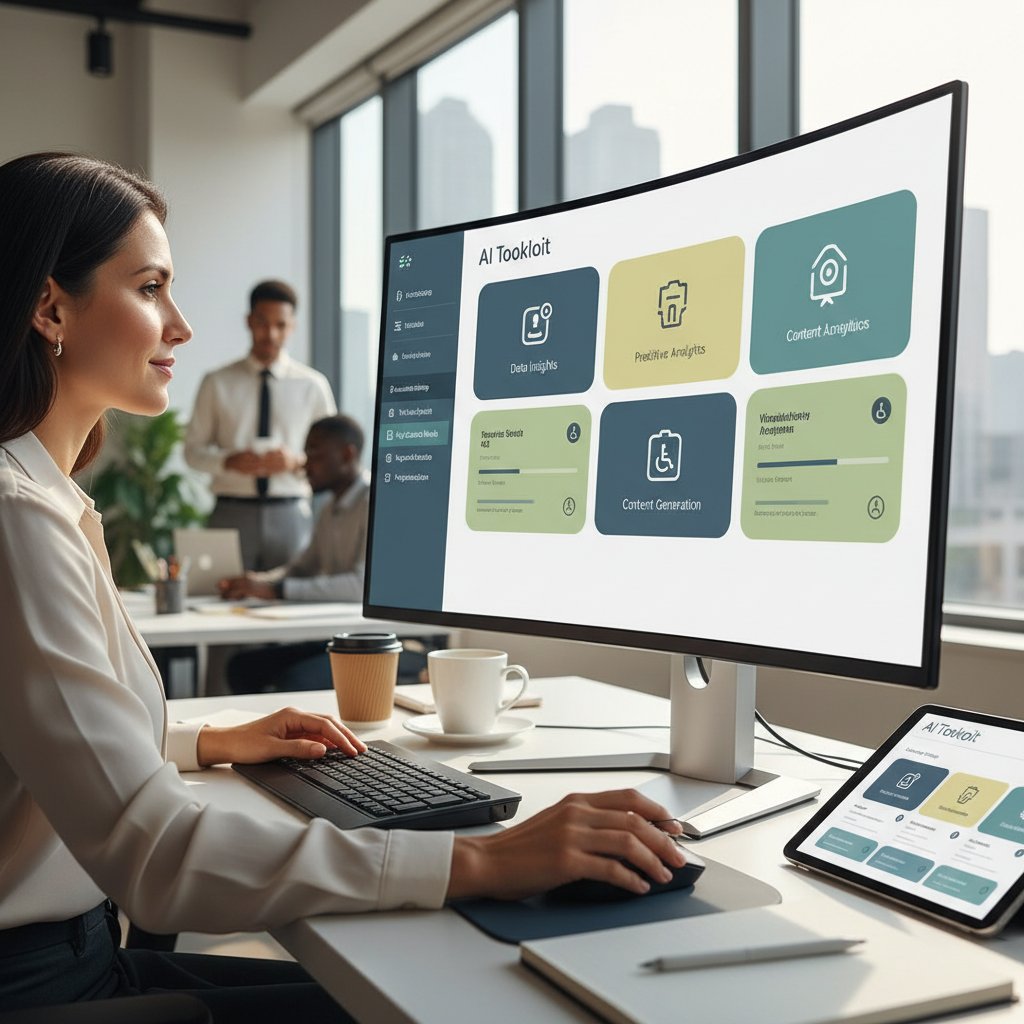
By focusing on intuitive interfaces and industry-specific models, accessible AI platforms make sure that the transformative power of AI-driven analysis isn’t reserved for the Fortune 500 crowd.
Checklist: Are you ready to implement AI-driven analysis?
Before you make the leap, run through this sanity check:
- Do you have executive buy-in and a clear business case?
- Is your data clean, relevant, and easily accessible?
- Are your chosen tools explainable and transparent?
- Is your team trained and open to hybrid human-AI workflows?
- Have you defined success metrics aligned to real business value?
- Are you prepared to iterate and learn from failures?
- Is your security framework robust enough for AI-powered automation?
If you can’t tick these boxes, pause. Rushing into AI analytics without groundwork is a recipe for disappointment.
Red flags: When not to trust the algorithm
AI is powerful, but it’s not omniscient. Here’s when you should pump the brakes:
- Opaque decision-making: If the tool can’t explain its recommendations, run.
- Data quality issues: Flawed, biased, or incomplete data guarantees bad outcomes.
- One-size-fits-all tools: Generic models rarely understand unique industry challenges.
- Unrealistic ROI promises: If it sounds too good to be true, it probably is.
- Lack of human oversight: Algorithms need accountability, not blind trust.
Never abdicate critical thinking—AI is a partner, not an oracle.
The human factor: Redefining roles in an AI-powered business
Upskilling for the AI era: What leaders need to know
The AI revolution isn’t about job loss—it’s about job evolution. Here’s what matters most:
- AI literacy: Every role, from the C-suite to the front line, needs basic understanding of AI’s strengths and limitations.
- Critical interpretation: Employees must learn to interrogate AI outputs, not passively accept them.
- Technical upskilling: Data fluency and basic coding are increasingly key—especially for analysts and managers.
- Ethical sensitivity: Awareness of bias, fairness, and the limits of automation is non-negotiable.
- Collaboration mindset: The best results come from human-AI teams, not silos.
Collaboration or conflict? Humans and machines in decision-making
If you imagine AI as a threat to human roles, you’re missing the bigger picture. The payoff is in collaboration: AI sifts the data, humans ask the right questions. The future isn’t about one replacing the other—it’s about creative friction, where challenge and debate drive better outcomes.

Organizations that foster this partnership—where skepticism and curiosity are welcome—emerge stronger, more adaptable, and more resilient to change.
Future-proofing your workforce: Lessons from the front lines
Change is uncomfortable, but the most resilient companies are those investing in continuous learning and open dialogue. As one senior leader put it:
"Trust is earned, not given—to both humans and machines. The companies winning with AI are the ones who never stop learning, questioning, and adapting." — Executive, Zebra BI, 2025
The lesson? Futureproofing isn’t about chasing the latest tech—it’s about building a culture that can weather any storm.
What’s next: The future of AI-driven business performance analysis
Emerging trends: What will matter in 2026 and beyond
Forget crystal balls. Focus on the trends reshaping AI business analytics right now:
- Unified AI governance: Fragmented approaches are dead. Organization-wide governance is the only way to ensure trust and compliance.
- Sustainability focus: AI isn’t just about profit—efficiencies from smarter analytics are cutting energy use and carbon footprints.
- Dynamic pricing models: Market-responsive, instant pricing is the new normal—especially in retail and e-commerce.
- Explainable AI everywhere: Transparency isn’t optional, it’s table stakes.
- Hybrid human-AI roles: The lines are blurring—expect more collaboration, not less.
- Data curation over accumulation: Quality, not quantity, is the game changer.

The evolving toolkit: New features and capabilities on the horizon
Here’s what’s defining the next wave of AI-powered business intelligence:
Transparent algorithms that allow users to understand, audit, and trust AI-driven decisions—critical for compliance and stakeholder confidence.
AI-generated datasets that augment real-world data, improving model accuracy without compromising privacy.
Tools that simulate “what-if” situations at scale, supporting better strategic planning and risk mitigation.
Plug-and-play connectors that allow AI analytics to fit natively within any business tech stack.
Final thought: Will you lead, follow, or get left behind?
The revolution isn’t coming. It’s already here. AI-driven business performance analysis isn’t a luxury or a side project—it’s the new baseline for competitiveness, resilience, and growth. The edge belongs to those willing to interrogate their data, question the hype, and demand more from both their algorithms and themselves. The real risk? Waiting for proof after the window has closed. In 2025, business as usual is dead. The new winners are the ones who see AI not as a shortcut, but as a force multiplier for human ambition and insight.
So, what’s your next move?
Sources
References cited in this article
- PwC AI Predictions 2025(pwc.com)
- ZDNet: 7 Strategic Insights for 2025(zdnet.com)
- Zebra BI: AI-Driven BI Trends for 2025(zebrabi.com)
- SRAnalytics: BI Trends 2025(sranalytics.io)
- Improvado: AI in BI(improvado.io)
- Analytics Insight: AI-Driven Business Analytics(analyticsinsight.net)
- McKinsey Report(psico-smart.com)
- PrometAI: AI in Operations(prometai.app)
- Pipefy: AI in BPM(pipefy.com)
- VentureBeat: BI Myths(venturebeat.com)
- BDO: AI Myths vs. Facts(bdo.com)
- DigitalOcean: Top AI Tools(digitalocean.com)
- ThoughtSpot: Best AI Tools for Business(thoughtspot.com)
- TechRadar: Why Bigger Data Sets Doesn’t Mean Better Insights(techradar.com)
- KDnuggets: Myths of Big Data(kdnuggets.com)
- Accenture: AI-Led Processes Outperform Peers(newsroom.accenture.com)
- McKinsey: AI-Driven Enterprise 2030(mckinsey.com)
- Medium: AI Success Stories(medium.com)
- DigitalSMB: Small Business AI Case Studies(digitalsmb.org)
- Grandview Research: AI in Healthcare(grandviewresearch.com)
- Tellix: Balancing AI and Human Intuition(tellix.ai)
- Medium: Strategic Decision-Making Case Study(futureforge.medium.com)
- Harvard Ethics: AI Failures(ethics.harvard.edu)
- Trace3: AI Risk Case Study(blog.trace3.com)
- Permutable: AI Bias in 2024(permutable.ai)
- IBM: Algorithmic Bias(ibm.com)
- Tech-Stack: ROI of AI(tech-stack.com)
- Forbes: AI ROI Strategies(forbes.com)
- Microsoft: Real-World AI ROI(blogs.microsoft.com)
Empower Your Business with AI
Futuretoolkit.ai empowers businesses of all sizes to harness the power of AI effortlessly, offering specialized solutions across diverse business functions without the need for technical expertise. Whether it's automating customer interactions, optimizing operations, or analyzing complex data, our AI toolkit streamlines processes, increases efficiency, and fuels growth. With easy integration, intuitive interfaces, and powerful AI models, Futuretoolkit.ai offers unmatched accessibility and value, enabling users to achieve measurable outcomes quickly and cost-effectively.
Get startedReady to Empower Your Business?
Start leveraging AI tools designed for business success
Frequently Asked Questions
What percentage of organizations have adopted or are exploring AI for analytics according to the article?
According to PwC's AI Predictions 2025, a staggering 65% of organizations have adopted or are actively exploring AI for analytics.
What is the main problem with current business metrics that AI-driven analysis aims to address?
Leaders often fall prey to number blindness—trusting outdated metrics or incomplete reports while market conditions shift, and AI-driven business performance analysis exposes the blind spots they didn't know they had.
Why is AI business analytics more important in 2025 than it was before?
The volume, velocity, and variety of business data in 2025 has eclipsed what human intuition can handle alone, making AI-driven analysis essential for making proactive decisions in response to rapid market changes.
What does the article suggest about the difference between winners and losers in today's business landscape?
The article states that AI-driven business performance analysis is redrawing the line between winners and losers in every industry, with competitors who use AI to look smarter gaining a significant advantage.
Continue Reading
Keep exploring Comprehensive business AI toolkit

AI-Powered Business Performance Management Software: Payoff Vs Risk

AI-Enabled Business Operations Analytics: Hype, Hazards, Real ROI

AI-Driven Business Intelligence Analytics: Impact and Risks

AI Business Analytics: What the Hype Obscures

AI-Driven Market Intelligence Analytics: Separating Hype From Results
