


AI-Powered Customer Lifecycle Management: Hidden Risks and Real ROI Outcomes
Written with AI assistance under our editorial guidelines
AI-powered customer lifecycle management can boost retention by up to 30%, but missteps can trigger a 60% churn spike if trust is broken. Success requires balancing hyper-personalization with privacy protection, real-time automation with human touch, and unified data platforms with ethical boundaries to avoid the hidden risks of 2026.
Walk into any boardroom in 2025 and mention “AI-powered customer lifecycle management”—watch as eyes light up with hope, fear, and a hint of exhaustion. Underneath the glossy vendor pitches, there’s a bruising reality: the digital battleground of modern business is no longer about who has the most data, but who can actually turn that data into trust, loyalty, and revenue before the next disruption hits. This isn’t another breathless ode to shiny algorithms or a shallow listicle of CRM “trends.” It’s a deep dive into the brutal truths, hidden traps, and game-changing strategies behind AI in customer lifecycle management. Buckle up—because the gap between hype and reality has never been more dangerous, or more full of opportunity.
Why customer lifecycle management is ground zero for AI disruption
The stakes: Why brands can’t afford to get this wrong
Every customer touchpoint is a landmine—one wrong move and you’re viral for all the wrong reasons. In a landscape where 80% of customers say the experience a company provides is as important as its products or services (Salesforce, 2024), the pressure for seamless, hyper-personalized engagement is relentless. Brands aren’t just fighting for attention anymore—they’re fighting for survival. AI-powered customer lifecycle management (CLM) sits at the heart of this fight, promising to unify data, automate workflows, and anticipate needs before customers even voice them. But according to CustomerThink, while AI-first platforms can boost customer retention by up to 30%, missteps can lead to a 60% spike in churn if trust is breached. The stakes are existential, and the margin for error is razor-thin.

| Challenge | AI-Powered Solution | Risk if Mishandled |
|---|---|---|
| Data silos | Unified data platforms | Privacy breaches |
| Slow response times | Real-time automation | Robotic interactions |
| Generic marketing | Hyper-personalization | Overstepping boundaries |
| Manual support | 24/7 AI-powered agents | Loss of human touch |
| Siloed customer insights | Predictive analytics | Algorithmic bias |
Table 1: High stakes in AI-powered customer lifecycle management—benefits vs. risks
Source: Original analysis based on CustomerThink, 2024, ServiceNow, 2024
The evolution: From spreadsheets to sentient algorithms
Customer management started on scribbled notepads, evolved into spreadsheet hell, and now lives inside complex, AI-driven ecosystems. Let’s be real: the leap from manual tracking to intelligent systems hasn’t just been about speed or scale—it’s been about survival. According to research from FullCircl, businesses relying on manual processes experience 50% higher operational costs, while those integrating AI-first CRM platforms see cycle times slashed by up to 40%.
- Manual records and spreadsheets dominate—fragmented data, slow reactions.
- Traditional CRM systems arrive—centralization, but little real intelligence.
- Analytics emerge—basic segmentation, limited personalization.
- AI-driven CRM platforms disrupt—predictive, adaptive, and increasingly autonomous.
- The rise of agentic AI—autonomous agents handle low-risk, goal-driven tasks, reshaping operations.
| Era | Main Tools | Strengths | Weaknesses |
|---|---|---|---|
| Pre-CRM | Paper, Excel | Human intuition | Error-prone, slow |
| Legacy CRM | Salesforce, SAP | Centralized data | Siloed, reactive |
| Analytics-driven CRM | Tableau, Power BI | Insights, segmentation | Lag in real-time action |
| AI-first CRM | ServiceNow, ZohoAI | Hyper-personalization | Complexity, trust issues |
Table 2: How customer lifecycle management matured from analog to AI-first
Source: Original analysis based on FullCircl, 2024, ServiceNow, 2024
What’s broken: Pain points AI claims to solve
Let’s cut through the vendor-speak: AI isn’t a silver bullet, but it does target some of the industry’s ugliest wounds. According to WillowTree, 2024:
- Chronic data fragmentation that kills insight and agility.
- Repetitive manual tasks that sap employee morale.
- Sluggish, one-size-fits-all customer journeys.
- Inability to predict churn or upsell opportunities in real-time.
- Scaling personalized interactions without ballooning costs.
But every solution brings its own set of risks—botched automation, dehumanized service, and the specter of algorithmic bias lurking beneath every “personalized” touch.
How AI really works in customer lifecycle management (beyond the buzzwords)
Inside the black box: Data, models, and real-world messiness
The fantasy: seamless, omniscient AI that “just works.” The reality: a tangled web of data pipelines, machine learning models, and endless debugging. AI-powered CLM systems ingest mountains of structured and unstructured data—think purchase histories, web clicks, chat logs—and attempt to create order from chaos. This is where the magic and mayhem collide.

Key terms and realities in AI-powered customer lifecycle management:
The raw material—customer interactions, transaction histories, support tickets, behavioral signals—feeding the AI engine. Quality, diversity, and recency matter more than volume.
When an AI model’s predictions degrade over time due to changes in customer behavior or external factors, requiring constant retraining and oversight.
Autonomous AI “agents” assigned to specific tasks (like qualifying leads), making decisions within predefined parameters. They’re fast, but not infallible.
The use of real-time data and predictive analytics to tailor every touchpoint. It’s powerful—unless it veers into “creepy” territory or violates privacy norms.
Where AI shines—and where it still fails
AI’s greatest strength in CLM is relentless pattern recognition—spotting churn risks, predicting next-best offers, routing support tickets with uncanny accuracy. According to ServiceNow, organizations using AI-first CRM platforms report a 35% increase in customer satisfaction and 40% faster resolution times. Yet, it’s far from infallible: AI models can amplify bias, misinterpret nuance, and sometimes create more confusion than clarity, especially when datasets are flawed or outdated.
| Area of Application | AI-Driven Strength | Current Limitation |
|---|---|---|
| Predictive analytics | Churn/upsell forecasting | Sensitive to data drift |
| Automated support | 24/7 response, agent relief | Robotic or inappropriate responses |
| Marketing personalization | High conversion rates | “Overfitting” to past behaviors |
| Data management | Speed, scale, accuracy | Privacy, regulatory hurdles |
Table 3: Where AI delivers value in customer lifecycle management—and where it falters
Source: Original analysis based on ServiceNow, 2024, WillowTree, 2024
“AI is a force multiplier, not a miracle worker. The real advantage comes when organizations pair robust data strategies with domain expertise and relentless iteration.” — Dr. Jane Hamilton, AI Strategy Lead, ServiceNow, 2024
The AI toolkit: What you actually need (and what’s just hype)
Strip away the buzzwords and you’re left with a core set of AI tools that consistently drive value in customer lifecycle management:
- Unified data platforms that break down silos and ensure data integrity
- Predictive analytics engines that forecast churn and upsell triggers with proven accuracy
- Automated workflow tools for routine support, onboarding, and feedback loops
- Hyper-personalization modules that dynamically adjust content and offers based on real-time behavior
- Regulatory compliance checks—especially under frameworks like the EU AI Act—built into every workflow
Ignore the shiny distractions—AI chatbots that don’t learn, dashboards that simply repackage old metrics, and “autonomous” solutions that require more babysitting than benefit.
The uncomfortable truths: Myths, risks, and the dark side of AI-driven customer management
Mythbusting: What everyone gets wrong about AI and customers
Let’s get brutally honest: the AI revolution in CLM is riddled with persistent myths, many of them dangerous.
Myth: “AI can fully replace human intuition in customer relationships.”
Reality: According to CustomerThink, even best-in-class AI can’t replicate the nuance of human empathy or cultural context.
Myth: “More data always means better results.”
Reality: Bad or biased data simply accelerates poor decisions—garbage in, garbage out.
Myth: “AI guarantees personalization.”
Reality: Without robust oversight, AI-driven personalization can easily cross ethical lines or trigger privacy backlash.
"Personalization without humanization is a recipe for mistrust. Customers can spot a fake ‘personal touch’ a mile away—and they punish brands for it." — Maya Patel, Customer Experience Researcher, CustomerThink, 2024
The hidden costs: Bias, privacy, and organizational backlash
The push for hyper-personalization has a dark underbelly—data privacy violations, algorithmic bias, and “automation fatigue” among frontline employees. The EU AI Act has forced companies to re-examine how they deploy AI in CLM, with fines for non-compliance reaching eye-watering levels.

- Data privacy: Regulatory frameworks like GDPR and the EU AI Act penalize misuse, and 68% of customers express concern about how their data is used (FullCircl, 2024).
- Algorithmic bias: Flawed training data can reinforce stereotypes or exclude minority groups, creating new reputational risks.
- Employee resistance: Automation can trigger morale issues, especially if perceived as job-threatening or “dehumanizing” customer service.
Failure files: When AI-powered CRM goes off the rails
AI’s failures aren’t just technical—they’re public, painful, and expensive. Consider the case of a major telco that automated support triage using an AI agent, only to see complaint resolution times double due to poor model training and unanticipated customer scenarios (source: FullCircl, 2024).
"We deployed AI to speed up customer support, but without robust human oversight, it quickly devolved into a nightmare—escalated complaints, lost customers, and an urgent rollback to manual processes." — Anonymous Operations Director, FullCircl, 2024
| Failure Mode | Root Cause | Fallout |
|---|---|---|
| Escalating complaints | Inadequate training data | Customer churn |
| Regulatory fines | Privacy violations | Financial loss |
| Brand damage | Algorithmic bias, “creepy” | Social backlash |
Table 4: High-profile AI-powered CRM failures and their consequences
Source: FullCircl, 2024
Survivors and thrivers: Real-world case studies you haven’t heard
The unexpected winners: Small brands, big AI bets
It’s not just the tech giants making headlines. Small and mid-sized businesses have quietly become some of the boldest innovators in AI-powered CLM. Take a regional retailer that slashed customer wait times by 40% and improved inventory accuracy by 30% by integrating autonomous AI agents into their support and stock management workflows (source: WillowTree, 2024). Their secret? Relentless focus on data quality and a willingness to iterate in public view.

The cautionary tales: Missteps, pivots, and comebacks
But not every AI experiment is a win. One healthcare provider attempted to automate patient outreach using a generic AI model, only to encounter a 25% surge in appointment no-shows due to impersonal, poorly timed messaging. They pivoted by layering human review on top of the AI, eventually reducing administrative workload and boosting patient satisfaction—a painful, but valuable lesson.
"Our AI rollout wasn’t a silver bullet. Only when we combined machine efficiency with human empathy did we see real results." — Chief Experience Officer, Healthcare Startup, 2024
Lessons learned: What actually worked (and what didn’t)
- Success came from integrating AI as a collaborator, not a replacement—humans in the loop mattered.
- Constant retraining and data hygiene proved more important than the latest AI model.
- Slow, staged rollouts allowed for course correction and minimized public missteps.
- The boldest experiments often came from organizations with the least to lose—and the most to gain.
The human factor: How teams, customers, and culture adapt (or don’t)
Frontline voices: What employees really think about AI
While executives evangelize AI’s promise, the frontline tells a more complicated story. Employees report that AI-powered CLM tools free them from rote tasks, but also raise anxiety about job security and erode the “human” element in customer relationships. According to recent surveys, 62% of employees say AI boosts productivity, but 48% worry about the loss of personal touch (FullCircl, 2024).

“AI takes care of the boring stuff, but customers still want to talk to a real person when it matters. There’s a fine line between efficiency and feeling like a number.” — Frontline Agent, Retail Sector, 2024
Customer reactions: Trust, skepticism, and delight
- Customers notice “creepy” hyper-personalization and may react with suspicion if messaging feels invasive.
- Trust is highest when brands are transparent about AI usage and allow easy escalation to human agents.
- Delight comes when AI-powered experiences are seamless, relevant, and genuinely helpful—especially in moments of need.
Culture clash: When AI meets organizational inertia
- Senior leadership pushes for “AI everywhere,” often underestimating change management needs.
- Mid-level managers struggle to balance efficiency gains with employee morale.
- Frontline staff resist or embrace AI based on perceived value and involvement in rollout decisions.
- The most successful implementations treat AI as a process, not a product—requiring ongoing training, feedback, and adaptation.
Beyond CRM: How AI-powered lifecycle management is changing entire industries
Healthcare, retail, and finance: Cross-industry shockwaves
AI-powered CLM is rippling beyond its CRM roots, transforming sectors from retail to healthcare to finance. In healthcare, AI-driven scheduling reduced administrative burdens by 25% and improved patient satisfaction scores. In finance, AI-enhanced forecasting boosted accuracy by 35%, lowering risk exposure significantly (see WillowTree, 2024).

| Industry | AI-Powered CLM Use Case | Outcome |
|---|---|---|
| Retail | Automated support, inventory management | 40% reduction in wait times, 30% inventory gain |
| Healthcare | Patient records & scheduling | 25% less admin workload, higher satisfaction |
| Finance | Forecasting, risk assessment | 35% more accurate, lower risk |
| Marketing | Targeted campaign automation | 50% more effective, 40% engagement boost |
Table 5: Cross-industry impact of AI-powered customer lifecycle management
Source: Original analysis based on WillowTree, 2024, FullCircl, 2024
Unexpected applications: Where AI is rewriting the rules
- Small retailers automating loyalty programs to compete with larger chains.
- Healthcare startups using AI-driven sentiment analysis to tailor patient communications.
- Financial institutions deploying autonomous agents for real-time fraud detection without human bottlenecks.
- Marketing teams leveraging AI for micro-segmented influencer campaigns, multiplying ROI.
What’s next: Predictions for 2025 and beyond
- Regulatory frameworks shape every AI deployment, making compliance a competitive differentiator.
- Agentic AI expands to manage more complex, low-risk tasks autonomously.
- Hyper-personalization becomes table stakes, raising the bar for meaningful, humanized engagement.
- Data quality, transparency, and ethical design become as important as technical sophistication.
A brutally honest guide to getting started with AI-powered customer lifecycle management
Are you ready? Self-assessment checklist
Before you jump into the AI-powered CLM deep end, answer these questions:
- Are your data pipelines unified, current, and accessible—or still stuck in silos?
- Is your leadership aligned on goals and risk appetite, or driven by FOMO?
- Do you have clear processes for model retraining, oversight, and compliance?
- How will you ensure the “human touch” is preserved at critical moments in the journey?
Choosing the right tools (without getting burned)
- Prioritize platforms with strong data unification and compliance features over flashy dashboards.
- Demand transparency from vendors on how their models are trained, tested, and updated.
- Evaluate ease of integration with existing workflows—avoid “rip and replace” solutions.
- Lean on communities and independent reviews, not just vendor case studies.
Implementation roadmap: From pilot to scale
- Start with a tightly scoped pilot—pick a high-impact, low-risk use case.
- Involve frontline staff early and solicit constant feedback.
- Monitor outputs and outcomes obsessively—churn, NPS, complaint volumes, operational costs.
- Iterate, retrain, and expand only when satisfied with real results—not vendor promises.
- Document lessons learned and adjust policies before scaling organization-wide.
The future is now: Radical strategies for staying ahead
AI-human collaboration: The new power couple
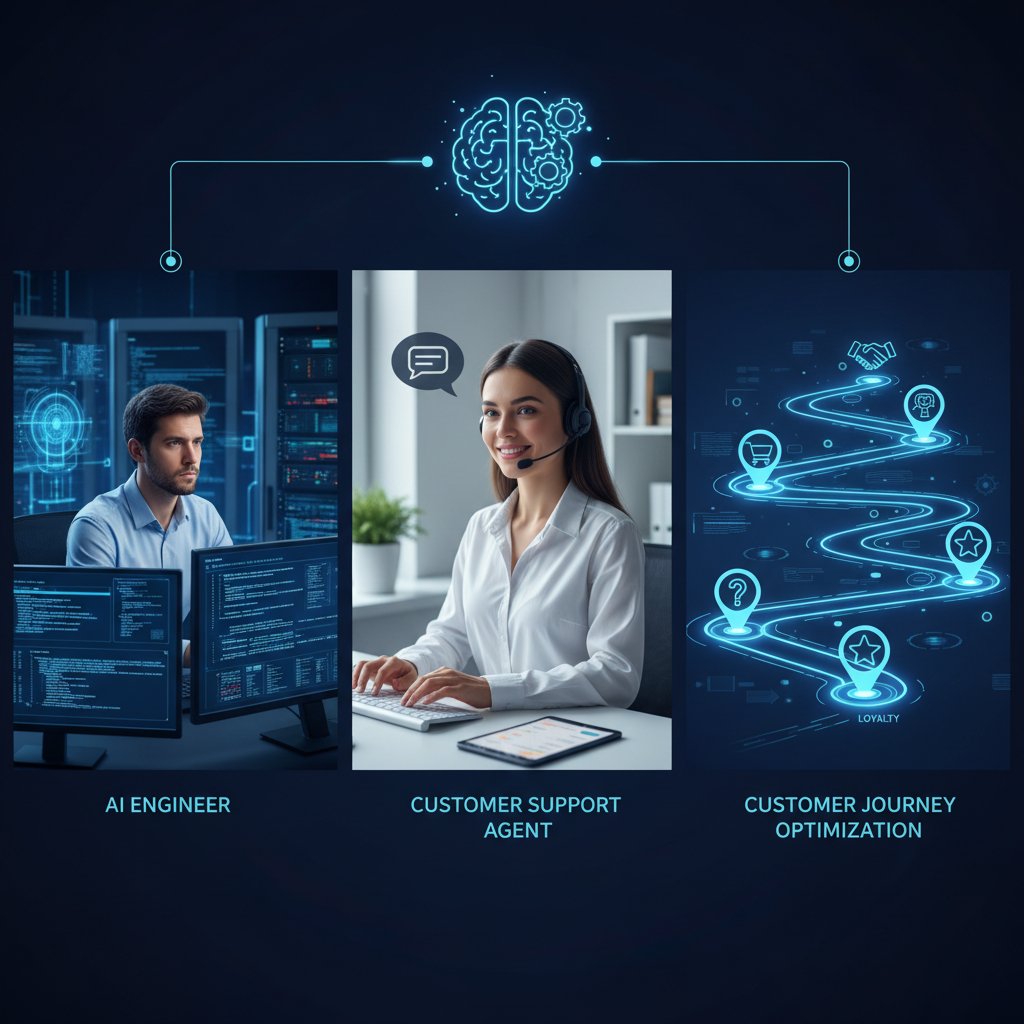
Forget the “AI vs. humans” narrative. The real winners pair machine intelligence with human judgment, constantly refining both. The most resilient organizations embed AI as a partner, not a replacement.
Measuring real ROI: Metrics that matter (and those that don’t)
| Metric | Why It Matters | Pitfall to Avoid |
|---|---|---|
| Churn rate | Direct impact on revenue | Can be lagging indicator |
| Net Promoter Score (NPS) | Customer advocacy signal | May mask deeper issues |
| Time to resolution (support) | Operational efficiency | Ignores issue complexity |
| AI intervention frequency | Process automation effectiveness | Over-automation risk |
| Compliance incidents | Regulatory risk management | Under-reporting |
Table 6: Metrics for evaluating AI-powered customer lifecycle management
Source: Original analysis based on ServiceNow, 2024, CustomerThink, 2024
Staying agile: How to pivot when AI doesn’t deliver
- Build “kill switches” and fallback procedures for failed AI interactions.
- Regularly audit model outcomes for bias, drift, and compliance.
- Encourage a culture of experimentation—reward failure as learning, not just success.
- Maintain close partnership with platform providers for ongoing support and updates.
Resources, references, and the road ahead
Expert voices: Who to follow and why
-
Dr. Jane Hamilton (AI Strategy Lead, ServiceNow): Deep dives into AI-first CRM and lifecycle management.
-
Maya Patel (Customer Experience Researcher, CustomerThink): Cutting-edge analysis on customer trust and personalization.
-
Futuretoolkit.ai Editorial Team: Thought leadership and practical guides on AI-powered business solutions.
-
FullCircl Research Group: Leading insights on compliance, bias, and best practices in CLM.
The essential reading and toolkit list
- ServiceNow: AI-powered CRM platform case studies
- CustomerThink: AI and customer experience trend reports
- FullCircl: Compliance and ethics in AI-powered CLM
- WillowTree: Guides to AI in lifecycle marketing
- futuretoolkit.ai for ongoing, practical resources
Where to learn more and connect with the community
- Join LinkedIn groups focused on AI in customer experience and lifecycle management.
- Attend webinars and workshops hosted by ServiceNow, FullCircl, and industry associations.
- Engage with practitioner forums on futuretoolkit.ai for real-world problem-solving.
Conclusion
AI-powered customer lifecycle management isn’t a magic wand or a doomsday device—it’s a tool, and like any tool, its impact depends on how you wield it. The hype is loud, but the risks and opportunities are even louder for those paying attention. The real story isn’t about algorithms overtaking humans. It’s about how bold, curious organizations are learning to blend machine intelligence with human empathy, adaptability, and ethics. The hard truth: there’s no shortcut to trust, no blueprint for loyalty, and no room for complacency. If you want to survive—and thrive—in this new era, get comfortable with discomfort, question every assumption, and keep your eyes wide open. Because the untold story of AI-powered customer lifecycle management isn’t just about technology. It’s about who’s willing to face the truth, act on it, and redefine what customer relationships mean—one real, unpredictable moment at a time.
Sources
References cited in this article
- ServiceNow Press(servicenow.com)
- CustomerThink(customerthink.com)
- FullCircl(fullcircl.com)
- WillowTree(willowtreeapps.com)
- Copy.ai(copy.ai)
- WorkFusion(workfusion.com)
- ServiceNow(servicenow.com)
- VBOUT(vbout.com)
- Salesforce(salesforce.com)
- IBM(ibm.com)
- Acacia Advisors(chooseacacia.com)
- Aqfer(aqfer.com)
- VentureBeat(venturebeat.com)
- CMSWire(cmswire.com)
- RedEye(redeye.com)
- Manifest.ai(blog.getmanifest.ai)
- ada.cx(ada.cx)
- CustomerExperienceDive(customerexperiencedive.com)
- NCBI(ncbi.nlm.nih.gov)
- NICE(nice.com)
- Forbes(forbes.com)
- InformationWeek(informationweek.com)
- DataGuard(dataguard.com)
- ASI Central(asicentral.com)
- PCMag(pcmag.com)
- CRMside(crmside.com)
- Bitrix24(bitrix24.com)
- Google Cloud Blog(cloud.google.com)
- LinkedIn(linkedin.com)
- Smart Insights(smartinsights.com)
- Adweek(adweek.com)
- MessageGears(messagegears.com)
- Execs In The Know(execsintheknow.com)
- BBC(bbc.com)
- AIM Research(aimresearch.co)
- EngageCustomer(engagecustomer.com)
- Shibumi(shibumi.com)
- RingCentral(ringcentral.com)
- HubSpot(blog.hubspot.com)
- MIT Sloan Management Review(sloanreview.mit.edu)
- McKinsey(mckinsey.com)
- iQmetrix(iqmetrix.com)
- Gainsight 2024(gainsight.com)
- KPMG(assets.kpmg.com)
Empower Your Business with AI
Futuretoolkit.ai empowers businesses of all sizes to harness the power of AI effortlessly, offering specialized solutions across diverse business functions without the need for technical expertise. Whether it's automating customer interactions, optimizing operations, or analyzing complex data, our AI toolkit streamlines processes, increases efficiency, and fuels growth. With easy integration, intuitive interfaces, and powerful AI models, Futuretoolkit.ai offers unmatched accessibility and value, enabling users to achieve measurable outcomes quickly and cost-effectively.
Get startedReady to Empower Your Business?
Start leveraging AI tools designed for business success
Frequently Asked Questions
What percentage boost in customer retention can AI-first platforms deliver?
According to CustomerThink, AI-first platforms can boost customer retention by up to 30%, though missteps can lead to a 60% spike in churn if trust is breached.
Why is customer lifecycle management considered critical for AI disruption?
Customer lifecycle management is ground zero for AI disruption because 80% of customers say the experience a company provides is as important as its products or services, making seamless, hyper-personalized engagement essential for brand survival.
What are the main risks of implementing AI-powered customer lifecycle management?
Key risks include privacy breaches from unified data platforms, robotic interactions from automation, overstepping customer boundaries through hyper-personalization, and loss of human touch in 24/7 AI-powered support agents.
What does the article identify as the core advantage of AI in customer management?
The article states that AI-powered customer lifecycle management promises to unify data, automate workflows, and anticipate customer needs before they are voiced.
Continue Reading
Keep exploring Comprehensive business AI toolkit

AI-Driven Customer Relationship Analytics Software’s Real Cost

AI-Driven Customer Interaction Software: What Works and What Fails

AI-Driven Customer Intelligence Tools: Capabilities and Real-World Risks

AI-Enabled Customer Experience Optimization Software: Benefits and Pitfalls

AI-Driven Customer Analytics Software: Capabilities and ROI Outcomes


